

Ever gotten a text that just said “ion know” and had absolutely no clue what it meant? You’re not alone. If you’ve been staring at your screen wondering whether your friend is talking about chemistry or just being lazy with their typing, this guide clears it all up.
ION is one of the most common pieces of internet slang floating around texts, Instagram comments, and TikTok captions today. It pops up in group chats, comment sections, and casual replies so often that many people type it without even thinking twice. For anyone who didn’t grow up texting this way, though, it can look like a random string of letters with no obvious meaning.
The truth is, once you understand where ION comes from and how it’s used, it becomes incredibly easy to spot and even easier to use yourself. It’s not a secret code, a typo, or an inside joke limited to one small group of people. It’s simply a fast, phonetic shortcut that has become part of everyday digital language. Once you understand it, you’ll never be confused by it again.
🧠 What Does ION Meaning in Text?
In texting slang, ION stands for “I don’t.” It’s a shortened, phonetic way of writing the phrase, based on how “I don’t” actually sounds when people say it quickly out loud. Instead of spelling out every letter of both words, people simply write down the sound that comes out when the two words blend together in casual speech.
Say “I don’t” fast a few times and it starts to blend into something that sounds a lot like “ion.” Over time, people began typing it exactly the way it sounds, and the abbreviation stuck. This is a common pattern in informal writing: spoken contractions eventually make their way into text exactly as they’re pronounced, rather than exactly as they’re spelled in formal English.
Today, ION is used by people from all kinds of backgrounds, often without them even realizing where the term originated. That’s fairly typical for internet slang: a phrase starts in one specific online community, gets shared widely through memes, comments, and captions, and eventually becomes so common that it feels like it’s just “internet language” rather than something with a clear origin.
Quick breakdown:
| Term | Meaning |
| ION | I don’t |
| Ion know | I don’t know |
| Ion care | I don’t care |
| Ion think so | I don’t think so |
Context almost always makes the meaning obvious. If a sentence doesn’t make sense with “I don’t” plugged in, it’s worth double checking but 9 times out of 10, that’s exactly what it means. Reading the rest of the sentence out loud, with “I don’t” substituted in, is usually the fastest way to confirm you’ve got it right.
📱 Where Is ION Commonly Used?
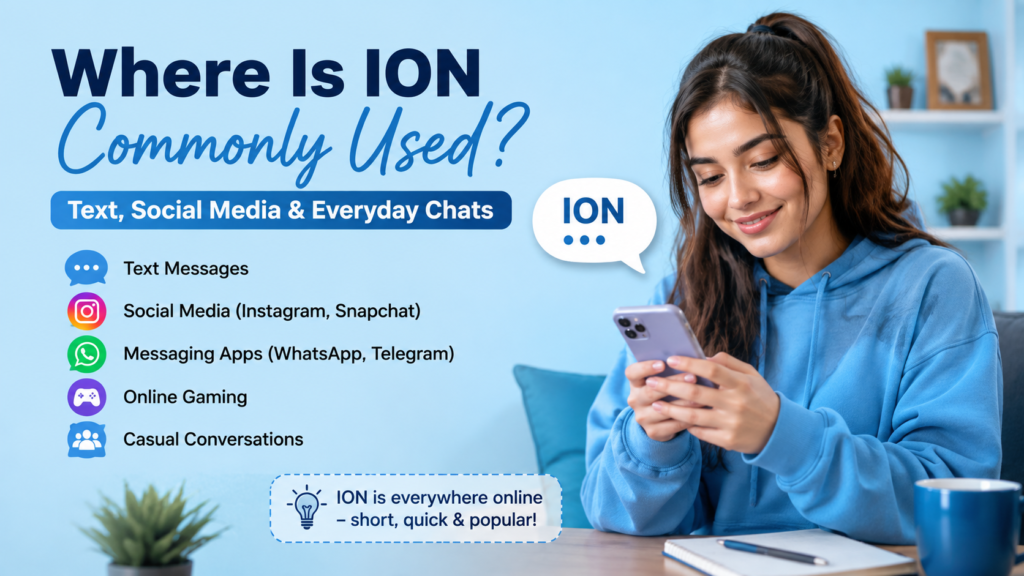
ION shows up mostly in casual, fast paced digital spaces where people prioritize speed and tone over grammar. These are places where messages are dashed off quickly, often on a phone, and where the goal is to communicate a feeling or a quick reaction rather than to write something polished. You’ll typically spot it in:
- Text messages between friends or in group chats
- Instagram DMs, comments, and captions
- TikTok comment sections and video captions
- Snapchat chats
- Twitter/X replies and casual posts
- Dating apps, where a laid-back tone matters
In all of these spaces, brevity and tone matter more than traditional spelling. A quick “ion” gets the same message across as “I don’t,” but it feels more relaxed, more conversational, and closer to how the sender would actually talk out loud. It also saves a few keystrokes, which matters in fast moving conversations like group chats or comment threads where dozens of replies can appear in minutes.
It’s rarely, if ever, used in emails, formal documents, or workplace communication. Think of it as something you’d say out loud to a close friend, not something you’d type to your boss or teacher. Using it in the wrong setting can come across as careless or overly casual, even if that’s not the intention, simply because the reader may not immediately understand what it means.
💬 Examples of ION in Conversation
Seeing ION in real conversation makes the meaning click a lot faster than any definition alone. Reading it in context shows exactly how naturally it fits into a normal back and forth exchange, without slowing the conversation down or requiring any extra explanation. Here are some everyday examples:
Example 1 A: “Are you coming out tonight?” B: “Ion feel like it tonight, kinda tired 😴”
Example 2 A: “Did you watch the new episode?” B: “Ion watch that show anymore tbh.”
Example 3 A: “Why are you being so quiet?” B: “Ion really have much to say right now.”
Example 4 A: “What do you think about the new update?” B: “Ion now, feels kinda mid ngl.”
In each case, “ion” simply slots in for “I don’t,” keeping the reply short, casual, and quick to type. None of these examples require any extra context to understand once you know the meaning of the abbreviation, which is part of why it has spread so widely. It works in almost any sentence where “I don’t” would normally appear, whether the topic is plans for the night, a TV show, or a general opinion.
🕓 When to Use and When Not to Use ION
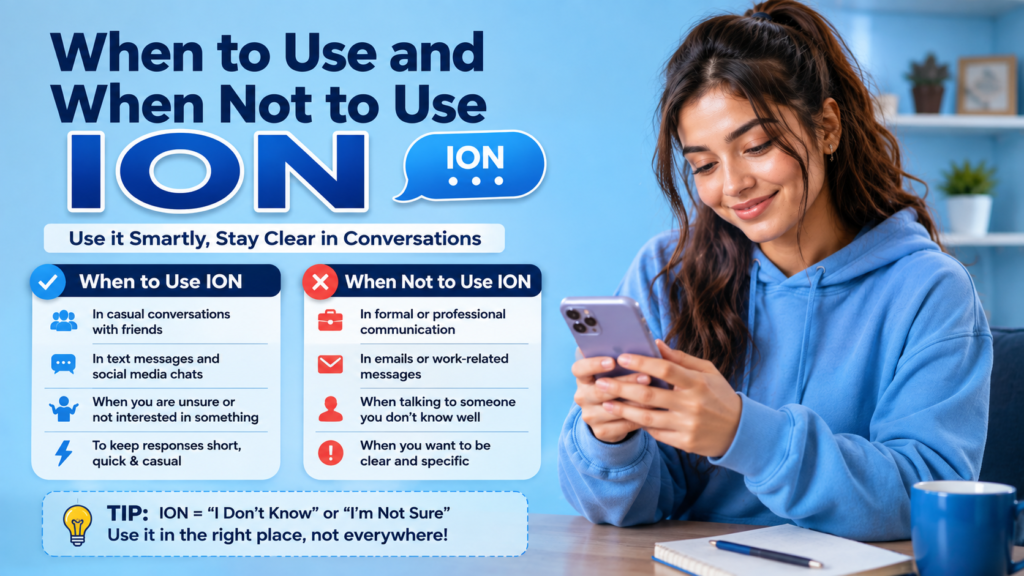
Like most slang, ION works great in certain situations and falls flat or looks unprofessional in others. Knowing the difference matters more than knowing the definition, since using the right word in the wrong setting can send an unintended message about how seriously you’re taking the conversation.
✅ When to Use ION
- Texting close friends or peers
- Casual social media captions or comments
- Group chats with a relaxed tone
- Replying quickly without sounding overly formal
- Light, low stakes conversations
These are all situations where speed, informality, and personality matter more than correctness. Using ION here signals familiarity and ease, and it usually reads as natural rather than lazy, especially among people who already text this way regularly.
❌ When Not to Use ION
- Professional emails or workplace chats
- Messages to teachers, professors, or elders unfamiliar with slang
- Formal writing, essays, or resumes
- Customer service or business communication
- Any conversation where clarity matters more than casualness
In these settings, using slang like ION can create confusion or come across as unprofessional, even if that’s not the intent behind it. Someone unfamiliar with the term might not understand the message at all, which can slow down communication or create an awkward exchange.
Using “I don’t” in full is always the safer choice outside of casual texting circles, especially with people who may not recognize the abbreviation. When in doubt, spelling things out fully is a simple way to avoid any miscommunication, particularly in situations where you want to come across as clear and professional.
Also Read This Meaning Hyy Mean From a Girl
📊 Context Comparison Table
Since ION can occasionally be confused with other short forms, here’s a quick side by side comparison to keep things clear. Slang terms often look similar to one another, especially when they’re all short strings of letters, so having them laid out together makes the differences easier to spot at a glance.
| Term | Meaning | Example | Tone |
| ION | I don’t | “Ion like that movie” | Casual, laid back |
| IDK | I don’t know | “IDK what to wear” | Casual |
| IDC | I don’t care | “IDC about the drama” | Neutral/dismissive |
| Ion (science) | A charged particle | “The atom lost an ion” | Formal/academic |
| IMO | In my opinion | “IMO it’s overrated” | Casual |
Notice how the slang “ion” and the science term “ion” are spelled identically but mean completely different things. Context is everything here: a group chat about weekend plans is not a chemistry class. Nobody texting about weekend plans is likely to bring up charged particles, so the surrounding conversation almost always makes the intended meaning obvious within a second or two.
🔄 Similar Slang Words or Alternatives
If you understand ION, a few related terms will make just as much sense, since they follow the same pattern of shortening common phrases based on how they sound when spoken quickly. Learning one of these terms often makes the rest much easier to pick up, since they all share a similar logic.
- Ima: “I’m going to”
- Finna: “Fixing to” / “About to”
- Tbh: “To be honest”
- Ngl: “Not gonna lie”
- Lowkey / highkey: Softly or strongly expressing something
- Deadass: Seriously, for real
These words often appear alongside ION in the same casual, Gen Z influenced texting style, so recognizing one usually helps with the others too.
Many of these terms also share roots in AAVE and have followed a similar journey into mainstream slang, moving from spoken conversation into text and then into wider internet culture. Seeing them used together in a single message is common, and once you can decode one, the rest of the sentence usually falls into place quickly.
What Does ION Mean From a Girl (or Guy)?
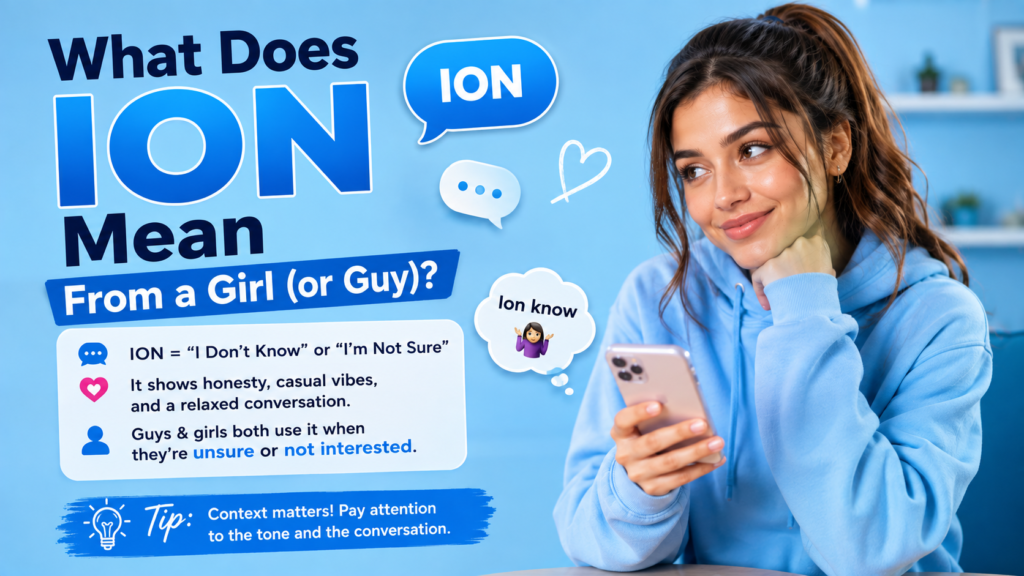
There’s no difference in meaning based on gender when a girl or guy uses ION in text, it still means “I don’t.” The word itself doesn’t shift meaning depending on who’s typing it, so there’s no need to interpret it differently based on the sender.
The tone, however, can shift depending on the message around it. Paired with a playful emoji, it might feel flirty or teasing. Used alone in a short reply, it can come across as neutral or even a little dismissive. The words around ION carry the emotional weight, not the abbreviation itself.
That means the best way to read the tone of a message using ION is to look at everything else in the text, including punctuation, emojis, and the overall flow of the conversation, rather than focusing on the word alone. A message like “ion know 😅” reads very differently from a flat “ion know.” with no punctuation or emoji at all.
Final Thoughts
ION might look confusing the first time you see it, but once you know it simply stands for “I don’t,” it becomes second nature to read. It’s fast, casual, and perfect for texting, DMs, and social media just not for formal writing or professional messages.
Understanding where it comes from, how it’s used, and when to avoid it gives you a much clearer picture than just memorizing a definition. Slang like this changes quickly, but the underlying pattern, shortening common phrases based on how they sound, is worth recognizing since it shows up again and again across different terms.
Next time someone texts “ion know 🤷” or “ion feel like it,” you’ll know exactly what they mean and how to reply like a fluent texter.

Hi, I’m Munaza, the creator of RTMeaning.com. I’m passionate about explaining internet slang, abbreviations, texting terms, and modern language in a simple and easy-to-understand way. Through this website, I help readers discover the meanings behind trending words, social media expressions, and online communication. My goal is to make learning new terms quick, clear, and enjoyable for everyone.