

Scrolling through a chat and hitting a random “CB” that stopped you midscroll? You’re not the only one. This tiny two letter combo shows up everywhere WhatsApp, Instagram DMs, TikTok comments, even group chats with friends and it rarely comes with an explanation.
The tricky part is that CB doesn’t have one fixed meaning. It shifts depending on who’s typing, what app they’re using, and what the conversation is actually about. Sometimes it’s a quick promise to reconnect later. Other times it’s a completely different word hiding behind the same two letters.
This guide walks through every common meaning of CB, where it came from, how it’s used today, and exactly how to reply when you see it. By the end, you’ll be able to spot the right meaning almost instantly, just by glancing at the words around it.
What Does CB Mean in Text & Chat?
In everyday texting, CB is almost always shorthand for “Call Back.” Someone types it when they can’t talk right now but want the other person to know they’ll return the call or message later.
A typical example looks like this:
“In a meeting rn, CB in 20”
That single line tells the reader: I saw your message, I’m not ignoring you, and I’ll get back to you soon. It’s fast, casual, and saves the sender from typing out a full sentence.
This is exactly why CB has survived so long in texting culture. People are busy, typing on small screens, often multitasking between work and personal life. A two letter shortcut that carries a full sentence’s worth of meaning is simply efficient.
That said, CB can flex depending on tone and context. In some casual threads, people also use it loosely to mean “Come Back” or, less often, “Can’t Be” as a reaction to something surprising. The exact meaning almost always becomes obvious once you read the rest of the message.
Think of CB less like a fixed word and more like a placeholder. The letters stay the same, but the intention behind them adjusts to fit whatever conversation they land in. That flexibility is part of why it’s confusing for newcomers but effortless for regular texters.
Full Form, Stands For & Short Meaning of CB
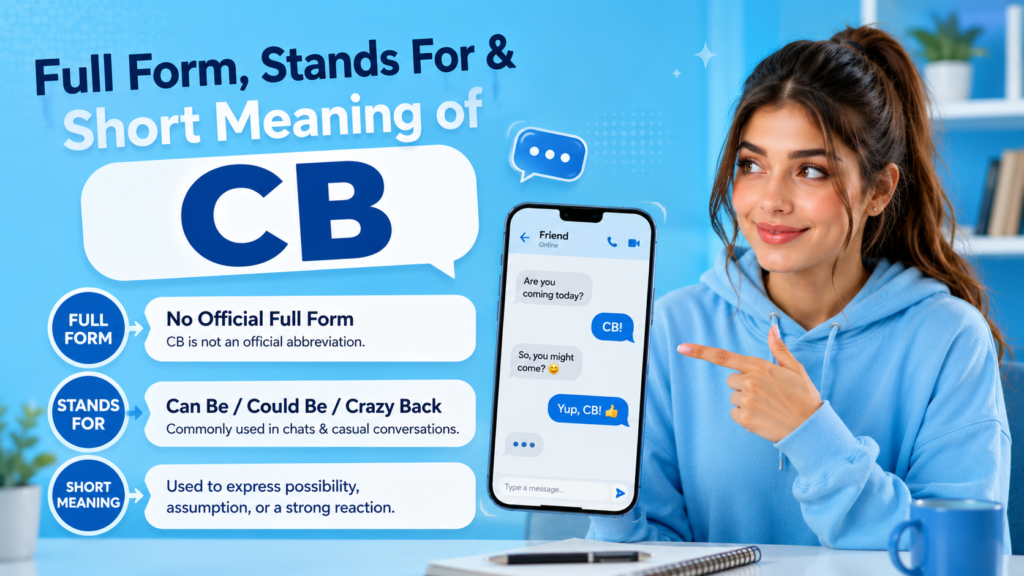
Here’s a quick breakdown of what CB most commonly stands for in different situations:
| Full Form | Common Context | Example |
| Call Back | Texting, phone related chats | “CB when free” |
| Come Back | Casual conversations | “Don’t leave, CB pls” |
| Can’t Be | Reacting to surprising news | “CB, that’s crazy” |
| Citizens Band (radio) | Radio/technical use | “CB radio channel 9” |
| Cash Back | Shopping, finance apps | “Got 5% CB on this order” |
| Confirmed Booking | Travel, ticketing | “CB status: confirmed” |
Short answer: In texting, CB almost always means “Call Back.” Outside of chat, it takes on other meanings depending on the industry.
Notice how each version of CB fits neatly into its own world. A trucker on a highway radio and a teenager replying to a DM are using the same letters, but neither would recognize the other’s meaning without context.
That’s really the core lesson with an abbreviation this short. Two letters simply don’t carry enough information on their own, so the surrounding sentence has to do the heavy lifting every single time.
Origin, History & First Known Use of CB
CB has actually been around far longer than smartphones. Long before texting existed, “CB” was widely known as Citizens Band radio, a communication system used by truckers, hobbyists, and everyday people from the mid20th century onward.
CB radio let ordinary people talk to each other over short distances without a license, which made it hugely popular in the United States during the 1970s. Truckers especially relied on it to warn each other about traffic, weather, and speed traps.
When SMS texting took off in the late 1990s and early 2000s, character limits and slow keypads pushed people to shorten everything. Words like “Call Back” naturally got trimmed down to just two letters. As texting culture grew, so did the abbreviation’s popularity.
A rough timeline of how CB evolved:
- 1940s–1970s: CB radio becomes popular for truckers and hobby communication.
- Early 2000s: SMS texting drives abbreviations like CB, BRB, and TTYL into mainstream use.
- 2010s: Smartphones and messaging apps (WhatsApp, iMessage) keep the shorthand alive.
- 2020s–2026: Social media platforms push fast, brief replies, keeping CB relevant in DMs and comments.
What’s interesting is that the radio meaning never fully disappeared. It simply moved into a smaller, more specialized audience while the texting meaning took over everyday conversation.
This kind of layered history is common with slang. An old meaning doesn’t vanish; it just gets pushed into the background while a newer, more popular meaning takes the spotlight.
How People Use CB in Daily Conversations
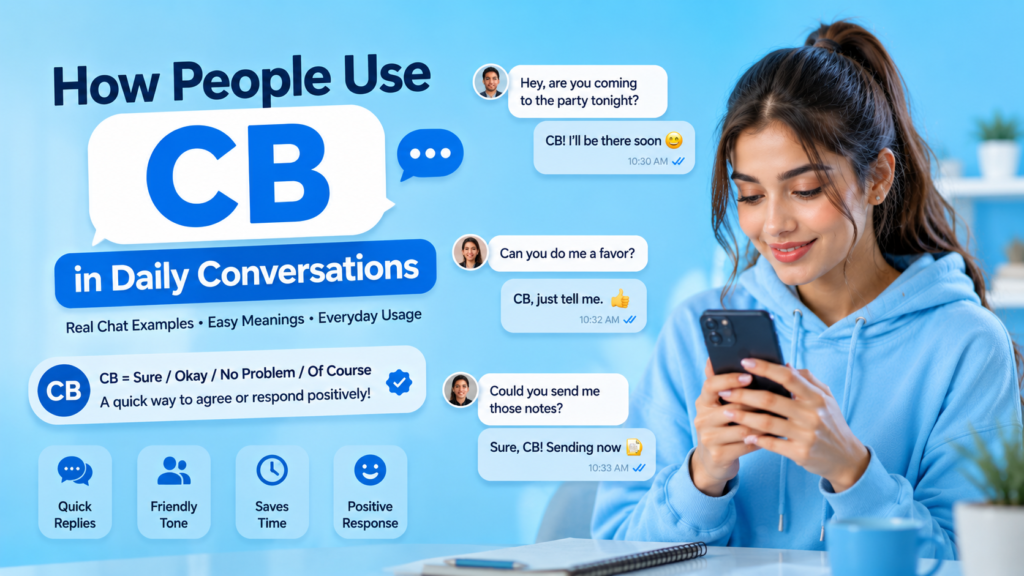
CB shows up most often in situations where someone is busy, distracted, or simply typing quickly. It works as a placeholder for a longer explanation that nobody really has time to type out.
Common everyday uses include:
- Letting a friend know you’ll call once you’re free
- Wrapping up a chat quickly without sounding rude
- Responding briefly in group chats when you’re multitasking
- Signaling that a conversation isn’t over, just paused
Each of these situations shares one thing in common: the sender wants to acknowledge the message without committing to a full reply right now. CB acts like a small placeholder that says “I see you, hang tight.”
It’s worth noting that CB is informal. You’d send it to a friend, sibling, or classmate not in a formal email or a professional Slack message to your manager. In workplace communication, it’s safer to write the full phrase.
Using CB with a boss or client can come across as careless, even if that’s not the intention. Formal settings generally expect full words, so it’s worth switching out of texting habits when the audience changes.
Also Read This Meaning GB Mean in Text
CB Meaning Across WhatsApp, Instagram, TikTok & Snapchat
The core meaning of CB doesn’t really change between apps, but how it’s used can shift slightly depending on the platform’s culture. Each app has its own rhythm, and CB adapts to match it.
| Platform | Typical Use of CB |
| Mostly “Call Back” used in personal and casual chats | |
| Instagram DMs | “Call Back” or “Come Back,” often in flirty or friendly exchanges |
| TikTok Comments | Sometimes reactionary, closer to “Can’t Be” (expressing disbelief) |
| Snapchat | Quick “Call Back” or “Come Back” between friends |
Because Snapchat and Instagram lean casual and fastpaced, CB fits naturally into short captions or replies where a full sentence would feel unnecessary. Friends texting back and forth throughout the day don’t need to spell out every word.
On TikTok, comment sections sometimes bend CB toward reaction slang rather than a literal callback request, so context still matters most. A comment under a shocking video reading “CB fr” has nothing to do with phone calls at all.
WhatsApp tends to stick closer to the original meaning since it’s often used for more direct, one on one conversations, including with family or coworkers. That slightly more personal setting keeps CB closer to its “Call Back” roots.
Different Meanings of CB in Other Fields
Outside texting, CB pops up across several unrelated industries, and mixing these up is where most confusion happens. Each field adopted the letters for its own convenience, long before texting slang existed.
- Radio & Communication: CB = Citizens Band radio, a two way radio system.
- Aviation: CB can refer to “Cumulonimbus,” a type of storm cloud pilots watch for.
- Finance & Shopping: CB often means “Cash Back,” a reward on purchases.
- Sports (American Football): CB stands for “Cornerback,” a defensive position.
- Medical Field: CB can refer to “Complete Blood” (as in a lab test) depending on the report.
- Gaming: In some gaming communities, CB is shorthand for a player’s initials or a squad tag.
A pilot reading “CB” on a weather report is thinking about storm clouds, not phone calls. A shopper seeing “5% CB” on a receipt is thinking about savings, not a callback request.
This is exactly why context is everything with abbreviations this short. The letters themselves are neutral; the meaning only appears once you know which world the conversation is happening in.
Common Confusions, Mistakes & Wrong Interpretations
Because CB is so short, it’s easy to misread, especially for people who aren’t used to texting shorthand. Here are the most frequent mixups people run into.
- Assuming CB always means “Call Back”: In technical or professional fields, it rarely does.
- Confusing CB with BRB or TTYL: CB implies a specific action (calling or returning), while BRB and TTYL simply mean a temporary pause in the conversation.
- Reading CB out of context: A single letter combo without surrounding text can be genuinely ambiguous and always check the full message.
- Using CB in formal writing: It comes across as too casual for emails or workplace documents.
These mistakes usually happen when someone jumps straight into a conversation midthread, without scrolling back to see what was said earlier. A message like “CB, that’s insane” makes no sense without the story that came before it.
When in doubt, the simplest fix is just asking: “What do you mean by CB?” It’s a completely normal question and avoids awkward guesswork. Nobody gets offended by a quick clarification, and it saves both people from a confusing back and forth.
Similar Terms, Alternatives & Related Slang
CB belongs to a whole family of texting shorthand, and comparing it to similar terms makes its meaning even clearer. Here’s how it stacks up against other common abbreviations.
| Term | Meaning | Key Difference from CB |
| BRB | Be Right Back | No specific action implied, just a short pause |
| TTYL | Talk To You Later | Ends the chat for now, less immediate than CB |
| GTG | Got To Go | Signals leaving, not necessarily returning |
| HMU | Hit Me Up | Invites contact, doesn’t confirm a return |
| OTW | On The Way | Refers to physical movement, not a callback |
CB stands out because it directly implies action someone is expected to call, message, or come back while terms like BRB and TTYL just describe a pause without promising anything specific.
HMU is closer in spirit to CB since both invite future contact, but HMU is an open invitation rather than a confirmed promise. CB tends to sound more definite, almost like a small commitment the sender is making.
Learning these small differences helps avoid mixed signals. Someone expecting a callback after seeing “CB” might feel ignored if the sender actually meant something closer to “BRB.”
Examples of CB in Real Chat Situations
Seeing CB in real conversations makes the meaning click faster than any definition. A few common scenarios show just how flexible the abbreviation really is.
- Busy at work: “In a meeting, CB after 5”
- Casual catchup: “Missed your call, CB in 10 mins”
- Group chat: “Gotta run, CB guys”
- Dating app chat: “Running late, CB soon 😊”
- Quick social reply: “That’s wild, CB fr” (used more like “can’t be”)
Notice how the surrounding words always clarify which meaning applies; that’s the pattern worth remembering. Time references like “in 20” or “after 5” almost always point toward “Call Back.”
Reaction phrases like “that’s wild” or “fr” (for real) usually signal the “Can’t Be” meaning instead. Once you start noticing these small clues, decoding CB becomes almost automatic.
How to Reply When Someone Says CB
If someone sends you a CB, your reply usually depends on how you want to keep the conversation going. A short, friendly response is generally enough to keep things moving without overthinking it.
Some simple, natural responses include:
- “Okay, talk soon!”
- “No worries, call whenever you’re free.”
- “Sure, I’ll wait for your call.”
- “All good, catch you later!”
These replies work well because they match the casual tone CB already sets. There’s no need to write a long message back when the original text itself was short and quick.
If the meaning genuinely isn’t clear from context, a short clarifying question works just fine: “Do you mean call back?” Nobody will think it’s a strange thing to ask, and it’s much better than guessing wrong and causing confusion later.
Is CB Still Popular? Trends & Online Usage
CB isn’t as trendy as newer slang terms that go viral on TikTok, but it hasn’t disappeared either. It remains a steady, lowkey abbreviation used mostly in personal chats rather than public social posts.
A few reasons it’s stuck around:
- It’s short, simple, and easy to type on any device.
- It fits naturally into fast paced messaging without sounding unusual.
- Older texting habits (from SMS days) still carry over into modern apps.
Unlike newer slang that can feel like a passing trend, CB has quietly blended into everyday texting habits across generations. Older users who grew up texting on flip phones still use it the same way younger users do today.
Compared to flashier slang, CB’s popularity is quieter but consistent. It’s the kind of term people use without thinking twice, which is exactly why it’s lasted this long. It doesn’t need viral moments to stay relevant; it just keeps working.
Final Thoughts
CB is a small abbreviation with a surprisingly wide range of meanings. In everyday texting, it’s almost always a quick way to say “Call Back.” But step outside casual chat, and it can mean anything from cash back on a purchase to a defensive football position or a storm cloud on a pilot’s radar.
The best approach is simple: read the full message, consider the platform, and if you’re still unsure, just ask. Once you get comfortable spotting the context clues, decoding CB and slang like it becomes second nature.
Two letters, this many meanings, and yet the trick to understanding all of them stays exactly the same: look at what surrounds them.

Hi, I’m Munaza, the creator of RTMeaning.com. I’m passionate about explaining internet slang, abbreviations, texting terms, and modern language in a simple and easy-to-understand way. Through this website, I help readers discover the meanings behind trending words, social media expressions, and online communication. My goal is to make learning new terms quick, clear, and enjoyable for everyone.