

If you’ve ever gotten a text or DM that just says “sup,” you already know it doesn’t need much explanation but you might still wonder exactly where it comes from, how to use it right, and how to reply without sounding awkward. Almost everyone who has spent time texting or scrolling social media has typed or received this word at least once, often without giving it a second thought.
This guide breaks down everything you need to know about “sup,” from its origin to its use across WhatsApp, Instagram, TikTok, and Snapchat, plus real chat examples and reply ideas. By the end, you’ll understand not just what the word means, but when to use it, when to avoid it, and how to respond so a conversation actually keeps going.
What Does Sup Mean in Text & Chat?
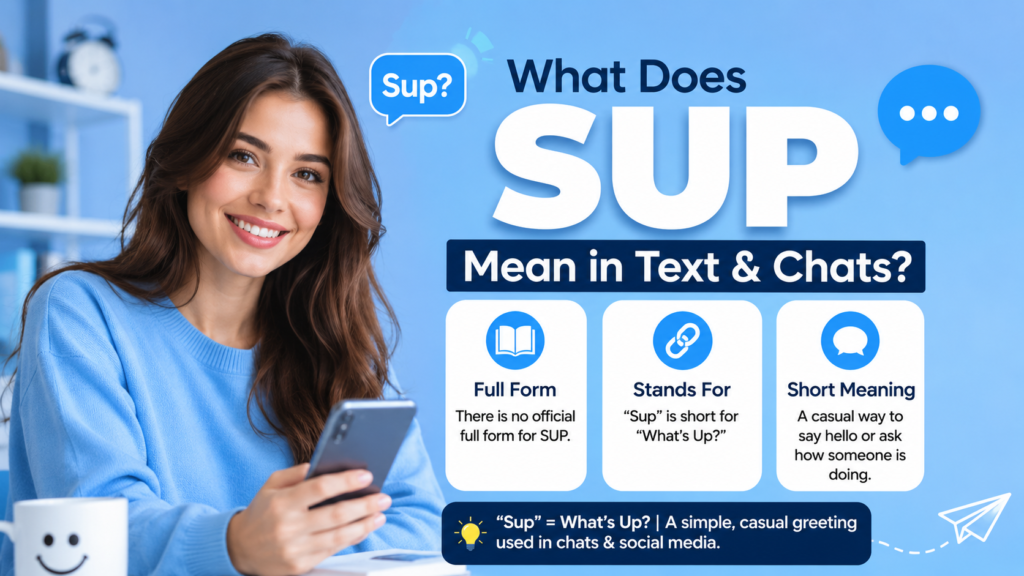
“Sup” is internet and texting slang for “what’s up?” It’s a short, casual greeting people use instead of “hello” or “how are you?” It’s most common in informal chats, DMs, and social media comments.
The word works because it strips a greeting down to its bare minimum. There’s no punctuation required, no real thought needed, and no pressure on either side of the conversation. That low effort quality is exactly why it spread so widely among texters who wanted speed over formality.
Quick Chat Examples
Friend: “Sup?”
You: “Not much, just chilling. You?”
Crush: “Sup 👀”
You: “Heyyy, just thinking about you lol”
Group chat: “Sup everyone”
Reply: “Yo!”
Each of these examples shows how flexible the word is. It can open a friendly checkin, hint at romantic interest, or simply announce that someone has joined a group conversation.
Full Form, Stands For & Short Meaning of Sup
“Sup” isn’t really an acronym, it’s a clipped version of the phrase “what’s up.” People simply dropped the “what” and the apostrophe to make it faster to type and say. There’s no hidden abbreviation behind the letters, despite how often people assume there must be one.
This is worth clarifying because plenty of new texters search for a “full form” of sup expecting something official. The truth is far simpler: it’s just casual pronunciation turned into casual spelling.
Short Meaning of Sup
In one line: “Sup” = a casual way of asking “what’s up?” or saying “hi.” It carries no deeper meaning beyond that, though tone and context can shift how it lands.
Different Ways People Write It
| Variation | Common Use |
| Sup | Standard, most common spelling |
| Wassup | Slightly more expressive, energetic tone |
| Whaddup | Informal, often spokenstyle texting |
| S’up | Rare, stylized spelling |
| Wyd | Related but means “what are you doing” |
Each spelling variation signals a slightly different energy. “Sup” feels neutral and quick, while “wassup” or “whaddup” adds enthusiasm, almost like raising your voice while typing.
Is It Formal?
No. “Sup” is strictly informal. It works well with friends, classmates, or people you’re comfortable with, but it’s not appropriate in professional emails, job applications, or formal messages. Using it with a boss, teacher, or someone you’ve just met in a professional setting can come across as careless or overly familiar.
Origin, History & First Known Use of Sup
“Sup” grew out of everyday spoken slang before becoming a texting staple. It traces back to casual American youth culture, where shortening greetings was already common long before smartphones existed.
Why It Became Popular
- Texting and SMS culture rewarded short words that were fast to type.
- Early online chat rooms favored quick, casual greetings.
- Gaming communities picked it up as a fast way to greet teammates.
- A viral early 2000s beer commercial featuring an exaggerated “Wassuuup!” helped push similar greetings into mainstream pop culture.
These factors combined to turn a small verbal habit into a nationwide, then global, texting standard. Once phones with keypads and later touchscreens made typing faster, shortened words like “sup” became second nature.
First Known Use
There’s no single documented “first use” of “sup.” Language and slang trackers generally place its rise in the 1990s and early 2000s, alongside the growth of SMS texting and instant messaging platforms like AIM. It likely existed in spoken form well before it ever appeared on a screen, since dropping “what’s” down to a single syllable is a natural shortcut in casual speech.
How People Use Sup in Daily Conversations
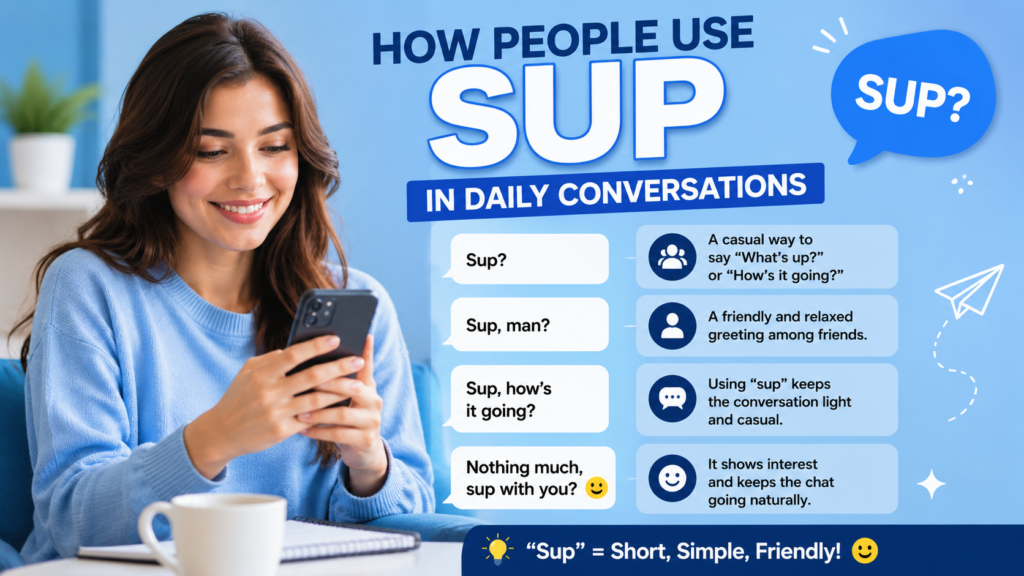
“Sup” fits naturally into everyday digital conversations, especially among younger users and close friends. It rarely appears in isolation; it usually opens the door to a longer exchange.
Common Daily Uses
Greeting a Friend Used the same way you’d say “hey” or “hi” quick, warm, and low effort. It signals familiarity without requiring any real setup.
Starting a Chat Often the very first message someone sends to open a conversation. It’s a safe, neutral way to break the ice without committing to a topic.
Checking on Someone Can double as a mini checkin, similar to “how are you doing?” It shows interest without demanding a detailed response.
Gaming Conversations Common in voice chats and lobbies as teammates join a match. It functions almost like a digital handshake before gameplay begins.
Tone Matters
The same word can feel different depending on delivery:
| Tone | Example | Feeling |
| Friendly | “Sup!” | Warm, casual hello |
| Flirty | “Sup 😏” | Playful, interested |
| Bored/dry | “sup.” | Low energy, disinterested |
| Excited | “SUPPP!!” | Hyped, enthusiastic |
Punctuation, capitalization, and emojis all change how “sup” reads. A period at the end can feel flat or even cold, while extra letters and exclamation points make it feel lively.
Common Replies
- “Not much, you?”
- “Just chilling”
- “Nothing much, wbu?”
- “Same old, same old”
These replies mirror the low effort nature of the greeting itself, keeping the conversation light until either person decides to steer it somewhere more specific.
Also Read This Meaning YG Meaning in Text
Sup Meaning Across WhatsApp, Instagram, TikTok & Snapchat
The core meaning of “sup” stays the same everywhere, but the vibe shifts slightly by platform. Each app has its own culture, and that culture colors how the word is read.
Sup on WhatsApp
Usually a relaxed check in between friends or family, often to see if someone is free to chat. Because WhatsApp skews toward closer, longer term contacts, “sup” there often feels more genuine than performative.
Sup on Instagram
Frequently shows up in DMs, sometimes after viewing a story or post can carry a flirty undertone depending on who’s sending it. Context clues like story replies or comment history often hint at the sender’s real intention.
Sup on TikTok
Common in comment sections and duets, often used casually or jokingly rather than as a real question. It’s less about genuine curiosity and more about jumping into the comment culture of a video.
Sup on Snapchat
Popular in snap captions or story replies as a quick, low pressure way to start a conversation. Snapchat’s disappearing message format makes casual openers like this feel even lower stakes.
Different Meanings of Sup in Other Fields
Outside texting, “SUP” (usually capitalized) stands for completely different things. Context and capitalization usually make the intended meaning obvious.
SUP in Sports
SUP commonly refers to StandUp Paddleboarding, a popular water sport enjoyed on lakes, rivers, and coastlines. It has grown into both a recreational activity and a competitive sport in recent years.
SUP in Business or Work
In some business contexts, SUP can be short for “supervisor.” This usage appears mostly in internal workplace documents, scheduling systems, or shorthand notes rather than everyday conversation.
SUP in Technology
In tech settings, SUP sometimes appears as shorthand in specific software or system names, though this usage is far less common than the texting slang. It’s typically limited to niche technical documentation rather than general use.
How to Know the Right Meaning
Context is everything. Casing, platform, and surrounding words tell you which “sup” you’re dealing with. A lowercase “sup” in a text almost always means the greeting, while an uppercase “SUP” near sports or workplace terms usually points elsewhere.
Example 1
“Going SUP this weekend” → sports (paddleboarding).
Example 2
“Sup, you free later?” → casual greeting in chat.
Common Confusions, Mistakes & Wrong Interpretations
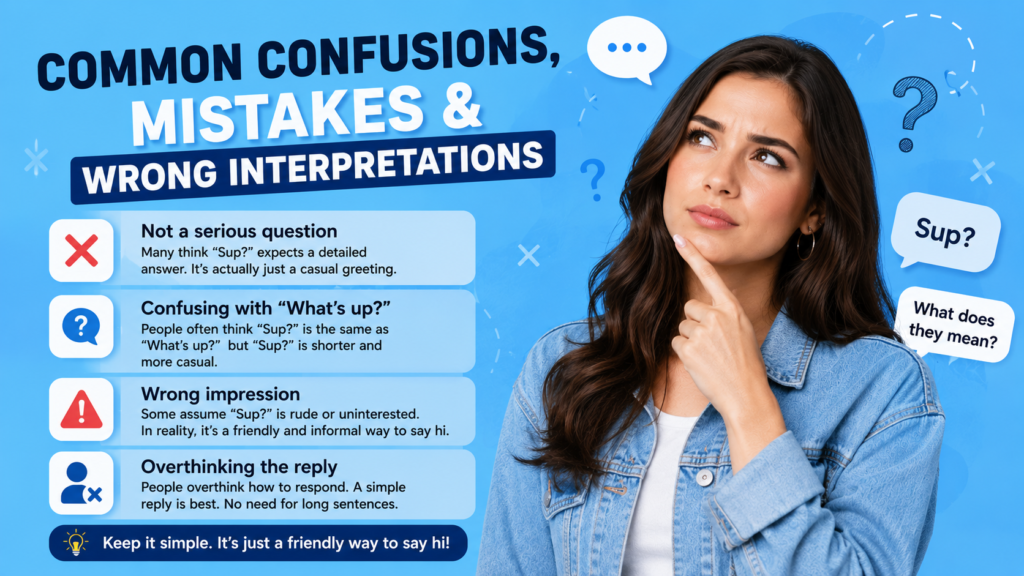
Even a simple word like “sup” trips people up sometimes, especially those newer to texting culture or unfamiliar with internet slang.
Common Mistakes
Thinking It Is an Acronym Many assume “SUP” stands for something formal it doesn’t in casual texting; it’s just short for “what’s up.” This misunderstanding often comes from confusing it with other capitalized abbreviations.
Confusing It With “SUP” in Sports Without Context, people sometimes mix up the paddleboard sport with the greeting, especially in written posts where capitalization isn’t consistent.
Using It in Formal Situations Texting “sup” to a boss or in a formal email can come across as unprofessional. It’s best reserved for peers and close contacts.
Misreading the Tone A dry “sup.” can be mistaken for rudeness when the sender may just be low energy or busy. Reading too much into punctuation alone can cause unnecessary misunderstandings.
Wrong Interpretations
Some people wrongly assume “sup” always implies flirting or disinterest in reality, tone and relationship context decide the true meaning far more than the word itself. The same greeting can mean something completely different depending on who sends it and why.
Similar Terms, Alternatives & Related Slang
“Sup” belongs to a broader family of casual greetings that share a similar loweffort, highfamiliarity vibe.
Popular Alternatives
- Hey
- Yo
- What’s good
- Wassup
Related Internet Slang
Wyd Short for “what are you doing” often used as a followup after “sup.” It moves the conversation from a general greeting toward something more specific.
Yo A short, energetic greeting similar in casualness to “sup.” It’s often used interchangeably, though it can feel slightly more upbeat.
Wassup A more expressive, stretched out version of “sup.” It’s often used to convey extra enthusiasm or excitement.
Example Comparisons
| Term | Formality | Typical Vibe |
| Sup | Very informal | Chill, quick |
| Yo | Very informal | Energetic |
| Wassup | Informal | Expressive |
| Wyd | Informal | Curious, followup |
Which One Is Most Common?
“Sup” remains one of the most widely used casual greetings across texting and social apps, largely because it’s short and universally understood. Its simplicity is exactly what keeps it ahead of longer or more elaborate alternatives.
Examples of Sup in Real Chat Situations
Friendly Chat
“Sup man, long time no see!”
Gaming Chat
“Sup team, ready to queue?”
Flirty Conversation “Sup cutie 😉”
Group Chat
“Sup everyone, who’s free tonight?”
Snapchat Example
Caption on a selfie: “sup ✌️”
Instagram DM
“Sup, saw your post that looked fun!”
These examples show how a single word can adapt to nearly any social situation without needing much rewording.
How to Reply When Someone Says Sup
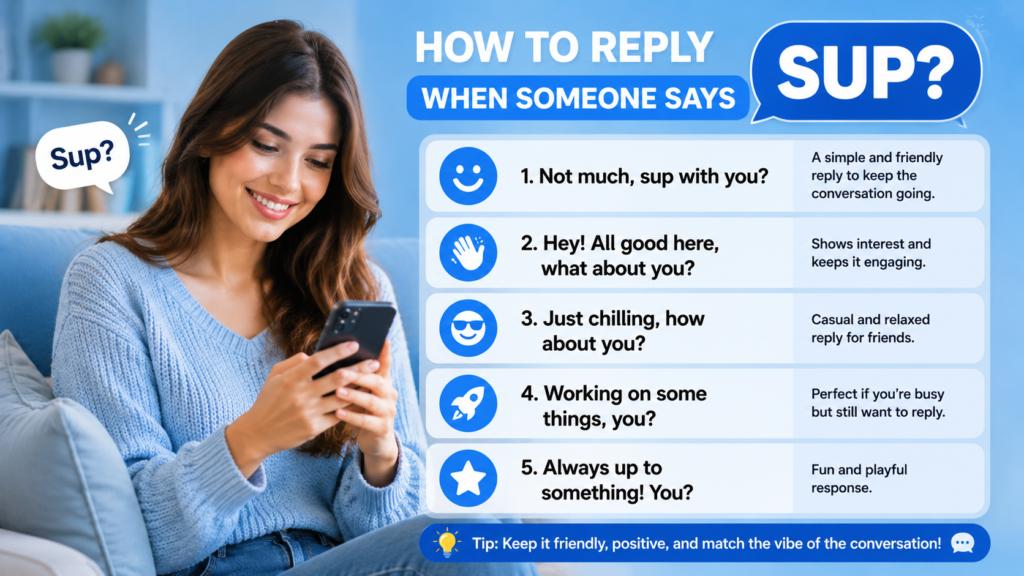
Replying doesn’t have to be complicated, but the right response can set the tone for the rest of the conversation.
Simple Replies
- “Not much, you?”
- “Just relaxing”
Funny Replies
- “The sky, obviously”
- “Living the dream (not really)”
Flirty Replies
- “Just thinking about you 👀”
- “Better now that you texted”
Busy Replies
- “At work, talk later?”
- “Kinda swamped rn”
Tips for Replying
- Match their energy and tone.
- Keep it short unless you want a longer conversation.
- Add an emoji to soften or clarify tone.
- Ask something back to keep the chat going.
Following these small habits usually keeps a casual chat feeling natural instead of forced or awkward.
Is Sup Still Popular? Trends & Online Usage
Slang terms come and go quickly, but “sup” has proven unusually durable across generations of internet users.
Why It Still Works
“Sup” remains popular because it’s short, easy to type, and instantly recognizable across generations of internet users. Its simplicity means it never really needed an update to stay relevant.
Younger Users vs Older Users
Younger users tend to use it constantly and casually, while older users may use it less often but still understand it clearly. This generational overlap is part of why the word hasn’t faded out.
Will It Disappear?
Unlikely. Because it’s so deeply embedded in texting culture and pop culture history, “sup” is expected to stay relevant for the foreseeable future, even as new slang terms emerge alongside it.
Conclusion
“Sup” is simple at its core, a quick, friendly way of asking “what’s up?” or saying hello. Its meaning shifts slightly with tone, platform, and relationship, but it remains one of the most reliable, universally understood greetings in texting and social media.
Whether you’re gaming, DMing a crush, or just checking in on a friend, knowing how and when to use “sup” and how to reply to it helps you communicate naturally in today’s fast moving digital world. It costs almost nothing to type, yet it carries enough flexibility to fit dozens of different social situations.
At the end of the day, a single short word has managed to outlast countless texting trends. That staying power is proof that sometimes the simplest greetings are the ones that stick around the longest.

Hi, I’m Munaza, the creator of RTMeaning.com. I’m passionate about explaining internet slang, abbreviations, texting terms, and modern language in a simple and easy-to-understand way. Through this website, I help readers discover the meanings behind trending words, social media expressions, and online communication. My goal is to make learning new terms quick, clear, and enjoyable for everyone.