

If you have been scrolling through a group chat or Instagram comments and spotted someone type “psh” out of nowhere, you are not imagining things. It is everywhere lately. It looks like an abbreviation, but it does not behave like one.
There is no hidden phrase behind it, no official dictionary entry, and yet everyone seems to instantly understand the vibe it is giving off. People use it without thinking twice, and readers rarely ask what it means.
This guide breaks down exactly what PSH means, where it came from, and how it shows up across different apps. By the end, you will know how to use it and how to reply to it without sounding out of touch.
What makes PSH interesting is how little it actually says on paper compared to how much it communicates in practice. Three letters can carry an entire eyeroll, a whole sarcastic sigh, or a full wave of playful attitude depending on who typed them.
That is part of the reason it keeps spreading across new apps and new generations of texters. It never needed a dictionary entry to survive, because the sound itself already lived in everyday speech long before anyone typed it out.
What Does PSH Mean in Text & Chat?
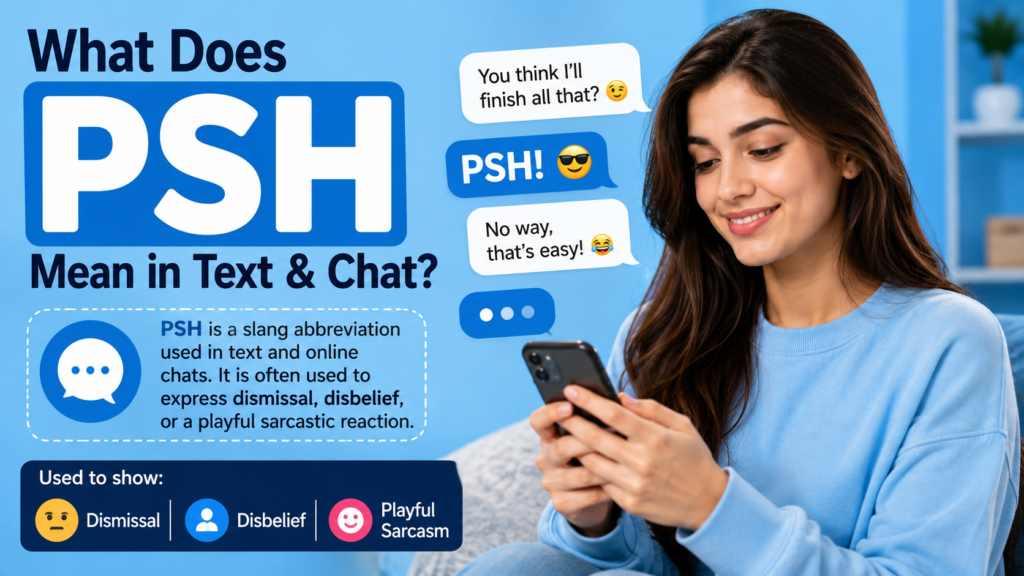
At its core, PSH is a written standing for a sound. It represents the quick, breathy scoff people make when they hear something they do not believe or do not take seriously.
Picture someone rolling their eyes and letting out a short “PSH” under their breath. That is exactly what is being typed on screen, just in three letters instead of a full sentence.
It is not really a word, and it is definitely not tied to one fixed definition. Instead, it functions as emotional shorthand that leans heavily on tone rather than literal meaning.
Common feelings PSH can express include:
- Disbelief (“I don’t buy that”)
- Dismissiveness (“that’s not a big deal”)
- Sarcasm (“yeah, sure it is”)
- Playful teasing among friends
- Mock confidence or fake indifference
Example:
Friend: “I’m going to the gym at 6 AM every day this year.”
You: “Psh, we both know that’s not happening 😂”
The reply does not need extra explanation. The tone carries the entire message, and both people already know what is really being said.
This is why PSH works so well in fastmoving conversations. Instead of typing out a whole paragraph explaining why you doubt someone, one short sound gets the same reaction across instantly and keeps the exchange moving.
It also gives the sender room to sound playful rather than harsh. A flat “I don’t believe you” can come across as cold, but “psh” almost always reads as teasing instead of genuinely dismissive.
Full Form, Stands For & Short Meaning of PSH
A lot of people search for what PSH “stands for,” assuming it works like an acronym such as LOL or BRB. It does not work that way at all.
There is no official full form, and any expanded version floating around online, like “Please Stay Humble,” is simply a joke someone invented after the term already existed. None of these backronyms are recognized or original.
Short meaning: PSH is a typed scoffing sound used to show disbelief, sarcasm, dismissal, or a playful attitude, depending entirely on context.
| Term | Category | Core Feeling |
| PSH | Sound expression | Disbelief / sarcasm / dismissal |
| Pfft | Sound expression | Mocking or brushing off |
| Meh | Slang | Indifference |
| Hmph | Sound expression | Annoyance or doubt |
People often stretch the word out to add emotional weight. A plain “psh” feels casual, while “pshhhh” or “pssshhhh” reads as more dramatic, exaggerated, or theatrical.
The spelling itself is not fixed either. Some people write “pshh,” others prefer “pssh,” and neither version is considered more correct than the other. It is purely a matter of personal texting style.
Because there is no official spelling committee for internet sounds, the word adapts naturally to whoever is typing it. That flexibility is part of why it feels so casual and personal in everyday chats.
Origin, History & First Known Use of PSH
PSH is not a modern internet invention. It began as a spoken sound that has existed in everyday conversation for generations, long before texting was ever a thing.
The scoffing or exhaling noise people made to show doubt simply got transcribed into letters once online chat took off. It was an easy sound to translate into text because everyone already recognized it out loud.
It gained real traction through the 2010s, spreading across social media comments, group texts, and early Twitter replies. People liked it because it offered a low effort way to signal skepticism without writing out a full sentence.
It stuck around because it was fast, expressive, and universally understood, which is exactly why it remains common in 2026 and shows no signs of disappearing from casual chat.
Unlike many internet abbreviations that fade once a new trend replaces them, PSH never really depended on a trend cycle at all. It rode along with ordinary conversation instead of a viral moment, which is likely why it has outlasted many flashier slang terms.
Its staying power also comes from how easily it transfers between spoken and typed conversation. People already made this sound out loud for decades, so typing it never felt forced or invented, unlike some newer slang that clearly started online.
How People Use PSH in Daily Conversations
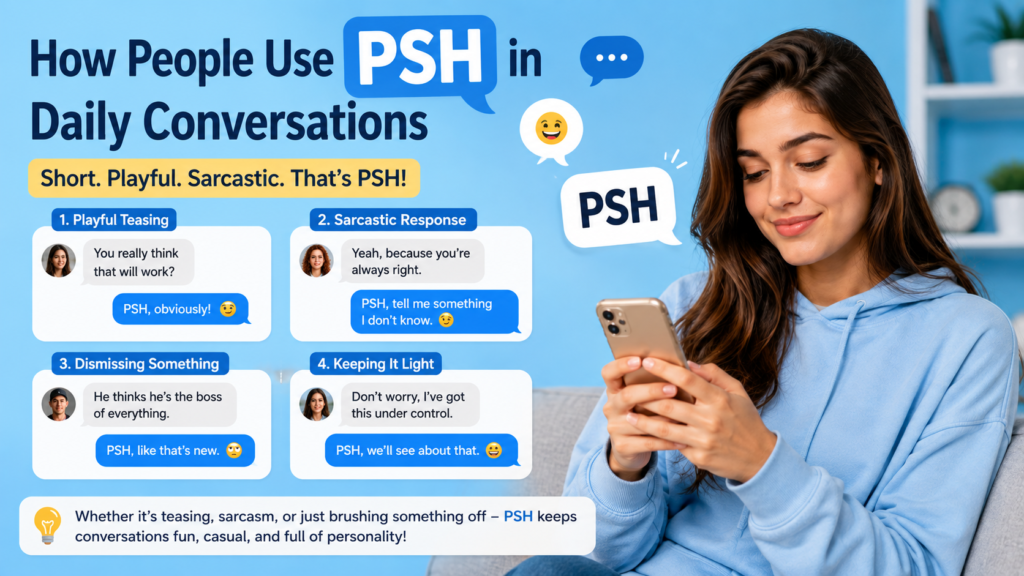
PSH is not a onenote reaction. Depending on context, it can shift between several different everyday tones, each carrying its own flavor.
Playful Confidence
Used when someone wants to sound cocky or self assured in a lighthearted, joking way.
- “Think you can beat me at this? Psh, watch me win.”
Friendly Teasing
A gentle way to poke fun at a friend without any real edge or hostility behind it.
- “You? On time? Psh, sure.”
Dismissive Humor
Brushing something off is no big deal, usually with a laugh attached to soften it.
- “Psh, that test was easy.”
Fake Offense
Pretending to be mildly annoyed as a joke, rather than expressing a genuine complaint.
- “Psh, I can’t believe you forgot my birthday 😂”
Each of these tones depends heavily on who is speaking and the relationship between the two people. The exact same word can feel warm between close friends and feel oddly cold between strangers online.
That is why reading the surrounding conversation matters more than reading the word in isolation. Context almost always fills in whatever the three letters leave unsaid.
PSH Meaning Across WhatsApp, Instagram, TikTok & Snapchat
The core meaning of PSH stays consistent everywhere, but the way people use it shifts slightly depending on the platform and its culture.
Mostly used in one on one or group chats between friends, usually reacting to a message that sounds unbelievable or exaggerated in some way.
Common in comment sections, often reacting to a bold caption or a friend’s confident post, usually meant in good fun rather than criticism.
TikTok
Shows up frequently in comments under videos where someone makes a big claim or brags playfully. It signals “sure, okay” without needing to type anything more.
Snapchat
Used in quick chat replies, often paired with emojis, since Snapchat conversations tend to be short and reactionbased by nature anyway.
Across all of these platforms, the underlying emotion stays remarkably consistent. What changes is simply the pace of the conversation and how much extra context, like emojis or reaction stickers, typically comes attached to it.
Group chats tend to use it more loosely as a running joke among friends, while comment sections often use it as a one off reaction to a stranger’s post. Both usages point back to the same core feeling of playful disbelief.
Also Read This Meaning WUT Meaning in Text
Different Meanings of PSH in Other Fields
Outside of texting slang, PSH can mean something completely different depending on the industry or professional setting involved.
- Medical field: PSH is a recognized abbreviation for “Past Surgical History,” used regularly in patient charts and clinical notes.
- Education: Occasionally used as shorthand for specific school program names or internal reference codes, and this varies widely by institution.
- Business: Sometimes appears in internal documentation as an acronym unique to a particular company’s terminology, without any standardized meaning.
- Gaming communities: Used the same way as in general texting, as a sarcastic or dismissive reaction to another player’s boast, like “Psh, you got lucky.”
Context always determines which meaning applies, so it is worth checking the setting before assuming which version of PSH someone means.
A patient chart that lists “PSH” clearly has nothing to do with sarcasm, and a gamer typing “psh” midmatch has nothing to do with surgery. The letters are identical, but the worlds they belong to rarely overlap.
Anyone unfamiliar with a specific field might briefly misread the abbreviation, which is a good reminder that slang and professional shorthand can collide in confusing ways online.
Common Confusions, Mistakes & Wrong Interpretations
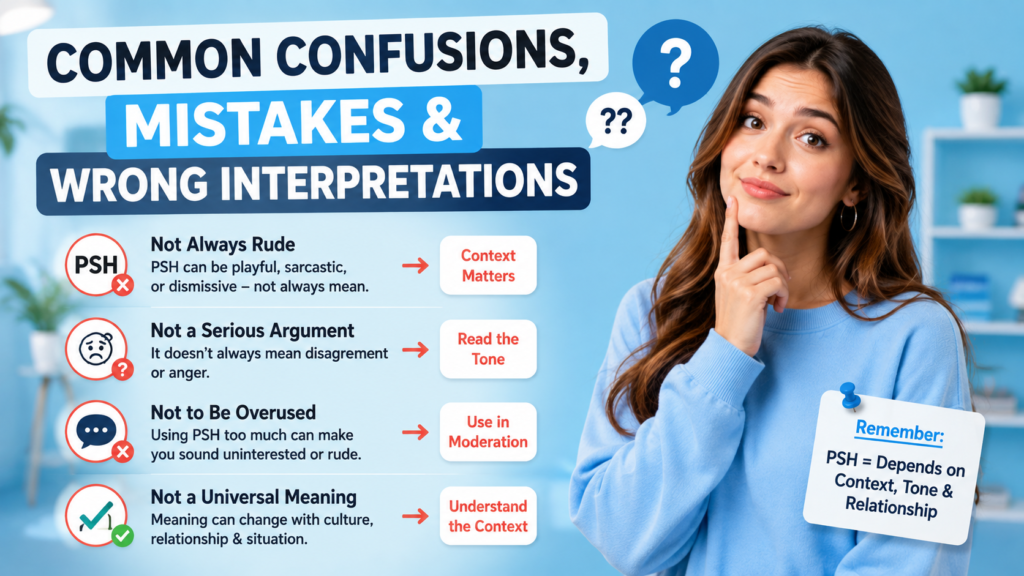
Thinking It Is Always an Acronym
People often search for a “hidden meaning” behind PSH, but it genuinely does not expand into any official phrase at all.
Assuming It Is Angry
PSH can read as blunt in text form, but it is rarely meant as genuine anger. Tone and relationship context matter far more than the word itself.
Using It in Formal Situations
Because it reads as casual and slightly sarcastic, PSH simply does not fit inside professional emails or formal written messages.
Confusing It With Similar Slang
Terms like “meh,” “pfft,” and “bruh” overlap in feeling but are not interchangeable, since each one carries a slightly different emotional shade.
Misreading Tone
Without emojis or added context, PSH can come across harsher than intended, especially when texting someone you do not know well.
Overusing It in Every Reply
Some people lean on PSH so often that it loses its punch and starts to feel like a verbal tic rather than a genuine reaction to anything specific.
Saving it for moments that actually call for a bit of sarcasm keeps the word feeling natural instead of automatic. A reaction that shows up in every single message stops reading as a reaction at all.
Similar Terms, Alternatives & Related Slang
| Comparison | Meaning Difference |
| PSH vs SMH | PSH shows playful disbelief; SMH (“shaking my head”) shows disappointment or frustration. |
| PSH vs Meh | PSH is dismissive with attitude; Meh is flat indifference with no real emotion attached. |
| PSH vs Bruh | PSH reacts with sarcasm; Bruh reacts with shock, disbelief, or exasperation. |
These terms often get combined for extra emphasis, such as “Psh, bruh” or “Psh… SMH,” stacking tone together for added comedic effect.
Knowing the small differences between these terms helps avoid sending the wrong emotional signal. Swapping PSH for SMH, for example, can shift a lighthearted joke into something that reads as genuine disappointment.
Most people learn these distinctions naturally just from reading enough chats, but it helps to know them consciously if you are texting in a language or platform that still feels new to you.
Examples of PSH in Real Chat Situations
- Friendly Competition: “I’ll beat your high score easily.” → “Psh, in your dreams.”
- Joke Between Friends: “I’m the funniest person you know.” → “Psh, sure you are 😂“
- Fake Confidence: “I definitely studied enough for this.” → “Psh, we’ll see.”
- Sarcastic Reply: “It’s not that expensive.” → “Psh, yeah okay.”
- Social Media Comment: Under a bold TikTok caption: “Psh, confidence like this 😭”
Notice how none of these examples need a followup sentence to make sense. The word alone, paired with a bit of context from the previous message, does all the necessary work.
That efficiency is exactly why PSH keeps showing up in fast, casual exchanges rather than longer or more formal ones. It fits naturally into the rhythm of quick back and forth texting.
How to Reply When Someone Says PSH

If someone sends you a “PSH,” there are a few natural ways to respond depending on the vibe of the conversation.
- Play Along: Match the playful energy instead of taking the comment too seriously.
- Respond With Confidence: Try something like “PSH yourself, I’ll prove it.”
- Joke Back: Turn it into a light back and forth instead of letting the conversation end there.
- Ignore the sarcasm: If it is clearly a joke, there is no need to defend yourself. Just laugh it off and move on.
There is rarely a wrong way to respond as long as you match the light tone the word usually carries. Taking it too seriously is really the only response that tends to fall flat in casual conversation.
Most people who send a “PSH” are simply inviting a bit of back and forth banter, so replying with your own playful jab usually keeps the exchange fun for both sides.
Is PSH Still Popular? Trends & Online Usage
PSH has not faded at all. If anything, it has held steady because it is short, expressive, and does not require any explanation to land correctly.
It is especially common among younger texters and shows up regularly in comment sections, direct messages, and casual banter across nearly every major platform available today.
As of 2026, it remains a goto reaction for playful sarcasm rather than a passing trend that is fizzling out or fading into obscurity.
Part of its longevity comes from how easily it moves between languages and regions. Because it mimics a universal human sound rather than an English phrase, nonnative speakers pick it up just as naturally as native ones.
That universal quality gives it staying power that many text based slang terms never manage to achieve. It does not rely on wordplay or cultural references that eventually go stale.
Conclusion
PSH is not an acronym hiding some secret phrase behind it. It is simply the text version of a scoffing sound that people have made out loud for years, now typed instead of spoken.
Whether it shows up as playful teasing, dismissive humor, or fake confidence, its meaning almost always comes down to tone rather than the actual letters themselves.
Once you understand that context, replying naturally becomes second nature, whether you are on WhatsApp, Instagram, TikTok, or anywhere else casual chat happens to take place.

Hi, I’m Munaza, the creator of RTMeaning.com. I’m passionate about explaining internet slang, abbreviations, texting terms, and modern language in a simple and easy-to-understand way. Through this website, I help readers discover the meanings behind trending words, social media expressions, and online communication. My goal is to make learning new terms quick, clear, and enjoyable for everyone.