

If you’ve ever texted a friend after a rough day and gotten back a single reply “FML” you already have a rough idea of the vibe. But what does it actually mean, where did it come from, and is it okay to use everywhere?
This guide breaks down everything you need to know about FML in 2026, from its literal meaning to real chat examples, regional differences, and when you should probably avoid typing it at all. Slang moves fast, and understanding the full context behind three letters can save you from an awkward or misread text.
FML Meaning Slang Quick Meaning
FML stands for “F* My Life.” It’s used online and in texting to express sudden frustration, embarrassment, disappointment, or bad luck, usually about one specific moment, not life as a whole.
It is one of the most recognizable pieces of internet shorthand, right up there with LOL or SMH. Despite the dramatic wording, most people typing it are not making a statement about their entire existence.
What Does FML Mean?
FML is a three letter reaction people send when something small but annoying goes wrong. It’s rarely meant literally.
The phrase works almost like a verbal sigh. It doesn’t require explanation, and the person receiving it usually understands the emotional weight instantly without needing more context.
Simple Definition
FML = a short, dramatic way of saying “this moment is going badly,” typically used right after an inconvenient, awkward, or unlucky event.
It’s less a cry for help and more an exclamation, similar to saying “ugh” or “great, just great” in a sarcastic tone after something goes wrong.
Quick Examples
“Forgot my charger at home. FML.” “Autocorrect changed my text to something embarrassing. FML.” “Spilled coffee on my white shirt right before the interview. FML.”
Each of these examples shares a pattern: a small, specific mishap followed by an exaggerated three-letter reaction. That contrast between the tiny problem and the dramatic phrase is exactly what makes FML feel funny rather than heavy.
Origin & Background
Understanding where FML came from helps explain why it still feels so casual today, even though the full phrase includes a curse word.
Where Did FML Come From?
FML gained mainstream traction in the late 2000s alongside the website FMyLife.com, where users submitted short, ironic stories about bad days. The acronym existed in online slang before that, but the site helped standardize both the phrase and its tone: self deprecating, exaggerated, and a little funny.
The website format encouraged short, punchy storytelling: describe an embarrassing or unlucky event in a sentence or two, then end with “FML.” That structure trained an entire generation of internet users to associate the acronym with comedic misfortune rather than genuine despair.
The Influence of Internet Humor
Early internet culture rewarded short, punchy reactions over long explanations. Forums, comment sections, and later Twitter trained people to compress emotion into acronyms LOL, SMH, FML that could be typed in seconds and understood instantly.
This shift toward compressed language wasn’t just about speed. It also reflected a shared culture where everyone already knew the reference, so spelling things out felt unnecessary and even a little uncool.
How the Meaning Evolved
What started as a genuine expression of frustration has shifted into something closer to comedic venting. Today, FML is less about despair and more about relatable, everyday annoyance, the digital equivalent of throwing your hands up.
Over time, the phrase softened. What once might have carried real emotional weight now mostly signals mild exasperation, similar to rolling your eyes at your own bad luck rather than genuinely suffering from it.
Also Read This Meaning NNN Meaning Explained
Real Life Conversations
Seeing FML in context makes the tone much easier to understand than any definition alone. Below are common scenarios where the phrase naturally appears.
WhatsApp Conversation
Maya: just missed the last bus home Maya: FML Sara: oh no 😭 want me to pick you up?
This exchange shows FML functioning as a quick emotional flag. Sara doesn’t need Maya to explain further; the tone is instantly clear, and the conversation moves straight to solving the problem.
Instagram DM
Alex: posted a story with my ex in the background lol Alex: FML someone already screenshotted it Jordan: 💀💀 delete it NOW
Here, FML pairs with humor rather than genuine panic. The skull emoji and lighthearted tone confirm that both people are treating the situation as an embarrassing joke, not a real crisis.
TikTok Comments
“the way she tripped on the red carpet and still smiled… FML if that was me I’d never leave the house again”
In comment sections, FML often expresses secondhand embarrassment on someone else’s behalf, imagining how mortifying a moment would feel if it happened to the commenter instead.
Text Message Conversation
Mom: Did you submit the assignment? You: I thought it was due tomorrow. FML. Mom: Email your professor right now.
This example shows FML slipping into a family conversation almost by accident, used more as a stress reaction than an attempt to shock or offend the parent reading it.
Emotional & Psychological Meaning
Beyond definitions and examples, FML says something about how people process small stressors in daily life.
What Emotion Does FML Express?
FML usually carries frustration, embarrassment, or exasperation. Occasionally it signals genuine stress, but context and tone almost always determine which one applies.
Reading the surrounding message matters more than the acronym itself. A laughing emoji nearby usually means the person is fine, while a lack of punctuation or follow up jokes can hint at something more serious.
Why People Use It
It’s fast, no need to explain the whole situation. It signals “I need a moment,” without asking for advice. It builds relatability with friends going through similar chaos. It softens embarrassment with humor.
These four reasons explain why FML has stayed popular for so long. It efficiently communicates a mood while inviting light sympathy or humor rather than a deep conversation.
What It Reveals About Modern Communication
Short-form slang like FML reflects how digital conversation favors emotional shorthand over detailed explanation. Instead of writing paragraphs, people compress an entire mood into a few characters, trusting the listener to fill in the rest.
This shorthand culture didn’t appear by accident. Texting, character limits, and fast paced social feeds all pushed language toward brevity, and acronyms like FML became a natural byproduct of that shift.
Personal Style Scenario
Picture this: you triple-check your bag before leaving for a trip, get to the airport, and realize your passport is still on the kitchen counter. There’s no better three letter summary for that gut drop feeling than FML.
Moments like these capture exactly why the phrase endures. It’s the instant, almost involuntary reaction to bad timing, and typing it out can feel oddly cathartic even before you’ve solved the actual problem.
Usage in Different Contexts

FML doesn’t mean the same thing everywhere it’s typed. Context reshapes its weight, tone, and appropriateness.
Social Media Usage
On platforms like Instagram, TikTok, and X, FML often appears in captions for minor mishaps, bad hair days, awkward moments, funny fails designed to get a laugh, not sympathy.
Public captions tend to lean more performative than private texts, since the goal is often entertainment for followers rather than personal venting to a close friend.
Friends & Relationships
Among close friends, FML is casual shorthand. It’s used constantly, rarely taken seriously, and often followed by jokes rather than concern.
Because friends usually share context about each other’s days, a single “FML” text can trigger an entire understood backstory without either person needing to type it out.
Work & Professional Settings
In workplace chats, especially with coworkers you’re close to, FML might slip out after a stressful meeting or missed deadline, but it’s still considered informal and best kept out of official channels.
Even in casual internal chats, it’s worth remembering that screenshots travel. A phrase that feels harmless between two coworkers can look unprofessional if shared more widely.
Casual vs Serious Tone
| Context | Typical Tone | Example |
| Friend group chat | Playful, exaggerated | “Forgot my umbrella. FML 😂” |
| Social media caption | Humorous, relatable | “Tripped in front of my crush. FML” |
| Close coworker chat | Light venting | “Client changed the brief again. FML” |
| Genuine distress | Rare, more serious | “I failed the exam I studied for months. FML.” |
This table highlights how the same three letters shift meaning depending on setting. Reading tone correctly is key to understanding whether a reply should be funny or supportive.
When NOT to Use It
FML is casual slang, and casual slang has boundaries. Knowing where those boundaries sit prevents awkward or unintended messages.
Professional Situations
Avoid FML in emails, official Slack channels, client messages, or anything that could be screenshotted and shared with a manager.
Formal communication generally expects a professional tone, and even mild slang can come across as careless in written records that outlast the moment they were sent in.
Sensitive Emotional Situations
If someone is dealing with a genuinely heavy issue, grief, illness, a serious loss, replying with “FML” can come across as dismissive rather than supportive.
In these moments, a more thoughtful and direct response shows care far better than compressed slang, which can unintentionally minimize what the other person is going through.
Around Older Generations
Because FML contains a swear word once spelled out, it can land poorly with parents, grandparents, or anyone unfamiliar with internet shorthand.
Not knowing the acronym doesn’t stop older readers from asking what it means, and explaining it after the fact can feel more awkward than simply avoiding it in that conversation.
Situations That Can Cause Misunderstanding
Using FML in a serious conversation (job loss, health scare, relationship breakup) risks being read as flippant, even if that wasn’t the intent.
Even well-meaning senders can accidentally minimize a serious topic just by relying on habitual slang instead of pausing to choose more sincere words.
Common Misunderstandings
Slang this widespread naturally picks up a few myths along the way.
People Think It Always Means Depression
FML is almost never a sign of deep despair. It’s typically reactive slang for a bad moment, not a statement about someone’s overall mental state.
Treating every use of FML as a red flag can cause unnecessary worry, since most senders are simply venting about a passing inconvenience rather than something ongoing.
Some Assume It’s Always a Joke
On the flip side, FML isn’t always lighthearted; occasionally it does signal real frustration or stress, so tone and surrounding context matter.
Assuming it’s always harmless can cause someone to overlook a friend who might actually need a check-in, especially if the message lacks its usual joking tone.
Literal vs Figurative Meaning
Almost no one typing FML means it word for word. It functions figuratively, similar to saying “this is the worst” without meaning it in a literal, permanent sense.
The figurative nature is part of why the phrase spread so widely; it exaggerates for effect, much like calling a minor inconvenience “the end of the world.”
Comparison Table
| Slang | Meaning | Typical Tone |
| FML | F*** My Life | Frustration, exaggerated bad luck |
| SMH | Shaking My Head | Disbelief or disapproval |
| LOL | Laugh Out Loud | Amusement |
| FOMO | Fear Of Missing Out | Anxiety about missing something |
| TBH | To Be Honest | Sincerity marker |
Comparing FML to similar acronyms shows how each piece of slang carries its own emotional signature, even though they’re all built the same way short letters standing in for longer feelings.
Key Insight
FML stands out from other slang because it’s emotionally louder; it’s meant to express a spike of frustration in the moment, not a passing reaction.
Unlike more neutral acronyms such as TBH, FML always carries an emotional charge, which is exactly why tone and context matter so much when reading it.
Variations / Types
FML shows up in slightly different flavors depending on the situation.
FML Bro: used between friends, casual and joking.
Major FML Moment: reserved for a bigger, more dramatic mishap.
Daily FML: a running joke about routine annoyances.
FML Seriously: added emphasis when something is genuinely irritating.
FML Today: tied to a single bad day, not an ongoing problem.
Tiny FML: used for very minor inconveniences, often ironically.
Relationship FML: dating mishaps or romantic frustration.
School FML: exam stress, missed assignments, awkward classroom moments.
Work FML: deadlines, meetings, or workplace mishaps.
Sleep Deprived FML: exhaustion-driven venting, often at odd hours.
These variations show how flexible the phrase has become, adapting to nearly any context where someone wants to express a quick, relatable complaint.
How to Respond When Someone Uses It
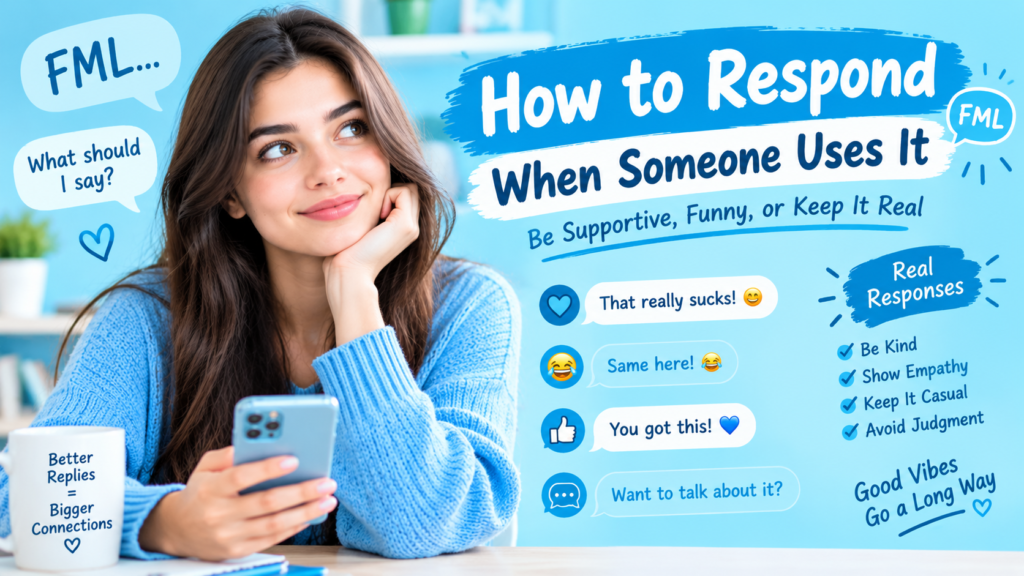
The right reply depends on your relationship and the situation.
Casual Replies
“Oof, that’s rough.” “Lol classic.”
These work well for everyday mishaps where humor is clearly welcome and no real support is being requested.
Funny Replies
“Big FML energy today, huh?” “Screenshot this for the FML hall of fame.”
Playful responses like these match the joking tone most FML texts carry, keeping the exchange light and friendly.
Mature Replies
“That sounds frustrating, are you okay?” “Want to talk about it or just vent?”
These responses work best when the situation feels slightly more serious, giving the sender space to share more if they want to.
Respectful Replies
“I hear that’s genuinely annoying.” “Let me know if there’s anything I can do.”
A respectful reply acknowledges the frustration without dismissing it, which is especially useful with coworkers or acquaintances rather than close friends.
Regional & Cultural Usage
Slang doesn’t spread evenly, and FML’s popularity varies by region and culture.
Western Culture
FML is deeply embedded in US, UK, Canadian, and Australian internet slang, often used lightly among peers.
It has become such a normalized part of everyday texting in these regions that most younger users barely register it as a curse word anymore.
Asian Culture
In many Asian countries, FML is popular among younger, English-fluent social media users, though it’s typically reserved for online spaces rather than everyday speech.
Because English slang often carries a different weight when it’s a second language, some users treat FML as more of a stylistic flourish than a literal expression.
Middle Eastern Culture
Usage tends to skip the literal swear-word meaning and lean fully into the “bad day” shorthand, especially among younger, bilingual users active on social platforms.
This pattern mirrors how many borrowed English phrases get adapted; the original literal meaning fades while the overall tone and function remain intact.
Global Internet Usage
Because it originated online rather than in any one country, FML has spread globally through memes, captions, and comment sections rather than spoken language.
Its digital-first origin explains why it feels almost universally recognizable online, even in communities where English isn’t the primary spoken language.
Generational Differences
Gen Z and younger millennials use FML the most casually and frequently. Older generations may recognize it but rarely use it themselves, and some find the underlying language off-putting.
This generational gap is one reason the phrase works so well in peer group chats but feels out of place in messages meant for parents or older relatives.
Is It Safe for Kids?

FML technically stands for a curse word, so many parents prefer kids to avoid it in writing, even though the intended meaning is rarely serious.
Because the acronym is so common online, many kids encounter it long before understanding its literal meaning, which is part of why some parents choose to address it directly rather than ignore it.
Understanding the Context
Ultimately, FML’s meaning bends around the context of who’s saying it, where, and why more than the three letters themselves.
Reading the relationship between sender and recipient, the platform being used, and the tone of surrounding messages will almost always tell you more than the acronym alone.
Conclusion
FML has grown from a niche internet acronym into one of the most recognizable pieces of digital slang. Most of the time, it’s harmless, a fast, expressive way to vent about a bad moment without writing an essay.
But like any slang, tone and setting matter: what works in a friend’s group chat can land very differently in a professional email or a genuinely difficult conversation. Reading context carefully helps avoid sounding careless when someone actually needs support.
Understanding when and when not to use FML helps you communicate clearly while staying fluent in the language of modern texting, without accidentally sending the wrong message at the wrong moment.

Hi, I’m Munaza, the creator of RTMeaning.com. I’m passionate about explaining internet slang, abbreviations, texting terms, and modern language in a simple and easy-to-understand way. Through this website, I help readers discover the meanings behind trending words, social media expressions, and online communication. My goal is to make learning new terms quick, clear, and enjoyable for everyone.