

You open a chat and see a message that says “what tf is this?” You get the mood, but you’re not completely sure of the exact meaning. It feels rude, funny, or maybe both at the same time.
You’re not alone. TF is one of the most common abbreviations in texting, gaming chats, and social media comments. It is short and punchy, and people use it dozens of times a day without a second thought.
This guide explains the meaning of TF in chat and where it comes from. You will also see how people really use it, how to reply to it, and when it is better to skip it completely.
What Does TF Mean in Text?
TF stands for “the f***.” It is an internet slang abbreviation that adds emphasis, shock, or annoyance to a sentence. Most people type it without thinking about the full words behind it.
It almost never stands alone. People attach it to question words, which gives the question extra force. Here are the most common pairings:
- What TF – “What the f***?”
- Why TF – “Why the f***?”
- How TF – “How the f***?”
- Who TF – “Who the f***?”
- Where TF – “Where the f***?”
Think of it as a volume knob for your message. “What is this?” is a plain question. “What TF is this?” tells the reader you are surprised, confused, or irritated.
Quick definition: TF is a texting abbreviation for “the f***,” used to show surprise, confusion, frustration, or strong emphasis.
The word “the” is what makes it flexible. It slides into almost any question without changing the grammar. That is why the abbreviation spread so quickly across every platform.
The Most Common Meanings of TF

The core meaning stays the same, but the feeling behind it shifts with context. Here are the four main ways people use it.
1. “The F***” (Shock or Confusion)
This is the default meaning. Someone sees something unexpected and reacts on the spot. The reaction is fast, honest, and usually short.
Friend: I just found out my landlord sold the building.
You: TF?? when did that happen
Here, TF signals shock. It is not an attack. It is a reaction to the news, not to the person who shared it.
2. Strong Emphasis
Sometimes TF does not express a big emotion. It simply adds weight to a sentence. The speaker wants the message to feel more urgent.
“Where TF did I put my keys?”
Nobody is angry at the keys. The speaker is stressed or in a hurry, and TF makes that clear in just two letters.
3. Reaction to Something Weird
People use TF when something looks strange, random, or hard to explain. It works like a verbal shrug mixed with a raised eyebrow.
“Why is there a shopping cart on the roof? Like what TF.”
The tone here is more “I can’t make sense of this” than “I’m upset.” The sender is curious and amused, not angry.
4. Funny or Dramatic Reaction
In group chats and comment sections, TF is often played for laughs. Add an emoji, a lowercase style, or a dramatic pause, and the meaning turns playful.
“tf 😭😭 I can’t believe you ate that”
Here it is exaggeration, not aggression. The crying emoji tells the reader that the sender is laughing, not fighting.
Rare Alternate Meanings
Outside of chat slang, TF can mean other things. You will seldom see these in a casual text. They mostly appear in specific fields or communities.
| Meaning | Where You’ll See It |
| Team Fortress | Gaming communities |
| Task Force | Business, government, military |
| Too Funny | Occasional informal slang |
| Transfer Function | Engineering and science |
| Teaching Fellow | Universities |
If the message is casual and emotional, it is almost certainly “the f***.” The other meanings need a very specific setting to make sense.
Also Read This Meaning SMH Meaning in Text
How TF Is Used in Real Conversations

The word does not change, but the vibe does. It depends on who you are talking to and where you are talking. Here is how it plays out on each platform.
Friends & Casual Texting
This is where TF feels most at home. Close friends use it to react, vent, and joke. There is little risk because everyone knows the tone.
“Bro, TF is that outfit 😂”
“Why TF is it so cold today”
“Nah TF, that can’t be true”
Between friends, it is usually background noise rather than a red flag. Nobody stops to analyze it.
Instagram & Snapchat
On Instagram comments, replies, and Snapchat chats, TF works as a quick reaction to photos, stories, and memes. People type it in seconds and move on.
“tf is this filter 💀”
“Wait, who TF is that behind you?”
Short, lowercase, and emoji-heavy is the standard style here. The skull emoji usually means “this is so funny.”
Dating Apps
TF can show up on dating apps, but it is riskier. With someone you have just matched with, it can read as playful or as harsh. The phrasing makes all the difference.
Playful: “You’ve been to 12 countries? TF, that’s amazing 😍”
Risky: “Why TF did you take so long to reply?”
The second one sounds like an accusation. If you barely know the person, choose softer wording.
Gaming & Online Communities
Discord servers, game chats, and live streams use TF constantly. Players react to glitches, lag, bad plays, and wild moments. The pace is fast, so short slang wins.
“TF just happened to my character”
“How TF did he hit that shot?”
Some gaming spaces also use “TF” for Team Fortress, but the surrounding words usually make it obvious.
Work or Professional Chat
Skip it. Even in a relaxed Slack channel, “TF” can come across as unprofessional. If you are tempted to use it, rephrase the message instead.
| Instead of | Try |
| “What TF happened here?” | “Can someone explain what happened here?” |
| “Why TF is this late?” | “Do we know why this is delayed?” |
Is TF Rude, Flirty, or Offensive?
The honest answer is none of the above, and all of the above. The tone depends on context, relationship, and delivery. The same two letters can mean very different things.
When It Feels Neutral
When you are reacting to a situation rather than a person, it is mostly neutral. Nobody is being blamed. The message just shows that something is surprising or annoying.
“What TF is going on with the traffic?”
When It Feels Funny
With friends, emojis, and exaggeration, TF becomes a joke. The playful setup removes any sting. Everyone in the chat understands that it is all in fun.
“tf, you’re literally so dramatic 😂”
When It Feels Rude
Aimed at someone in a tense moment, it lands hard. The reader feels attacked rather than informed. The same slang that was harmless in a joke now sounds like a threat.
“Who TF do you think you are?”
That is a confrontation, not a reaction.
When It Feels Slightly Offensive
Some people dislike any form of profanity, even abbreviated. Older relatives, religious contacts, teachers, and clients may not appreciate it. The letters are short, but everyone knows what they stand for.
Quick Tone Guide
| Situation | How TF Reads |
| Reacting to a random event | Neutral |
| Joking with close friends | Funny |
| Directed at a person during an argument | Rude |
| Sent to a boss, client, or elder | Inappropriate |
How to Respond When Someone Says TF
Your reply should match the mood of the sender. A joke needs a joke back, and a serious question needs a clear answer. Here is how to handle each type.
Casual Replies
“Right? I couldn’t believe it either.”
“I know, it’s wild.”
“Exactly what I thought.”
Funny Replies
“Same reaction here 😂”
“Wait until you hear the rest.”
“I don’t have answers, I just work here.”
Neutral Replies
“Let me explain.”
“Sorry, what part is confusing?”
“It’s a long story, but here’s the short version.”
Professional Replies
If a coworker sends you a TF message and you want to keep things calm, stay steady and clear.
“Happy to clarify. Which part should I go over?”
“Let me look into it and get back to you.”
Stay polite and do not mirror the slang. A calm reply helps the other person cool down.
Common Misunderstandings About TF
A few myths trip people up. Clearing them away makes it easier to read messages correctly.
Thinking It Always Means Anger
It does not. TF can show excitement, disbelief, confusion, or humor. “TF, you got the job?!” is a happy message.
Confusing It With “WTF”
They are related but not identical. WTF is a complete phrase (“what the f***”). TF is usually a piece of a bigger sentence. We will compare them in a moment.
Assuming It Is Always Rude
Tone depends on the sender, the audience, and the emoji. Friends use it constantly with no ill will. Judge the message by its context, not by the letters alone.
Reading Too Much Into It
A two-letter reaction rarely carries a hidden agenda. If you are unsure, look at the rest of the message, the punctuation, and how that person normally texts. Or just ask.
TF vs. WTF: What’s the Difference?
Many people mix up these two abbreviations. They share the same roots, but they behave differently in a sentence.
| Feature | TF | WTF |
| Stands for | The f*** | What the f*** |
| Structure | Usually inside a sentence | Usually a standalone reaction |
| Intensity | Slightly softer | Slightly stronger |
| Example | “Where TF are you?” | “WTF, are you serious?” |
| Flexibility | Pairs with who, why, how, where | Mostly used alone or at the start |
WTF is louder and more direct. TF is smoother and blends into sentences.
Similar Slang Terms You Should Know
If you want to express the same feeling in a milder or different way, here are some alternatives. Each one carries a slightly different tone.
| Slang | Meaning | Tone |
| WTF | What the f*** | Strong |
| WTH | What the heck | Mild |
| OMG | Oh my god | Light, excited |
| SMH | Shaking my head | Disappointed |
| BRUH | Expression of disbelief | Casual, comedic |
| FR | For real | Agreement or emphasis |
| TBH | To be honest | Candid |
| IDK | I don’t know | Neutral |
WTH is the safest swap when you are not sure how your audience will react. It keeps the emotion but drops the profanity.
When You Should Avoid Using TF
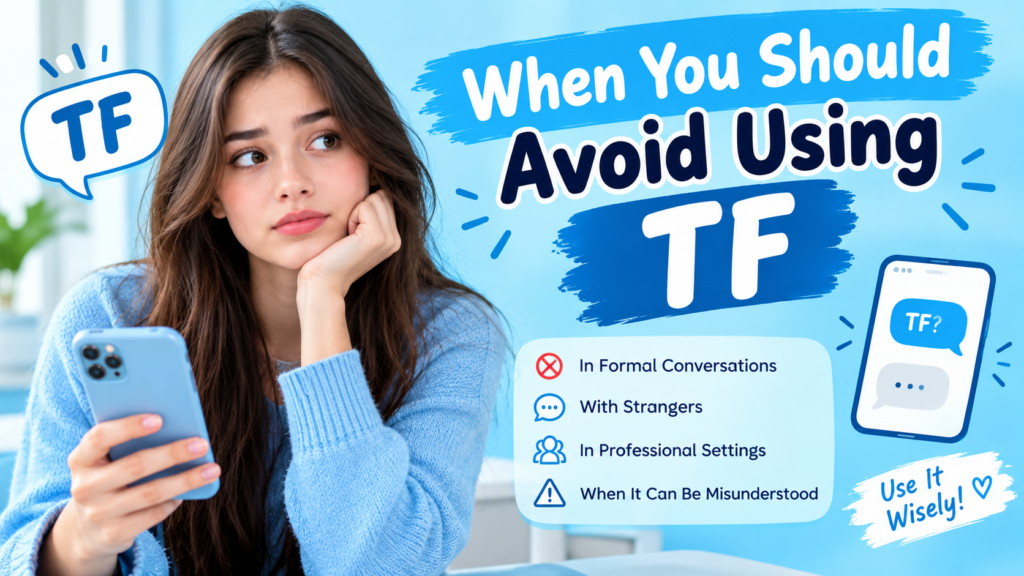
Knowing the meaning is only half the skill. Knowing when to hold back matters just as much. Three situations deserve extra care.
Professional Settings
Emails, client chats, job applications, and team messages with senior staff are all off-limits. Written words stick around, and profanity, even abbreviated, can damage your credibility.
Cross-Cultural Conversations
Slang travels unevenly. What feels casual in one country or age group can feel disrespectful in another. If you are chatting with someone from a different background, or someone who speaks English as a second language, use clear, plain words.
Sensitive Situations
Avoid TF when someone is grieving, anxious, or dealing with bad news. A sharp reaction can come across as dismissive or aggressive, even if you meant it as support.
Conclusion
TF is short for “the f***.” People use it to show surprise, confusion, frustration, or plain emphasis. The exact feeling always comes from context, so the two letters alone never tell the full story.
Among friends, in gaming chats, and in comment sections, it is normal and often funny. With coworkers, elders, or in emotional moments, it is better to leave it out. A milder option like WTH is always available.
The next time you see TF in a message, check the tone, the person, and the platform before you react. If you are unsure, a simple “wait, what do you mean?” clears things up fast. That small step protects both the message and the friendship.

Hi, I’m Munaza, the creator of RTMeaning.com. I’m passionate about explaining internet slang, abbreviations, texting terms, and modern language in a simple and easy-to-understand way. Through this website, I help readers discover the meanings behind trending words, social media expressions, and online communication. My goal is to make learning new terms quick, clear, and enjoyable for everyone.