

Someone just called you “chula,” and now you are staring at your screen. Was that a compliment? A flirt? A joke at your expense?
Good news: in most cases, it is a compliment. Chula is a Spanish slang word that means “cute,” “pretty,” or “beautiful,” and people often use it as a pet name for a woman or girl. But the word has a few twists. The tone, the speaker, and even the country can change how it lands.
This guide breaks it all down in plain English. You will learn the exact meaning, where the word comes from, how people use it in texts and real chats, and how to reply without making things awkward. You will also see when to use it yourself and when to skip it.
Let’s start with the basics.
What Does Chula Mean?
Quick answer: Chula (pronounced CHOO-lah) is a Spanish slang word meaning “cute,” “pretty,” “lovely,” or “cool.” It is the feminine form of chulo. People use it to describe a girl or woman, or as an affectionate nickname, much like “cutie,” “beautiful,” or “sweetheart” in English.
Here is the short version in a list:
- Literal feel: pretty, cute, lovely
- Used as a nickname: “hey, chula” = “hey, beautiful”
- Used for things: qué chula can describe a nice dress, a car, or a house
- Typical tone: warm, friendly, sometimes flirty
- Gender: chula is feminine; chulo is masculine
The word is informal. You will hear it in casual talk, songs, and social media captions. You will almost never see it in a business email or a legal document.
Chula Slang Meaning Explained
Slang words rarely mean just one thing, and chula is no different. At its heart, the word carries a feeling of charm and admiration. It says, “I like how you look” or “I like your vibe.”
Think of it as a step above plain “nice” and a step below a very strong compliment. It is casual and cheerful. It also sounds a bit playful, which is why people use it with friends, family, and partners.
The Core Ideas Behind Chula
Most uses of chula fall into one of these buckets:
- Beauty or cuteness. “Qué chula te ves hoy” means “You look so pretty today.”
- Affection. A boyfriend, a mom, or a best friend might say “mi chula” to mean “my darling.”
- Coolness. Something can be chula if it is stylish, fun, or well made.
- Playful confidence. In some regions, the word hints at someone who is bold or a little showy.
Chula vs. Chulo
The two words are twins. Spanish changes word endings based on gender, so the ending tells you who or what is being described.
| Word | Gender | Basic meaning | Example |
| Chula | Feminine | Pretty, cute, cool | Qué chula está tu casa. (Your house is so nice.) |
| Chulo | Masculine | Handsome, cute, cool | Qué chulo tu carro. (Your car is cool.) |
| Chulita | Feminine, diminutive | Extra cute, little cutie | Hola, chulita. (Hi, cutie.) |
| Chulito | Masculine, diminutive | Little cutie | Mi chulito. (My little cutie.) |
Adding -ita or -ito makes the word softer and sweeter. It is the Spanish way of saying “little” as a sign of love.
What Does Chula Mean in English?
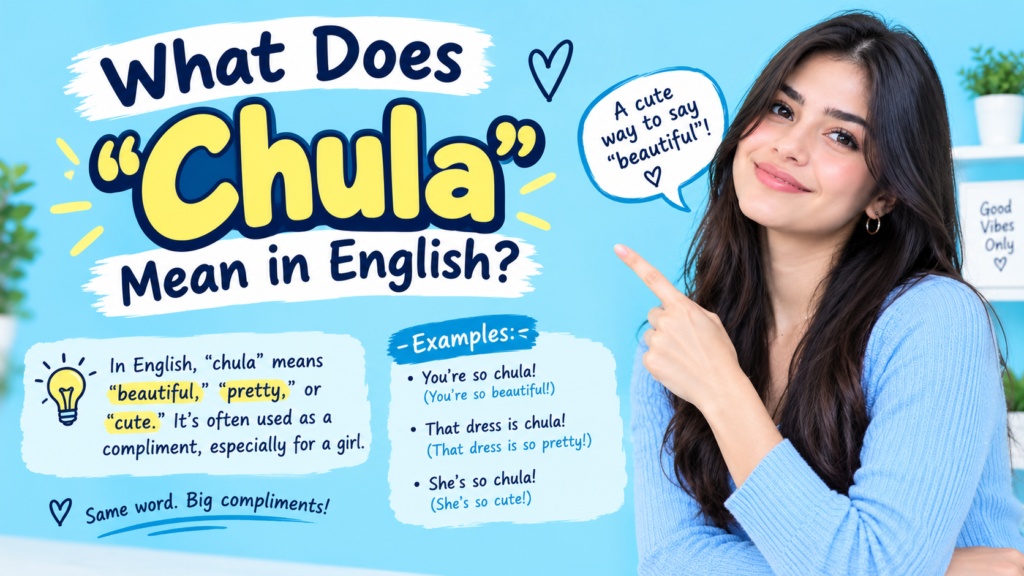
If you want a one-word translation, there isn’t a perfect one. English does not have a single word that covers all the shades. The best match depends on how the word is used.
| How it’s used | Closest English meaning |
| “Hola, chula” | Hey, beautiful / hey, cutie |
| “Mi chula” | My darling / my love |
| “Qué chula” (about a person) | How pretty / how cute |
| “Qué chula” (about an object) | How cool / how nice |
| “Eres muy chula” | You are really sweet / lovely |
| “Mami chula” | Hottie / gorgeous (more flirty) |
So when someone asks, “what does chula mean in English,” the safest answer is “cute, pretty, or beautiful,” often used as a pet name.
One thing to remember: because English speakers have borrowed the word from Spanish, it often shows up in mixed-language chats. A person might type an entire sentence in English and drop “chula” at the end like a nickname. That is normal and very common, especially in bilingual communities in the United States.
Does Chula Have Different Meanings?
Yes. This is where many people get confused. Spanish is spoken in more than twenty countries, and each place has its own slang flavor. Chula is mostly positive, but a few regions give it a different spin.
Regional Meanings at a Glance
| Region | Typical meaning of chula / chulo | Tone |
| Mexico | Pretty, cute, nice, cool | Positive, very common |
| Central America | Pretty, cute, affectionate nickname | Positive |
| Caribbean (e.g., Puerto Rico, Dominican Republic, Cuba) | Cute, attractive; chulo can also mean a flashy or cocky man | Mostly positive, sometimes cheeky |
| Spain | Cheeky, cocky, showy, or someone with attitude; can sound rude depending on context | Mixed, can be negative |
| Venezuela | Can describe someone who takes advantage of others | Often negative |
| Chile | Can be vulgar slang, so it may be avoided | Risky |
| Argentina / Spain (masculine chulo) | Can mean “pimp” | Negative |
That last point matters. The masculine word chulo has a rougher side in some countries. The feminine chula, on the other hand, tends to stay on the sweet side in Mexico and much of Latin America.
Positive vs. Negative Uses
Positive uses (the most common):
- Complimenting how someone looks
- Calling a loved one by a sweet nickname
- Praising something stylish or fun
Negative uses (less common, and region-specific):
- Describing someone as arrogant or cocky
- Hinting that a person is showy or cheap-looking
- Calling someone a freeloader (in a few areas)
The takeaway is simple. If you hear the word in a U.S. text or a Mexican family setting, it is nearly always kind. If you hear it in Spain or Venezuela, pay closer attention to tone and context.
Also Read This Meaning GRWM Meaning
How Context Changes the Chula Meaning
The same word can feel sweet in one chat and sharp in another. Context is everything. Here are the main clues to watch.
1. Who Is Saying It?
- A family member or close friend: almost always affectionate
- A partner: loving, maybe flirty
- A stranger on the street: can be flattering or unwelcome, depending on delivery
- A coworker: usually a bit too casual unless you two are close
2. How Is It Said?
Tone shapes meaning. A soft “hola, chula” in a warm voice feels sweet. The same word shouted from a passing car feels very different.
3. What Words Come With It?
Pairings change the feel:
- Mi chula → tender, “my darling”
- Chula bonita → very sweet, “pretty girl”
- Mami chula → flirtier, more physical
- Qué chula eres → compliment, “how lovely you are”
- Ay, chula → can be playful or can be a mild scolding, depending on voice
4. Where Are You?
Place matters. A word that sounds cute at a family barbecue in Texas may sound odd in a formal meeting in Madrid. When in doubt, look at the setting.
Chula Meaning in Text and on Social Media
Online, chula is everywhere. You will see it in comment sections, birthday posts, couple photos, and captions.
Common Ways It Appears
- Photo comments: “Hola chula 😍” under a friend’s selfie
- Birthday wishes: “Happy birthday, chula! Love you so much.”
- Couple posts: “My chula forever ❤️”
- Captions: “Chula vibes only”
- Group chats: “Where are you, chula?”
Emojis often tell you the mood. Hearts, sparkles, and smiley faces point to affection. A smirk or flame emoji can suggest flirting.
What It Means When Someone Texts “Chula”
If someone texts you the word out of the blue, here is a quick guide:
| What you see | Likely meaning |
| “Hey chula 😊” | Friendly greeting |
| “Hey chula 😍🔥” | Flirty compliment |
| “Gracias, chula ❤️” | Warm thanks, close bond |
| “Ya, chula…” (no emoji) | Could be playful or slightly impatient |
| “Chula” alone, no context | Probably a nickname; check the history of your chats |
Is It Used on TikTok and Instagram?
Yes. Creators with Latino roots often use it as part of their everyday language. Fans borrow it, too. It has also become a brand and business name for shops, cafés, and accessories that want a warm, Latin-inspired feel.
Real Conversation Examples
Reading about a word is helpful, but seeing it in action is better. Here are three short chats that show how chula can sound in different moods.
Example 1: Friends
Context: Two close friends are planning a night out.
Ana: Are you ready yet? The taxi is almost here.
Mia: Almost! Just fixing my hair.
Ana: Okay, chula. You always look good anyway 😂
Mia: Stop it, you’re too sweet. Two minutes!
What it means here: Pure friendship. “Chula” works like “girl” or “babe” in English. There is nothing romantic about it.
Example 2: Dating Conversation
Context: Two people who have been dating for a few weeks.
Luis: Good morning, chula. Did you sleep okay?
Sofia: Good morning! Yes, I did. Thanks for checking 😊
Luis: Wanted to say you looked beautiful last night.
Sofia: Aww, you’re cute too. Dinner again this weekend?
What it means here: A soft, affectionate pet name. It shows interest and warmth without being over the top.
Example 3: Argument
Context: A tense chat where one person is annoyed.
Diego: You said you would call me back.
Camila: I was busy at work, I told you that.
Diego: Ya, chula, I get it. But you always say that.
Camila: Don’t “chula” me when you’re mad.
What it means here: In a fight, the nickname can sound sarcastic or patronizing. Camila hears it as a way to talk down to her. Same word, very different feeling.
What These Examples Teach Us
- Friendly chats make chula feel warm.
- Romantic chats make it feel affectionate.
- Arguments can twist it into something condescending.
Is Chula Rude?
Short answer: No, chula is not rude by default. In most Latin American settings, it is a kind word.
That said, it can feel rude in a few situations:
- From a stranger: If someone you don’t know calls you “chula” on the street, it may feel too familiar or invasive.
- At work: Using it with a colleague can sound unprofessional, even if you mean well.
- With a mocking tone: If someone says it with a sneer, the word loses its kindness.
- In places where it has a negative sense: In parts of Spain or Chile, the word may carry rough or cheeky tones.
- When it replaces a name: Some people dislike pet names from people they barely know.
How to Tell If It’s Meant Kindly
Ask yourself:
- Do I know this person well?
- Is their tone friendly?
- Are they smiling or joking?
- Have they used pet names with me before?
If the answers are mostly yes, relax. It is almost surely a compliment.
If you feel uncomfortable, you can say so. A calm line like “I’d rather you use my name” is perfectly fine.
Is Chula Flirty?
It can be, but it does not have to be. Chula lives in the gray area between friendly and flirty. The mood depends on who says it and how.
Signs It’s Flirty
- It comes with winks, heart eyes, or fire emojis
- The person adds words like mami or bonita
- The compliment is about your looks only
- They use it late at night or in private chats
- They keep the conversation focused on you
Signs It’s Just Friendly
- It is used in group chats
- The sender calls everyone the same thing
- The tone is cheerful, not intense
- It shows up with a plain greeting like “Hola, chula, how’s your day?”
The “Mami Chula” Factor
Add the word mami and the feel changes. Mami chula is closer to “hot mama” or “gorgeous.” It is usually more physical and more flirtatious. Some women like it. Others find it too forward, especially if it comes from a stranger.
The male counterpart is papi chulo, which suggests a good-looking, confident guy.
| Phrase | Vibe |
| Chula | Sweet, light, often friendly |
| Mi chula | Loving, close |
| Chula bonita | Sweet and complimentary |
| Mami chula | Flirty, physical |
| Papi chulo | Flirty, confident man |
How to Reply to Chula
What you say back depends on how you feel and how well you know the person. Here are options for every mood.
Friendly Replies
Use these when it’s a friend or family member.
- “Thanks, that’s so sweet!”
- “Aww, you’re too kind.”
- “Hey, you! How are you?”
- “Gracias, you made my day.”
- “Love you too, chula!”
Funny Replies
Great for keeping things light.
- “Careful, my ego is already big enough 😂”
- “Chula? I prefer ‘your majesty,’ but okay.”
- “You only say that when you need something.”
- “Say it again, I want to record it.”
- “Okay, now I have to live up to it.”
Flirty Replies
Use these only if you want to flirt back.
- “You’re not so bad yourself.”
- “Keep talking, I’m listening 😉”
- “Is that your best line?”
- “Careful, I might get used to it.”
- “Say it in Spanish again.”
Polite Boundary Replies
If you don’t like the nickname, you can say:
- “I appreciate it, but I prefer my name.”
- “Let’s keep things friendly, okay?”
- “That’s a bit too familiar for me.”
Quick Reply Chooser
| Your goal | Best reply type |
| Be kind and neutral | Friendly |
| Lighten the mood | Funny |
| Show interest | Flirty |
| Set a limit | Polite boundary |
When to Use Chula
Using the word well shows warmth and cultural awareness. It works best in the right moments.
Good Times to Use It
- With close friends, especially bilingual ones
- With a partner as a pet name
- With family, if that is your family style
- In birthday or anniversary messages
- When praising something stylish, such as “Qué chula tu bolsa”
- In casual Spanish or Spanglish chats where everyone is relaxed
Simple Examples You Can Borrow
- “Happy birthday, chula! I’m so glad you’re in my life.”
- “Qué chula se ve tu casa nueva.”
- “Gracias por todo, mi chula.”
- “Hola, chula, ¿cómo amaneciste?”
A Quick Rule of Thumb
If you would call the person “babe,” “cutie,” or “sweetheart” in English, chula usually fits.
When to Avoid Chula
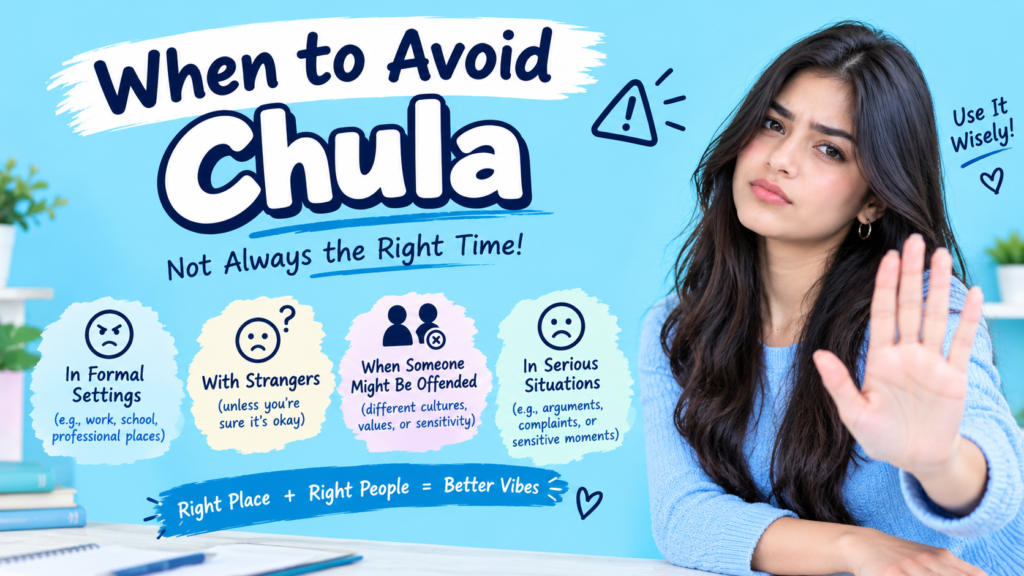
Some situations call for a different word. Skip chula when:
- You don’t know the person well: Familiarity has to be earned.
- You are at work or school: Keep things professional.
- The person has said they dislike nicknames: Respect their wishes.
- You are in a formal setting: Weddings with older relatives may be an exception, but use judgment.
- You are unsure about regional meaning: If you are in Spain, Chile, or Venezuela and don’t know the local sense, ask first.
- You are angry: The word can sound mocking.
- You are messaging someone much older or younger: in a way that may feel off.
A Note on Respect
Even a sweet word can feel pushy if it is used too often or too soon. A compliment is nice. A compliment that ignores someone’s comfort is not.
Common Mistakes With Chula
Learners and curious English speakers trip over the same few things. Here are the main ones.
1. Using the Wrong Gender
Chula is for female subjects. Chulo is for male. Mixing them up is a quick giveaway that you are guessing.
- ✅ “Qué chula está María.”
- ❌ “Qué chulo está María.”
2. Assuming It Means the Same Everywhere
As the table earlier showed, the word shifts by region. What is sweet in Mexico can be cheeky in Spain.
3. Mispronouncing It
Say it CHOO-lah, not “shoe-la” or “chew-la.” The ch sounds like the ch in “cheese.”
4. Using It With Strangers
Calling someone you just met “chula” may come across as overfamiliar.
5. Confusing It With Similar Words
Some people mix it up with the name of the city Chula Vista in California. That place name means “pretty view” in Spanish, so the idea of “pretty” is actually baked in. It has nothing to do with being rude, but it shows the same root.
6. Overusing It
If every sentence ends in “chula,” the word loses charm and starts to feel like filler.
7. Ignoring Tone
Even good words can sound bad with the wrong voice. Check your tone before you hit send.
Quick Mistake Checker
| Mistake | Fix |
| Wrong gender | Use chula for females, chulo for males |
| Using it everywhere | Match it to the place and person |
| Skipping context | Read the room first |
| Overusing | Mix in other words |
| Poor pronunciation | Practice “CHOO-lah” |
Similar Slang Terms
Chula has plenty of cousins. Some are just as sweet, and some have their own twist.
| Term | Language | Meaning | Compared to chula |
| Bonita | Spanish | Pretty | More classic and polite |
| Linda | Spanish | Pretty, lovely | Gentle and common; a bit softer |
| Guapa | Spanish | Good-looking | More about looks; common in Spain |
| Hermosa | Spanish | Beautiful | More formal and poetic |
| Preciosa | Spanish | Precious, gorgeous | Warm and tender |
| Mami | Spanish | Mom; also a term for an attractive woman or close female friend | Often flirty or affectionate |
| Mamacita | Spanish | Hot woman, often flirty | Stronger and more physical |
| Cutie | English | Cute person | Closest English match |
| Babe / Babes | English | Affectionate nickname | Similar warm tone |
| Queen | English | Respected, admired woman | More about confidence and power |
| Gorgeous | English | Very beautiful | Stronger compliment |
Which One Should You Pick?
- Want something safe and sweet? Try Linda or Bonita.
- Want something casual and fun? Chula fits.
- Want something serious and romantic? Hermosa or preciosa might do better.
- Want something that cannot be misread? Use the person’s name and a plain compliment.
Origin and Usage
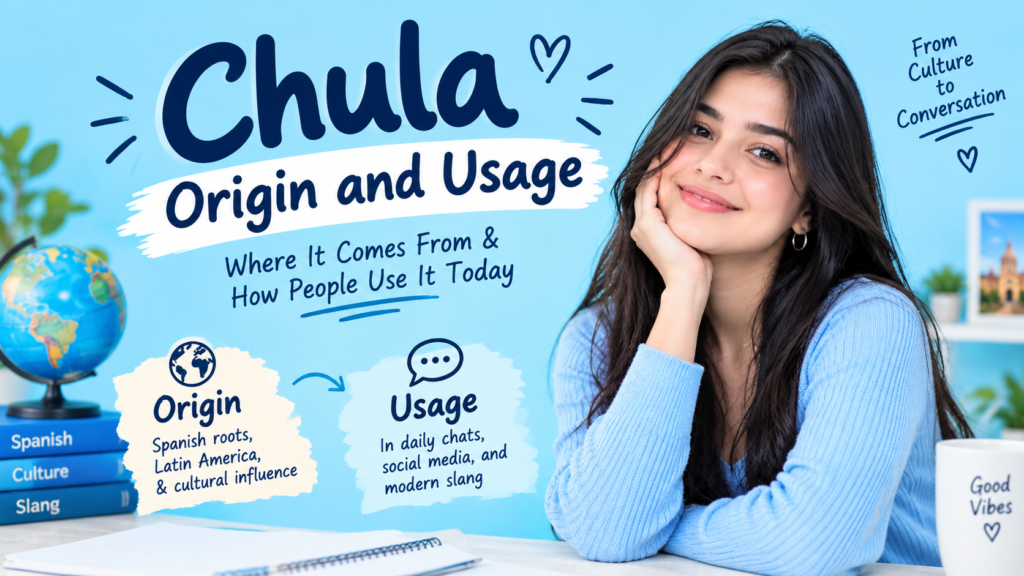
Where does chula come from? The honest answer is that language historians still debate the exact roots of chulo and chula. What we do know is the story of how the words traveled and changed.
Early Roots in Spain
The words chulo and chula were associated with working-class people in Madrid. In the 18th and 19th centuries, the chulos and chulapas were known for lively street culture, sharp clothes, quick wit, and plenty of attitude. They were proud city folk with a swagger.
That history explains why, in Spain, the word still carries a bit of cheekiness. A chulo can be a confident, showy man. A chula can be a woman with spirit. Over time, the meaning moved in different directions.
Even today, Madrid celebrates this heritage in festivals where people wear traditional chulapo and chulapa outfits. The tone there is playful and proud, not insulting.
The Journey to Latin America
As Spanish spread across the Americas, the words took on local colors. In Mexico and Central America, chula drifted toward “pretty,” “cute,” and “nice.” In the Caribbean, chulo and chula kept some of that flashy, confident feel while also becoming terms of attraction.
This is a normal pattern in language. A word crosses an ocean, meets new speakers, and picks up fresh meanings.
How the Word Entered English
Chula reached many English speakers through three main paths:
- Bilingual families and communities: in the United States, where Spanish and English blend daily
- Music: especially Latin pop and hip-hop, where phrases like mami chula showed up in lyrics
- Social media: where short, catchy words spread fast
Today, many English speakers know it as a cute nickname, even if they don’t speak Spanish.
Place Names and Brands
You may have seen the word in place names like Chula Vista, a city in California. The name is Spanish and refers to a “pretty view.” You will also spot it in restaurant names, boutiques, and product lines that want a warm, friendly Latin feel.
Usage Today
| Setting | How chula is used |
| Family homes | Affectionate nickname for girls and women |
| Friend groups | Casual compliment or greeting |
| Romantic relationships | Sweet pet name |
| Social media | Comments, captions, hashtags |
| Music | Lyrics about attraction and love |
| Business | Brand and shop names |
Tips to Use Chula Naturally

You don’t have to be fluent to use the word well. A few habits make it sound natural.
- Listen first. Notice how your friends or family use it.
- Match the tone. Warm voice, warm words.
- Start with a simple phrase. “Hola, chula” or “Qué chula” is plenty.
- Add a smile. In text, an emoji can help.
- Respect the response. If the person looks uneasy, stop using it.
- Learn a few siblings. Words like linda, bonita, and preciosa give you variety.
Mini Phrase Bank
| Spanish | English |
| Hola, chula | Hi, beautiful |
| Qué chula eres | How lovely you are |
| Mi chula | My darling |
| Te ves muy chula | You look really pretty |
| Qué chula blusa | What a cute blouse |
| Gracias, chula | Thanks, sweetie |
| Feliz cumpleaños, chula | Happy birthday, beautiful |
Why the Word Is So Popular
Why does chula keep spreading? A few reasons stand out.
- It sounds good. Short, bouncy, and easy to say.
- It feels warm. People pick it for kindness.
- It fits many moods. Friend, family, or flirty.
- It is culturally rich. It links people to heritage and shared roots.
- It works in two languages. Perfect for Spanglish speakers.
For many people, using chula is about connection. It says, “I see you, and I like you.”
Final Thoughts
So, what does chula mean? In everyday life, it means “cute,” “pretty,” or “lovely,” and it is mostly used as a warm nickname for a girl or woman. It can also describe something stylish or cool.
Still, context matters. The word may sound flirty with a certain emoji, patronizing in an argument, or cheeky in parts of Spain. Reading the setting, the speaker, and the tone will tell you what you need to know.
Here is a quick summary to take with you:
- Chula is mostly positive and affectionate.
- It is feminine; the masculine form is chulo.
- It can be friendly or flirty, depending on tone.
- It can be rude in rare cases, such as from strangers or in certain regions.
- You can reply with kind, funny, flirty, or boundary-setting responses.
- Use it with people you know, and skip it in formal settings.
The next time someone calls you chula, you will know exactly what to do. Smile, read the mood, and choose your reply. And if you want to use the word yourself, start small, stay respectful, and let your warmth do the rest.

Hi, I’m Munaza, the creator of RTMeaning.com. I’m passionate about explaining internet slang, abbreviations, texting terms, and modern language in a simple and easy-to-understand way. Through this website, I help readers discover the meanings behind trending words, social media expressions, and online communication. My goal is to make learning new terms quick, clear, and enjoyable for everyone.