

You open a message and see two letters: “SU.” No punctuation, no explanation, nothing else. Is your friend telling you to be quiet? Asking how you are? Pointing you to a link?
All three are possible. That is what makes this tiny abbreviation so confusing.
SU most commonly means “swipe up,” “shut up,” or “what’s up.” Which one applies depends on the app, the sender, and the tone of the chat. This guide breaks down every meaning, shows real conversation examples, and tells you how to reply without embarrassing yourself.
What Does “SU” Mean in Text?
Short answer: “SU” is a texting and social media abbreviation with several meanings. The three most common are:
- Swipe Up: a prompt to open a link or see more content
- Shut Up: an interjection, used jokingly or seriously
- What’s Up: a casual greeting, short for “sup”
Less often, people write it as S/U and mean “see you” or “scroll up.”
Because it is only two letters, SU depends almost completely on context. The platform and the words around it usually tell you what the sender means.
Quick Examples
| Message | Likely Meaning | Why |
| “SU 👆 new video” | Swipe up | Posted on a Story with a link |
| “SU omg you did NOT” | Shut up (playful) | Reaction to surprising news |
| “SU bro, you free?” | What’s up | Greeting at the start of a chat |
| “SU tonight!” | See you | Sign-off before meeting |
| “SU. Stop texting me.” | Shut up (serious) | Angry tone, no humor |
The Most Common Meanings of “SU”
1. SU = Swipe Up
This is the original social media meaning. On Snapchat and Instagram, creators attached links to their Stories. To tell viewers where to go, they wrote “SU” or “S/U” on the screen.
The idea is simple: swipe up on your screen to see more.
You might see it like this:
- “New merch drop, SU 👆”
- “SU to vote on my next outfit”
- “SU for the full video”
Good to know: Instagram replaced the swipe-up feature with link stickers in 2021, so the phrase is less common there now. It still appears on Snapchat, in older posts, and in creator habits that never changed. Some people also use “SU” to mean “scroll up,” such as when pointing a friend to an earlier message in a group chat.
2. SU = Shut Up
In private chats, SU often stands for “shut up.” Tone decides everything.
Playful version (very common):
“I got the job!” “SU!! Congrats!”
Here the sender is not annoyed. They are shocked and happy. It works like “no way” or “stop it.”
Serious version (less common):
“Just SU already.”
Here it is rude and meant to end the conversation.
Same letters, opposite emotions. If you are unsure, look at the emojis, punctuation, and your history with the person.
3. SU = What’s Up
Some people shorten “sup” even further to “SU.” It is a lazy, friendly greeting, often sent as the first message of the day.
- “SU, how was your weekend?”
- “SU man, long time”
This meaning is more common among younger users and close friends. It is rarely used with people you just met.
Other Meanings You May Run Into
| Meaning | Where You See It | Example |
| See you | Texts, sign-offs | “SU at 7” |
| Scroll up | Group chats, comment sections | “SU, I already answered that” |
| Su (Spanish/Turkish word) | Non-English chats | “Su casa” or “su” meaning water in Turkish |
| Student union | Campus conversations | “Meet at the SU” |
If the chat is in another language, “su” may not be slang at all. In Spanish it means “his,” “her,” or “your.” In Turkish it means “water.” Always check the language first.
Origin & Background of “SU”
SU has no single inventor or official birthday. Like most texting shorthand, it grew out of necessity. Early phone keyboards were slow, so people cut words down to initials. “Shut up” became SU, “see you” became CU or SU, and “sup” became even shorter.
The swipe-up meaning came later, when mobile apps added vertical gestures. A two-letter instruction was faster to type on a photo than a full sentence.
In other words, SU was not created once. It was reinvented by different groups at different times, which is why it has so many meanings today.
How Social Media Changed It
Social media gave SU a second life. Short-form platforms reward speed. Captions, stickers, and overlays have limited space, so abbreviations spread fast.
Three things pushed SU into everyday use:
- Mobile-first design: thumbs, not keyboards, drive most chats.
- Visual stories: text sits on top of photos, so shorter is better.
- Creator culture: influencers use calls to action like SU to drive clicks.
Instagram & Snapchat Era
Between roughly 2016 and 2021, “SU” was everywhere on Stories. Brands, bloggers, and regular users used it to send people to links. On Snapchat, swiping up on a friend’s Story can also open a private reply, so SU doubled as an invitation to message them.
Then Instagram retired the swipe-up link and Snapchat updated its tools. The abbreviation stayed, but the “shut up” and “what’s up” meanings grew more common in everyday chats.
Meme & Reaction Culture
Memes pushed the “shut up” meaning into the spotlight. Reaction posts, comment threads, and group chats made “SU” a quick way to say “that is so shocking or funny that I can’t handle it.”
You will often see it paired with:
- 😭 or 💀 emojis
- Stretched spellings like “SUUU”
- Phrases like “SU I can’t”
Real-Life Conversations Using “SU”
Seeing SU in action makes the meanings much clearer.
WhatsApp Conversation
Zara: SU? Been ages!
Ali: Haha all good, just got back from the trip
Zara: SU tell me everything
Here, the first SU means “what’s up.” The second means “so, tell me,” with a casual, excited tone.
Instagram DM Example
Mia: I’m moving to Toronto next month!
Jay: SU!!! 😭 that’s amazing
Jay is not rude. He is thrilled. This is the playful “shut up.”
TikTok Comment Section
@creator: Full recipe on my page, SU in bio 👆
@viewer: SU this looks unreal
The creator uses SU as “swipe up” (or “scroll up”), pointing to a link. The viewer uses it as “shut up,” meaning “wow.”
Text Message Example
Sam: Dinner at 8?
Priya: Yep. SU there.
Priya means “see you there.” The word “there” gives it away.
Also Read This Meaning: TMI Mean
Emotional & Psychological Meaning Behind “SU”
Why do two letters carry so much feeling?
Abbreviations let people sound relaxed. A full sentence like “I cannot believe you did that” feels formal. “SU” feels warm, fast, and a little dramatic.
Using “SU” also signals closeness. You usually only send “SU” to someone who understands your humor. It says, “we are comfortable enough to skip the formalities.”
A note on “lwk”: You may see SU next to other casual slang like “lwk.” LWK is short for “low-key” and means “kind of” or “secretly.” For example: “SU lwk I’m nervous.” Together they sound relaxed and honest.
Why People Like Using It
- Speed: two letters beat a full sentence.
- Tone: it sounds casual and friendly.
- Belonging: it signals you are part of the same online culture.
- Emotion in miniature: one abbreviation can show surprise, excitement, or teasing.
Usage of “SU” in Different Contexts
Social Media Usage
On public posts, SU is mostly used as a call to action (“swipe up”) or as a reaction in comments (“shut up, this is great”). On Snapchat, you will see it on Stories. On TikTok, it appears in captions and replies.
Friends & Relationships
Among friends, SU is usually playful. It can express disbelief, joy, or teasing.
In romantic chats, it can be flirty: “SU you’re so cute.” It can also be hurtful if the other person does not share your humor. Know your audience.
Work or Professional Settings
Avoid SU at work. It can be read as rude (“shut up”) or confusing. Choose clear alternatives:
- Instead of “SU?” write “How are you?”
- Instead of “SU” for “see you,” write “See you tomorrow.”
- Instead of “SU” for scroll up, write “Please see my earlier message.”
Casual vs Serious Tone
| Situation | Tone | Should You Use SU? |
| Chatting with a close friend | Casual | Yes |
| Commenting on a meme | Casual | Yes |
| Texting a new date | Mixed | With care |
| Messaging a teacher or boss | Formal | No |
| Arguing with someone | Tense | No, it can escalate things |
Common Misunderstandings About “SU”
People Assume It Has Only One Meaning
Many people learn one meaning, usually “shut up,” and apply it everywhere. That leads to awkward moments, like taking a friendly “SU, what’s good?” as an insult.
Tone Can Be Misread
Text strips away voice and facial expression. A playful “SU” can look harsh on a screen. Emojis, exclamation marks, and laughing reactions help, but they are not guaranteed to land.
Not Everyone Knows the Slang
Parents, coworkers, and older relatives may never have seen the abbreviation. Others may only know the swipe-up version from old Stories. If you use SU outside your usual circle, expect confusion.
When You Should NOT Use “SU”
Skip SU in these situations:
- Professional emails or work chats: It can seem rude or unclear.
- Messages to older relatives: They may not recognize it.
- Serious or emotional conversations: “Shut up” can feel dismissive.
- First messages to strangers: You do not yet know their humor.
- Customer service or public brand accounts: Clear language builds trust.
- Any time the meaning could change the situation: When in doubt, spell it out.
Comparison Table: “SU” vs Similar Slang Terms
| Slang | Meaning | Tone | Common Platform |
| SU | Swipe up / shut up / what’s up | Varies | Snapchat, texts, TikTok |
| STFU | Shut the f*** up | Strong, often rude | Texts, gaming |
| Sup | What’s up | Friendly | Texts, DMs |
| WYD | What are you doing? | Casual | Texts, Snapchat |
| TTYL | Talk to you later | Neutral | Texts |
| IYKYK | If you know, you know | Playful | Instagram, TikTok |
| CU | See you | Casual | Texts |
Key Insight
SU is softer than STFU, shorter than “sup,” and more flexible than most abbreviations. That flexibility is its strength and its biggest risk.
Variations and Types of “SU”
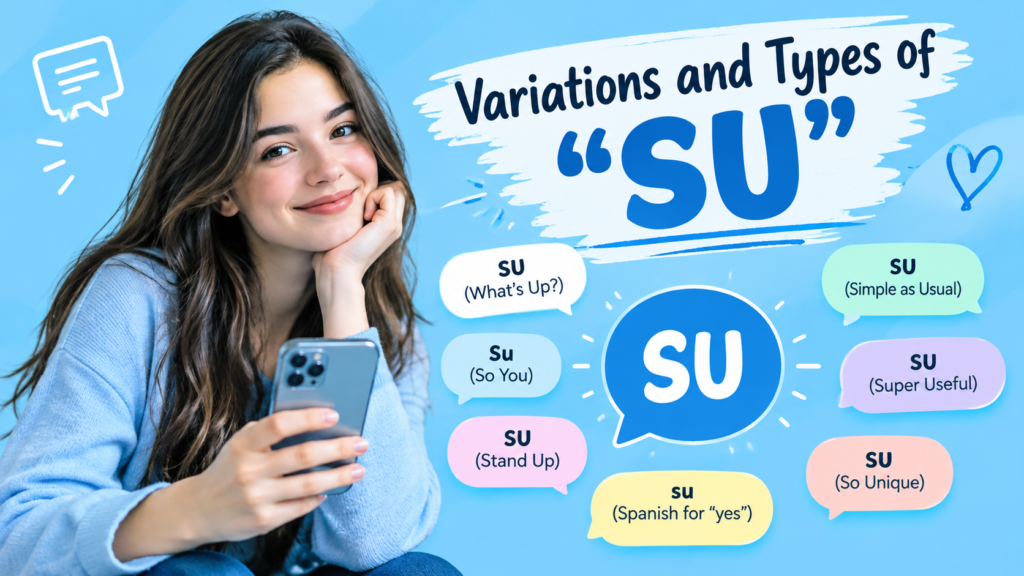
Slang rarely stays the same. Here are the most common forms of SU you will see.
1. SU
The base form. Meaning depends entirely on context.
2. SU Fr
“Shut up, for real.” Used when someone is genuinely surprised or amazed. Example: “SU fr?? You met him?”
3. SU and Watch
A prompt to swipe up and watch a video. Seen mostly on creator Stories.
4. SU Link
A direct call to action: swipe up to open the link.
5. SU Tonight?
Can mean “see you tonight?” or “what’s up tonight?” Look at the plans being discussed.
6. SU Bro
A casual greeting between friends: “what’s up, bro?”
7. SU RN
“Swipe up right now” or “shut up right now.” The tone tells you which.
8. SU Pls
Usually “swipe up, please,” but can also be a playful “shut up, please,” meaning “stop, that’s too funny.”
9. SU Nahhh
Pure disbelief. Think “no way, that can’t be true.”
10. SU I’m Dead
A reaction to something hilarious. “I’m dead” here means “I’m laughing so hard.”
How to Respond When Someone Uses “SU”
Your reply depends on how you want to come across.
Casual Replies
- “Not much, you?” (if it was “what’s up”)
- “Right?? I’m still shocked” (if it was a reaction)
- “See you then!” (if it meant “see you”)
Funny Replies
- “SU yourself 😂” (only with close friends)
- “I would, but this gossip is too good.”
- “SU back at you with extra sauce.”
Mature or Confident Replies
- “I’m not sure what you meant. Can you clarify?”
- “Glad you liked the news.”
- “Let me know if you want to talk about it.”
Respectful or Private Replies
If the “shut up” sounded rude or hurt your feelings:
- “That felt a bit sharp. Did you mean it jokingly?”
- “I’d prefer we keep it respectful.”
- Step away from the chat and respond when you are calm.
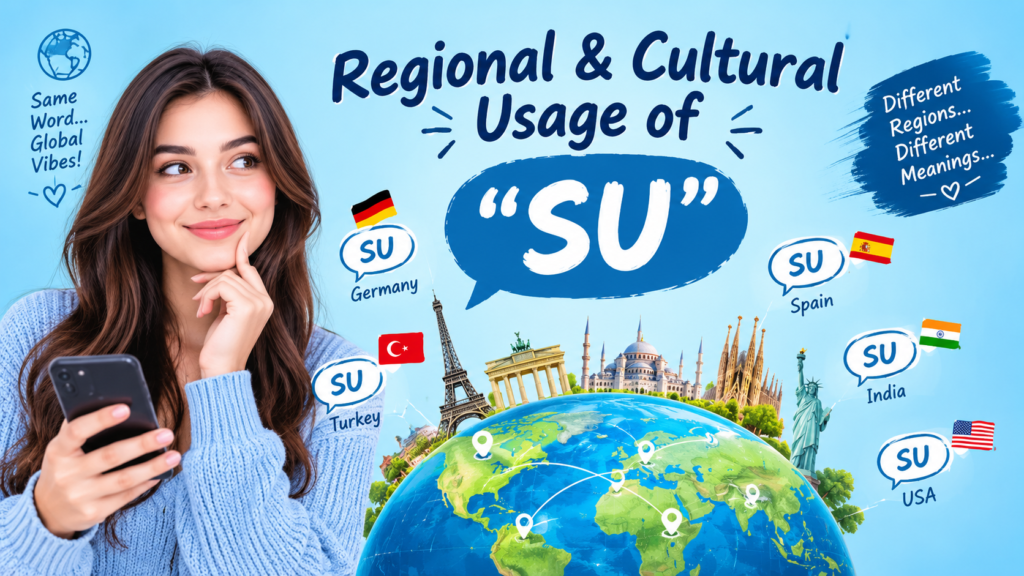
Regional & Cultural Usage of “SU”
Western Culture
In the US, UK, Canada, and Australia, “SU” shows up most often as “shut up” (playful) or “swipe up.” Younger users, especially teens and young adults, use it the most.
Asian Culture
In many Asian countries, English abbreviations mix with local languages in chats. SU may appear as “swipe up” in marketing and influencer content. In Japanese, “su” is also a syllable and a word in its own right, so check whether the chat is in English or romanized text before assuming slang.
Middle Eastern Culture
In Arabic-speaking regions, people often switch between Arabic and English in chats. SU is mostly understood as “swipe up” on Snapchat, which is hugely popular there. Because “shut up” can feel blunt in many cultures, the playful version is usually kept for close friends.
Global Internet Usage
Online, SU behaves like a global shorthand with local flavors. The “swipe up” meaning is the most universal because it comes from app features. The “shut up” and “what’s up” meanings depend more on friend groups and regions.
LWK Full Form
LWK stands for “lowkey,” a slang term used in texting and social media to mean “kind of,” “somewhat,” or “secretly.” For example, “I lwk want pizza” means you want pizza a little, or you don’t want to make a big deal of it. Its opposite is “highkey,” which means something is obvious or intense.
It became popular through online culture and Gen Z, and is mostly used casually among friends. It’s best avoided in formal writing like school or work emails.
Conclusion
So, what does SU mean in text? Most of the time, it means swipe up, shut up, or what’s up, and sometimes see you or scroll up. The right meaning depends on the platform, the people, and the tone.
Here is the simple rule: read the context, check the emojis, and when you are unsure, ask. Use SU with friends, not in professional chats, and you will avoid most mix-ups.
Slang changes quickly, but understanding context never goes out of style. Now that you know the full story behind these two letters, you can decode your next “SU” with confidence.

Hi, I’m Munaza, the creator of RTMeaning.com. I’m passionate about explaining internet slang, abbreviations, texting terms, and modern language in a simple and easy-to-understand way. Through this website, I help readers discover the meanings behind trending words, social media expressions, and online communication. My goal is to make learning new terms quick, clear, and enjoyable for everyone.