

You see the blue-and-white roundel every day. On the road, in ads, on a neighbour’s driveway. But what does BMW actually stand for?
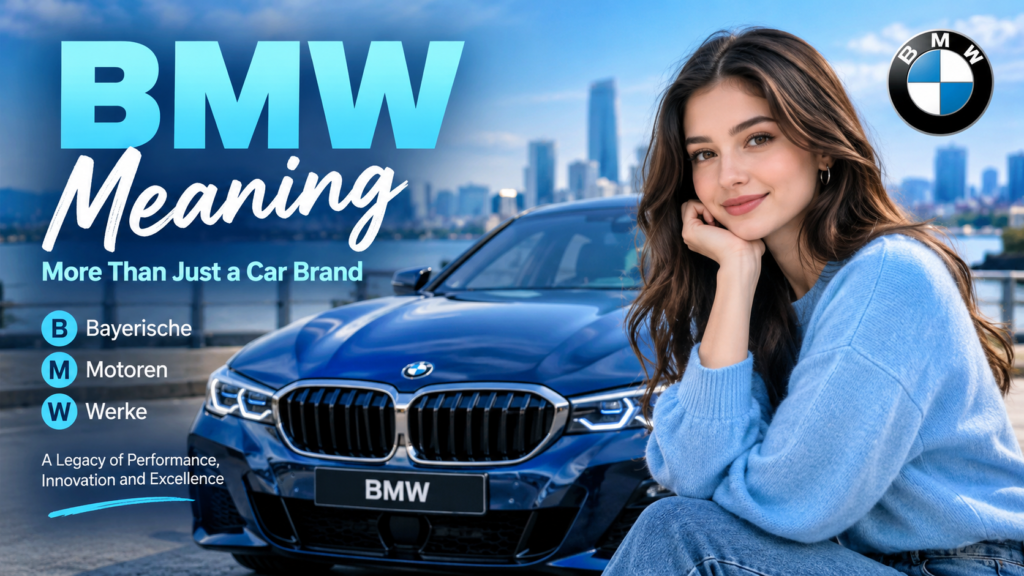
BMW stands for Bayerische Motoren Werke. In English, that means Bavarian Motor Works. It is a German name, not an English one, and it points straight to the company’s home: Bavaria, in southern Germany.
That short answer is only the start. The name carries a century of engineering, a few near-disasters, and a reputation that people now use as shorthand for status, speed, and drive. This guide covers the meaning, the history, the logo, the slang, and how the three letters are used in real life in 2026.
BMW Meaning
BMW – Quick Meaning
| Letter | German Word | English Translation |
| B | Bayerische | Bavarian |
| M | Motoren | Motors / Engines |
| W | Werke | Works / Factories |
English Translation
Bayerische Motoren Werke = Bavarian Motor Works.
“Werke” is the plural of “Werk,” which means a factory, plant, or works. So the name literally describes a place where Bavarian engines are made.
Simple Definition
BMW is a German company that builds premium cars, motorcycles, and electric vehicles. The name tells you three things: where it comes from (Bavaria), what it first made (engines), and where it makes them (works, or factories).
Quick Examples in Sentences
- “BMW stands for Bayerische Motoren Werke.”
- “Did you know BMW is German for Bavarian Motor Works?”
- “My dad has driven a BMW for twenty years and still loves it.”
- “The BMW Group also owns MINI and Rolls-Royce.”
- “In German, you say it as Beh-Em-Veh.”
Origin & Background
Historical Roots
The story does not begin with cars. It begins with engines, and with aircraft.
1913: Karl Rapp starts Rapp Motorenwerke in Munich, a small firm that builds aircraft engines.
1916: On 7 March 1916, the company was reorganised as Bayerische Flugzeug-Werke (Bavarian Aircraft Works). BMW treats this date as its founding day.
1917: The business is renamed Bayerische Motoren Werke. The name that lasted over a hundred years was born. The blue-and-white logo is registered around the same time.
During the First World War, the company’s reputation rested on its aircraft engines. One of them, designed by engineer Max Friz, became known for working well at high altitude.
Then the war ended. The Treaty of Versailles banned Germany from building aircraft engines. BMW had to find something else to make, fast. It built brakes for trains, farm equipment, and, in 1923, its first motorcycle, the R32.
Evolution Over Time
Here is how BMW grew from an engine workshop into a global brand:
| Year | Milestone |
| 1923 | First BMW motorcycle, the R32 |
| 1928–29 | BMW buys the Eisenach car factory and starts building cars |
| 1936 | The BMW 328 roadster becomes a racing success |
| 1948 | Motorcycle production restarts after the Second World War |
| 1955 | The tiny Isetta keeps the company afloat |
| 1959 | Shareholders reject a takeover bid and BMW stays independent |
| 1962 | The “Neue Klasse” sedans set the template for modern BMWs |
| 1972 | BMW Motorsport GmbH is created, later known as BMW M |
| 1975 | The first 3 Series arrives and becomes a bestseller |
| 1998–2003 | BMW secures the Rolls-Royce brand and revives MINI |
| 2013 | The i3 launches as BMW’s first mass-produced electric car |
| 2025–26 | The “Neue Klasse” returns, now as an electric platform, starting with the iX3 |
The 1950s were the hardest period. Big luxury cars were not selling, and the company nearly collapsed. Support from the Quandt family investors and the success of smaller, cheaper cars gave it a second chance.
Today the BMW Group sells vehicles in more than 140 countries. In 2025 it delivered about 2.46 million passenger cars. In 2026 the story is electric: the new iX3 became the first Neue Klasse model on sale, with more than 50,000 European orders in its first months, and the i3 sedan followed into production in Munich.
What About the Logo?
The round badge uses blue and white, the colours of the Bavarian flag. The quadrants are arranged in reverse order, partly because of rules that restricted using national symbols on commercial trademarks.
You may have heard the logo represents a spinning propeller against a blue sky. That idea comes from a 1929 advertisement, not from the original design. BMW has even repeated the story itself in marketing. The company is happy to let the myth live, because it fits the aviation roots.
BMW of Murrieta
BMW of Murrieta is a BMW dealership serving Murrieta and the surrounding Temecula Valley area in Southern California. It offers new and certified pre-owned BMW models, along with financing, service, and genuine parts. Its team focuses on helping drivers find the right vehicle and keeping it running well after the sale.
Also Read This Meaning: LYT Mean
Real-Life Conversations
Here is how people really talk about BMW online and off.
WhatsApp Chat
Sara: Quick question. What does BMW even stand for? 😅
Imran: Bayerische Motoren Werke. It’s German.
Sara: Wait, so it’s not “Best Money Wasted” like my uncle says?
Imran: 😂 That’s a joke. It means Bavarian Motor Works.
Sara: Okay, now I sound smart at dinner tonight.
Instagram DMs
@zayn.drives: Bro, saw your story. Is your new car a BMW?
@m_hassan: Yep, 3 Series.
Finally, @zayn.drives: Clean. Is it true BMW means something Bavarian?
@m_hassan: Bavarian Motor Works. Munich is where it all began 🔥
@zayn.drives: Respect. Taking me for a drive?
TikTok Comments
@carfan_dxb: Nobody: …
Me: “BMW is just Bee-Em-Dub.” 😂
@munich_mike: Actually it’s Bayerische Motoren Werke. Say it like “Beh-Em-Veh.”
@lena.audio: Germans pronounce the W as a V. That’s why it sounds funny in English.
@driftking22: Bro just taught the whole comment section German 💀
@newdriver_nina: Okay but why is the logo blue and white?
@munich_mike: Bavaria’s flag colours. 💙🤍
Emotional & Psychological Meaning

The three letters mean one thing on paper. In people’s heads, they mean much more.
1. Achievement
For many people, a BMW is a milestone. It is the “I made it” car. First promotion, first big contract, first car bought without help. Psychologists would call this a status marker: an object that quietly says, “I worked hard for this.”
It is not always about money. Sometimes it is a dream that starts with a poster on a bedroom wall.
2. Identity & Personality
Brands become part of how people see themselves. A BMW often signals someone who values precision, performance, and polish. Owners tend to care about how a car feels, not just how it looks.
Of course, stereotypes exist too. The “aggressive BMW driver” joke is common. It says more about reputation than about any individual driver.
3. Driving Pleasure Philosophy
BMW’s German slogan is “Freude am Fahren,” meaning “Sheer Driving Pleasure.” In the United States, the long-running line has been “The Ultimate Driving Machine.”
Both ideas share one belief: driving should feel good. That means:
- Balanced handling
- Responsive steering
- Strong, smooth engines (and now, instant electric torque)
- A driver-focused cabin
This is the real emotional core of the brand. It is less about showing off and more about enjoying the road.
Usage in Different Contexts
1. Social Media
Online, “BMW” is used in three main ways:
- As the brand: car reviews, spotted-on-the-street photos, and owner clubs.
- As a status flex: “New BMW, who dis?”
- As a joke acronym: people invent funny full forms (more on that below).
Hashtags like #BMW, #BMWM, and #Bimmer pulls in huge car-enthusiast communities.
2. Friends & Relationships
Among friends, a BMW can mean a dream car, a family car, or a weekend toy. Couples might joke about whose turn it is to drive “the Beemer.” Friends tease each other about the “BMW driver never uses indicators” stereotype.
It usually stays light and playful.
3. Work & Professional Settings
At work, BMW shows up in:
- Job titles and industry talk (engineering, supply chain, dealerships, finance)
- Company cars and leasing benefits
- Case studies about branding, quality control, and electrification
Here you should say the full name correctly: BMW Group, BMW AG, or Bayerische Motoren Werke AG in formal documents.
4. Casual vs Serious Tone
| Tone | How BMW Is Used | Example |
| Casual | Nicknames and slang | “Just picked up my Beemer!” |
| Casual | Jokes | “Break My Wallet, anyone?” |
| Serious | Official name | “Bayerische Motoren Werke AG reports strong EV growth.” |
| Serious | Business reports | “The BMW Group delivered 2.46 million vehicles in 2025.” |
Common Misunderstandings

Misunderstanding 1: BMW Is an English Acronym
Many people assume BMW is a made-up English acronym, like “Best Motor Wheels.” It is not. The letters come from German, and the correct reading is Bayerische Motoren Werke.
This is why you see the odd mix of pronunciations. In English: “Bee-Em-Dub-ya.” In German: “Beh-Em-Veh.”
Misunderstanding 2: It Only Means “Luxury”
The word “Bavarian Motor Works” says nothing about luxury. BMW’s early business was aircraft engines and motorcycles, then small, affordable cars like the Isetta. Premium positioning grew later, especially from the 1960s onward.
So the name is about origin and engineering, not about price.
Misunderstanding 3: All BMW Owners Are Wealthy
Not at all. Plenty of people buy used 1 Series, 3 Series, or older models. Others lease. Some save for years. A BMW badge does not confirm a bank balance.
When It Should NOT Be Used
Avoid these situations:
- Mocking joke acronyms in formal writing: “Break My Wallet” or “Bring Money, Walk” are slang jokes, not meanings.
- Using stereotypes about drivers or owners: in professional or sensitive settings.
- Calling every German car a BMW: Mercedes-Benz and Audi are separate brands.
- Using “Beamer” for a car in a motorcycle crowd: Traditionally, “Beemer” refers to cars and “Beamer” to motorcycles, and enthusiasts care.
Comparison Table: BMW vs Other German Car Brands
| Brand | Full Name | Meaning | Founded | Headquarters |
| BMW | Bayerische Motoren Werke | Bavarian Motor Works | 1916 | Munich |
| Mercedes-Benz | Mercedes-Benz | Named after Mercedes Jellinek and Karl Benz | 1926 (merger) | Stuttgart |
| Audi | Audi | Latin for “listen” (from founder August Horch’s surname) | 1909 | Ingolstadt |
| Volkswagen | Volkswagen | “People’s car” | 1937 | Wolfsburg |
| Porsche | Dr. Ing. h.c. F. Porsche AG | Named after Ferdinand Porsche | 1931 | Stuttgart |
The main takeaway: BMW is the only one of these whose name directly describes a region and a product.
Variations / Types of BMW
When people say “BMW,” they might mean any of these. Here are the main types.
1. BMW Sedan
The classic four-door body. The 3 Series, 5 Series, and 7 Series are the best-known examples. The 3 Series has been the brand’s core model for decades.
2. BMW Coupe
Two doors, sportier styling. The 2 Series and 4 Series Coupe are popular choices for people who want style over space.
3. BMW Convertible
Roof down, windows down. The 4 Series Convertible and Z4 roadster serve fresh-air fans.
4. BMW M Series
The performance division started in 1972 as BMW Motorsport GmbH. Models like the M3, M4, and M5 are built for track-ready speed and carry the famous tri-colour stripe.
5. BMW SUV (X Series)
Raised ride height, family practicality. The range goes from the X1 up to the X7. SUVs now make up a big share of global sales.
6. BMW Electric (i Series)
The fully electric line, including the i4, i5, i7, and iX. In 2026, the new iX3 is the headline model. It uses an 800-volt architecture, quotes up to 805 km of WLTP range, and supports very fast DC charging.
7. BMW Hybrid
Plug-in hybrid versions (often labelled “e” or “xDrive PHEV”) combine petrol and electric power. They suit drivers who want short electric trips with petrol flexibility.
8. BMW Touring (Wagon)
Estate-style bodies, such as the 3 Series Touring and 5 Series Touring. They offer more luggage space without moving to an SUV.
9. BMW Gran Coupe
Four doors with a sloping, coupe-like roofline. Examples include the 2 Series Gran Coupe and 4 Series Gran Coupe. Style meets everyday usability.
10. BMW Classic / Vintage
Older models that collectors love, such as the 2002, E30 3 Series, E46 M3, and the 328 from the 1930s. Many fans see these as the purest versions of the “driving pleasure” idea.
Quick Summary Table
| Type | Best For | Example Model |
| Sedan | Daily comfort | 3 Series |
| Coupe | Style | 4 Series |
| Convertible | Open-air driving | Z4 |
| M Series | Performance | M3 |
| SUV (X) | Families | X5 |
| Electric (i) | Low running costs | iX3 |
| Hybrid | Flexibility | 330e |
| Touring | Space and style | 5 Series Touring |
| Gran Coupe | Sleek four-door | 4 Series Gran Coupe |
| Classic | Collectors | 2002 |
How to Respond When Someone Uses It
If someone drops “BMW” into a chat or conversation, here is how you might answer, depending on the mood.
Casual Replies
- “Nice, how do you like it so far?”
- “Oh, which model?”
- “Love the 3 Series. Great to drive.”
Funny Replies
- “Careful, those things come with a built-in ‘Look at me’ button.”
- “Ah, so the monthly payment is the real engine.”
- “You know BMW stands for ‘Bring My Wallet’, right?” (Use this only with friends who enjoy the joke.)
Mature / Confident Replies
- “It’s a great brand. The engineering and handling are hard to beat.”
- “I appreciate that it’s still a driver-focused car, even with electrification.”
- “Bayerische Motoren Werke has been refining that formula for more than a century.”
Private / Respectful Replies
- “Congratulations. I hope it brings you plenty of good drives.”
- “That sounds like a big step. Enjoy it.”
- Skip any questions about price or income. Keep the conversation on the car, not the owner’s finances.
Regional & Cultural Usage
Western Culture
In Europe and North America, BMW is seen as a premium performance brand. In Germany, it is part of everyday life, from taxis to company cars. In the US, BMW leans on its “Ultimate Driving Machine” identity. Slang such as “Bimmer” and “Beemer” is common among owners.
Asian Culture
In many parts of Asia, a BMW is a strong success symbol. In China, one of the group’s largest markets, it is also associated with modern technology and premium ownership. In South Asia, including Pakistan and India, BMW often stands for aspiration and achievement. It is a car people hope to own, and many imported or locally assembled models are treated as a milestone purchase.
Middle Eastern Culture
In the Gulf region, BMW is closely tied to luxury, performance, and personalisation. High-spec SUVs and M models are popular, and car culture is a big part of social life. Owners often value a mix of comfort, power, and prestige.
Global Internet Usage
Online, BMW has become a meme and a message at the same time. Memes poke fun at the “no indicator” stereotype, while car channels celebrate the brand’s engineering. Short-form video has pushed terms like “Bimmer,” “M Power,” and “Beemer” to a global audience. The three letters now need almost no explanation: people read them instantly, in almost any language.
The Name in 2026: Still Bavarian, Increasingly Electric
The name has not changed since 1917, but what sits under the badge has. In 2026, BMW is balancing a global market that is shifting unevenly. European electric orders have jumped on the back of the iX3, while sales in some other regions have been mixed. BMW Group reached its two-millionth fully electric delivery this year, and the second Neue Klasse model, the i3, has entered production in Munich.
So “Motoren” no longer only means combustion engines. It now covers electric drive units, software, and batteries too. The “Werke,” or works, are still real factories, now running on a very different kind of power.
Conclusion
BMW stands for Bayerische Motoren Werke, or Bavarian Motor Works. It is a German name that points to Bavaria, the home region, and to the company’s roots in building engines.
From a 1913 aircraft-engine workshop to a global brand with electric models like the iX3, the name has stayed the same while the technology has moved on. The blue-and-white logo reflects Bavaria’s flag, the slogan promises “Sheer Driving Pleasure,” and the badge has become a symbol of achievement for millions of people.
Next time someone asks what the three letters mean, you will have the full answer: where it comes from, how it is pronounced, what the logo really says, and why it still matters in 2026.

Hi, I’m Munaza, the creator of RTMeaning.com. I’m passionate about explaining internet slang, abbreviations, texting terms, and modern language in a simple and easy-to-understand way. Through this website, I help readers discover the meanings behind trending words, social media expressions, and online communication. My goal is to make learning new terms quick, clear, and enjoyable for everyone.