

You open a chat and see this: “NGL, that was the best day I’ve had in weeks.” Two seconds later, another message pops up: “NGL I’m kind of annoyed at you.”
Same three letters. Two very different moods.
That is exactly why so many people search for the NGL meaning in text. The abbreviation looks simple, but its tone changes with the sentence around it. In this guide, you will learn what NGL stands for, where it came from, how people use it on WhatsApp, Instagram, and TikTok, and when you should skip it completely.
Let’s start with the quick answer.
Meaning of NGL in Chat – Quick Meaning
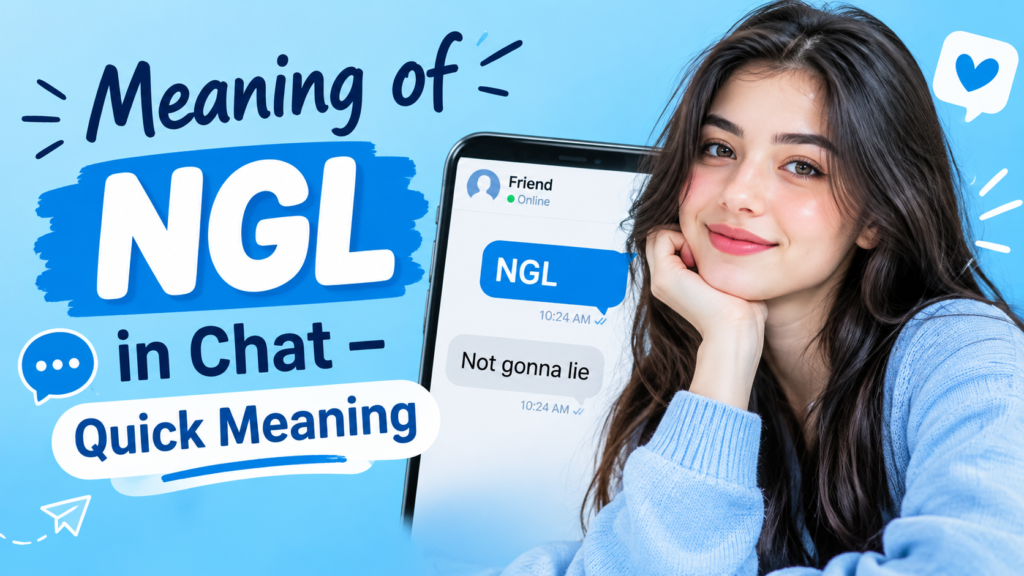
NGL stands for “not gonna lie.” People type it before or after a statement to show they are being honest, direct, or a little vulnerable.
Think of it as a small signal flag. It tells the reader, “What comes next is my real opinion, not a polite one.”
Simple Definition
NGL (abbreviation): short for “not gonna lie.” Used in texting, social media, and online chats to introduce an honest opinion, confession, or blunt comment.
It is written in three ways, and all are accepted:
- NGL (all caps)
- ngl (all lowercase, the most common style in chats)
- Ngl (first letter capitalized)
There is no strict rule. Lowercase usually feels more relaxed, while capitals can add a little emphasis.
One small note: outside of chat, “NGL” can also mean natural gas liquids, a term from the energy industry. Context makes the difference clear. If someone is texting you about dinner plans, they are not talking about hydrocarbons.
Examples
Here are simple examples that show how the phrase works in real sentences.
| Situation | Example | What it really means |
| Honest opinion | “ngl, that movie was way too long.” | I’m being truthful, I didn’t enjoy the length. |
| Confession | “NGL, I forgot your birthday was today.” | I’m admitting something awkward. |
| Compliment | “Your presentation was really good, ngl.” | I mean this, I’m not just being nice. |
| Mild criticism | “Ngl, that outfit isn’t my favorite.” | I’m softening a negative opinion. |
| Surprise | “I actually enjoyed the gym today, ngl.” | I didn’t expect to say this. |
Notice the placement. NGL can sit at the start of a sentence, the end, or even in the middle. All three are normal.
Origin and Background of NGL
Nobody can point to one person who invented NGL. Like many pieces of internet slang, it grew out of everyday speech and spread through typing habits.
The spoken phrase “not gonna lie” has been around for a long time. People have used it in conversation for decades to introduce an honest remark. When instant messaging, forums, and early chat rooms took off in the 2000s, typing speed mattered. Long phrases got chopped down into letters. “Laughing out loud” became LOL. “Be right back” became BRB. “Not gonna lie” followed the same path and became NGL.
For years, it stayed in the background. Then smartphones, short-form video, and social platforms pushed it into the mainstream. Gen Z and younger millennials carried it into captions, comments, and group chats, and it stuck.
Here is a simple timeline:
- Spoken English: “Not gonna lie” is used in casual conversation.
- Early 2000s: Chat rooms and message boards shorten phrases to save time.
- 2010s: Texting apps and Twitter make NGL common among younger users.
- Late 2010s to now: TikTok, Instagram, and Snapchat make it a regular part of online talk.
- 2026: It is widely understood, and many people now say “ngl” out loud, just like “lol.”
A quick word about the NGL app
You may also come across an app called NGL, which let people receive anonymous messages through Instagram links. Despite the same name, the app is not where the slang came from. The slang is older and far more widespread. If your search results mix the two, keep that difference in mind.
Real-Life Conversations Using NGL
Definitions are useful, but seeing the phrase in action is better. Here are four everyday scenes.
WhatsApp Conversation
Sara: Did you finish the group project slides?
Ali: Ngl, I only did half. Work was crazy.
Sara: Thanks for being honest, send me what you have.
Ali: Sending now. I’ll finish the rest tonight.
Why it works: Ali admits something slightly uncomfortable. NGL makes the confession feel honest rather than lazy.
Instagram DM
Maya: Saw your story from the beach trip, looks insane.
Zoe: Thanks! Ngl, I almost didn’t go. I’m so glad I did.
Maya: You always say that and then have the best time lol.
Why it works: NGL adds a friendly, personal touch. It makes Zoe sound open and real.
TikTok Comments
“ngl this recipe saved my dinner tonight”
“the ending was unexpected ngl”
“ngl I watched this three times”
Why it works: In comments, NGL works like a mini review. It tells the creator the viewer’s reaction is genuine.
Text Messages
Dan: What did you think of the restaurant?
Chris: Ngl, the food was great but the service was slow.
Dan: Yeah, I noticed too. Probably won’t go on a weekend again.
Why it works: Chris shares a balanced opinion. NGL makes the criticism feel fair, not harsh.
The Emotional and Psychological Meaning Behind NGL
NGL is more than a shortcut. It does a quiet emotional job in a conversation. Understanding that job helps you read messages better and write yours with more care.
Why People Connect With It
Honest talk feels good, but it can also feel risky. Saying “I didn’t like it” or “I’m nervous” can create tension. NGL gives people a gentle way to say these things. It frames the statement as a shared moment of truth, not an attack.
It creates honesty.
When someone starts with “ngl,” the reader expects sincerity. That small signal can make a message feel more trustworthy. It also invites the other person to be honest.
It lowers social pressure.
Compare these two messages:
- “I don’t want to go out tonight.”
- “Ngl, I don’t really want to go out tonight.”
The second one sounds softer. NGL adds a human touch that takes the edge off. The speaker is admitting a feeling, not issuing a rule.
It builds relatability.
People often use NGL when sharing small, imperfect moments: “ngl, I cried at that ad.” Those moments make others think, “Me too.” That shared feeling builds closeness, especially among friends.
It reflects modern communication styles.
Today’s online talk is fast, casual, and personal. People prefer short, real-sounding messages over polished ones. NGL fits perfectly. It is quick to type, easy to read, and carries a clear emotional signal in just three letters.
Also Read This Meaning: WTV Mean in Text
Usage of NGL in Different Contexts
The same phrase can feel friendly in one place and awkward in another. Here is how it plays out across common settings.
Social Media
This is where NGL feels most at home. You will see it in:
- Captions (“ngl this trip changed me”)
- Comments (“ngl, this is my favorite video of yours”)
- Story replies and DMs
- Video overlays and tweet-style posts
On social platforms, short and honest wins. NGL helps posts sound authentic instead of staged.
Friends and Relationships
Among close friends, NGL is natural. It lets you share opinions, jokes, and confessions without sounding stiff.
In romantic relationships, it can be sweet or serious:
- Sweet: “Ngl, I miss you more than I expected.”
- Seriously: “Ngl, I felt hurt when you cancelled again.”
For heavier topics, think twice before using it. A big emotional conversation usually deserves full sentences, not slang.
Work or Professional Settings
This one needs care. Many workplaces are casual in chat tools like Slack or Teams, and younger teams may use NGL freely with peers. Even so, a good rule is:
- Fine: Quick chats with colleagues you know well (“ngl, that meeting could have been an email”).
- Avoid: Emails to clients, messages to senior leaders, job applications, or official documents.
If you’re unsure, write the full phrase or choose a polished alternative like “to be honest” or “candidly.”
Casual vs Serious Tone
NGL is casual by nature. It can add warmth to light topics, but it may reduce the weight of serious ones.
| Topic | Is NGL a good fit? | Better approach |
| Movie opinions | Yes | “ngl, I loved it.” |
| Food reviews | Yes | “Ngl, best pizza in town.” |
| Apologies | Use with care | Write a clear, direct apology. |
| Bad news | Usually no | Use plain, respectful language. |
| Business emails | No | “To be honest” or “frankly.” |
Common Misunderstandings About NGL
Even a simple slang term can cause confusion. Here are the four mistakes people make most often.
Mistake 1: Assuming It’s Always Negative
Many people think “ngl” always comes before bad news. It doesn’t. It is just as common in positive messages: “Ngl, you looked amazing tonight.” The phrase signals honesty, not criticism.
Mistake 2: Thinking It Gives Permission to Be Rude
Starting with NGL does not make a harsh comment acceptable. “Ngl, you’re terrible at this” is still hurtful. NGL softens a message only when the words that follow are kind or at least considerate.
A helpful test: would the sentence be okay if you removed “ngl”? If not, adding it won’t fix the problem.
Mistake 3: Using It in Formal Situations
Writing “NGL, I’m interested in the role” in a cover letter would raise eyebrows. Formal writing needs formal language. Save NGL for texts, chats, and social posts.
Mistake 4: Assuming Everyone Understands It
Older relatives, new English learners, and people outside online circles may not know the term. If you’re texting someone who might be confused, either spell it out or use a simpler phrase. Clear communication matters more than sounding trendy.
Comparison Table: NGL vs Similar Terms
Slang words that signal honesty can look the same, but they don’t feel the same. Here is a side-by-side view.
| Term | Full form | Tone | Typical use | Example |
| NGL | Not gonna lie | Candid, personal | Confessions, honest opinions | “Ngl, I’m tired.” |
| TBH | To be honest | Neutral, straightforward | Everyday opinions | “TBH, I preferred the book.” |
| FR | For real | Emphatic, agreeing | Strong agreement or emphasis | “That show is great, fr.” |
| Low-key | Subtly, quietly | Understated | Mild feelings or secrets | “I low-key love this song.” |
| High-key | Openly, strongly | Bold, enthusiastic | Strong feelings | “I high-key need a vacation.” |
| No cap | No lie | Playful, youthful | Proving something is true | “That was the best game, no cap.” |
| Honestly | In truth | Neutral, widely accepted | Casual and semi-formal | “Honestly, it was fine.” |
| Frankly | Candidly | Direct, formal | Professional or serious talk | “Frankly, the plan needs work.” |
Key Insight
NGL and TBH are close cousins, but there is a subtle difference. TBH feels like a neutral opinion marker. NGL often carries a hint of vulnerability, as if the person is admitting something they might hesitate to say. Both are casual, and both are fine in friendly chats.
Variations and Related Expressions

If you want to avoid repeating yourself, or you just want to understand more of the slang you see online, here are ten related expressions.
1. TBH
Short for “to be honest.” It is the most common alternative to NGL and works in almost any casual setting.
Example: “TBH, I didn’t expect to like it.”
2. FR
Short for “for real.” It adds emphasis or shows agreement.
Example: “That concert was incredible, fr.” You may also see “fr fr” for extra emphasis.
3. Low-Key
Used to describe feelings you don’t announce loudly.
Example: “I low-key want to stay home.”
4. High-Key
The opposite of low-key. It means you feel something openly and strongly.
Example: “I high-key love this show.”
5. Honestly
A classic word that works both online and offline. It is more acceptable in mixed or semi-formal settings than slang abbreviations.
6. Real Talk
Signals that the speaker is about to be serious or direct.
Example: “Real talk, you should take the job.”
7. No Cap
Popular with younger users. It means “no lie” and is used to stress that something is true.
Example: “The line was two hours long, no cap.”
8. I Can’t Even Lie
A more expressive version of NGL, often used when the speaker is surprised by their own honesty.
Example: “I can’t even lie, I loved that ending.”
9. Truthfully
A polished option for writing or speaking in neutral settings.
Example: “Truthfully, I’m not sure it will work.”
10. Frankly
The most formal of the group. It suits workplaces, presentations, and serious discussions.
Example: “Frankly, we need more time.”
Quick tip: If you ever see variations like “NGTL” (not gonna tell lies) or the stacked form “NGL TBH,” they carry the same honest spirit. They are less common but easy to understand once you know the base phrase.
How to Respond When Someone Uses NGL
A reply depends on what the other person said and how well you know them. Here are ideas for four different moods.
Casual Replies
Use these for everyday chats with friends:
- “Appreciate the honesty!”
- “Fair enough.”
- “Same, honestly.”
- “Thanks for telling me.”
- “Ha, I figured.”
Funny Replies
Light humor can ease the moment, especially if the comment was blunt:
- “Ngl, I wasn’t ready for that truth.”
- “Ouch, but fair.”
- “Okay, now I need a minute.”
- “Your honesty is both scary and refreshing.”
- “Noted, and slightly offended.”
Mature and Confident Replies
When the comment touches something real, a calm answer works best:
- “Thanks for being upfront. I’d like to understand more.”
- “I hear you. Let’s talk about it.”
- “I appreciate you saying that. Here’s how I see it.”
- “That’s a fair point. I’ll think about it.”
Private and Respectful Replies
If the message was personal, emotional, or a vulnerable confession, respond with care:
- “Thanks for trusting me with that.”
- “I’m glad you told me. Want to talk about it more?”
- “That means a lot. Let’s chat when you’re ready.”
- “No judgment here.”
Pro tip: If the comment hurts your feelings, you don’t have to joke it off. It’s okay to say, “That stung a bit. Can we talk about it?”
Regional and Cultural Usage

Slang travels fast online, yet it does not land the same way everywhere. Here is a general look at how NGL is seen around the world. These are broad patterns, not strict rules.
Western Culture
In the United States, the United Kingdom, Canada, and Australia, NGL is common among teens and young adults. It appears in texts, comments, and even casual spoken conversation. Directness is often valued in these cultures, so an honest “ngl” feels natural.
Asian Culture
In many Asian countries, English slang spreads through social media, gaming, and entertainment. Younger users often know and use NGL online, especially when chatting in English or mixing languages. In more formal or hierarchical settings, people may prefer softer, more indirect language, so NGL is usually kept for friends and peers.
Middle Eastern Culture
Among young, English-speaking users in the Middle East, NGL is familiar on social platforms like Instagram, Snapchat, and TikTok. Many people blend English slang with their native languages in the same message. Politeness and respect for elders remain important, so the phrase tends to stay in casual peer conversations.
Global Internet Usage
Online spaces are blending cultures. Because the same videos, memes, and trends reach millions of people at once, NGL now feels like a shared digital word. Still, English learners and older users may not know it, which is why a quick explanation can help.
When Should You Use NGL? A Simple Checklist
Not sure whether to type it? Run through these quick questions:
- Is the setting casual? (Friends, social media, group chats = yes.)
- Do I know my reader well? (Close contacts = safer.)
- Is my message honest and kind enough to stand alone?
- Would a more formal word fit better? (Work or school = probably yes.)
- Will the reader understand the slang?
If you answer “yes” to the first three and “no” to the fourth, go ahead and use it.
Do and Don’t Summary
| Do | Don’t |
| Use NGL for honest, light opinions | Use it to excuse hurtful comments |
| Place it at the start or end of a sentence | Overuse it in every message |
| Pair it with kind or thoughtful words | Use it in formal emails or reports |
| Explain it to people who may not know it | Assume everyone understands it |
Final Thoughts
NGL is a tiny phrase with a clear purpose: it tells the reader, “I’m being real with you.” That is why it has lasted from early chat rooms to today’s social feeds.
Used well, it adds warmth, honesty, and a personal touch to your messages. Used carelessly, it can sound rude or out of place. The best approach is simple. Match the tone to the situation, keep your words kind, and save the slang for casual spaces.
So the next time you see “ngl” pop up on your screen, you will know exactly what it means, how to reply, and when to use it yourself. And ngl, that’s a pretty useful bit of internet knowledge to have in 2026.

Hi, I’m Munaza, the creator of RTMeaning.com. I’m passionate about explaining internet slang, abbreviations, texting terms, and modern language in a simple and easy-to-understand way. Through this website, I help readers discover the meanings behind trending words, social media expressions, and online communication. My goal is to make learning new terms quick, clear, and enjoyable for everyone.