

You open your phone and see a new message. It says “WTW?” That is all. No hello. No other words. Just three letters. If you stopped and wondered what it meant, you are in good company. Millions of people in the United States see this slang every day and have the same thought.
WTW is now part of daily texting. It shows up in DMs, Snapchat chats, TikTok comments, group texts, and even sports threads. The tricky part is that it can mean more than one thing. The meaning depends on who sent it, where you saw it, and what came before it.
This guide explains WTW in plain English. You will learn what it means, where it came from, and how people really use it. You will also see sample chats, tone tips, similar slang, and reply ideas you can copy and send. By the end, you will read WTW with ease and answer it with confidence.
What Does WTW Mean in Texting? – Quick Meaning
In texting, WTW most often means “What’s the word?” It is a relaxed way to ask, “What’s up?” or “What’s going on?” Many younger users also say it as “What’s the wave?” In that case, the sender is asking about the plan or the vibe. They want to know what you are doing or what the group is doing.
Both meanings are close. The sender wants a quick update. The tone is usually friendly and light. It is an easy way to start a chat without writing a long message.
There are a few other meanings too. They are less common, but you may run into them. Here is a simple table to keep them straight.
| Meaning | Full phrase | What it asks or says |
| Most common | What’s the word? | What’s up? What’s new? |
| Gen Z favorite | What’s the wave? | What’s the plan? What’s the vibe? |
| Streaming talk | Where to watch | Where can I see this show or game? |
| Business | Willis Towers Watson | A global advisory and insurance firm |
So how do you pick the right one? Look at the setting. A friend texting you at 7 p.m. likely means “What’s the plan?” A comment under a movie clip likely means “Where to watch.” A line in a finance article likely means the company.
Here are the quick takeaways:
- WTW is casual and friendly.
- It usually asks for an update or a plan.
- It can change meaning by platform and topic.
- It is rarely rude or serious.
WTW meaning dating
In dating, WTW is a soft opener. It usually means “What’s the word?” or “What’s the wave?” It is a way to say, “Hey, I thought of you. What are you up to?” It sounds relaxed, so it does not put pressure on anyone.
Many people use WTW to test the waters. It is a safe first step. If the other person answers with energy, the chat can grow. If they reply with one word, the sender can back off without feeling embarrassed.
Adding a time word changes the feel. “WTW tonight?” may be a small invite. “WTW this weekend?” can be a hint that the sender wants to see you. Still, it does not promise a date. It simply opens a door.
If you like the person, reply with a little more than “Nothing.” Share a detail and ask something back. That shows interest and keeps the talk moving.
Wtw meaning tiktok
On TikTok, WTW shows up in comments, replies, and DMs. In many cases, it means “What’s the word?” or “What’s the wave?” A viewer might comment on it to ask a creator what is happening or what the plan is. It can also be a friendly way to get attention.
There is another common use. Under clips from shows, movies, and games, WTW often means “Where to watch.” Viewers drop it to ask for the title or the streaming service. Other users then reply with the name or a link.
Because the meaning changes, read the video first. A comedy skit, a trend, or a plan video points to the slang meaning. A movie scene or a sports highlight points to “Where to watch.”
WTW meaning in text from a guy
When a guy texts “WTW,” he usually means “What’s up?” or “What’s the plan?” It is short and casual. Guys often use it with friends, classmates, teammates, and people they talk to now and then.
If he adds “tonight” or “this weekend,” he probably wants to make plans. If he sends only “WTW,” he may just be starting a chat. Some guys use it as a low-effort way to check if you are in the mood to talk.
Do not read too much into one message. Look at the pattern. Does he text often? Does he ask follow-up questions? Does he suggest plans? Those clues tell you more than three letters can.
Wtw meaning from a girl
When a girl sends WTW, it means the same thing: “What’s the word?” or “What’s up?” She may use it with friends, cousins, or someone she likes. It is a quick check-in and nothing more.
Tone helps you read it. A message like “WTW 😏” feels playful or flirty. A plain “WTW?” feels neutral and friendly. If she adds your name, such as “WTW Alex?”, she may be more direct.
As with any text, context matters most. Think about how well you know her and how you usually talk. A reply that matches her energy is almost always the right move.
WTW meaning company
Outside of slang, WTW is the short name for Willis Towers Watson. This is a large global company. It gives advice on insurance, risk, employee benefits, and workplace strategy. Its stock trades under the ticker WTW.
You may see this version in emails, job posts, news stories, and finance sites. A headline about earnings or a hiring page will use WTW as a company name. It has no link to texting slang.
The easy rule is to check the setting. If the page talks about insurance, business, or investing, it means the company. If it shows up in a casual chat, it is slang.
Wtw meaning on instagram
Instagram is one of the biggest homes for WTW. You will see it in DMs, story replies, and comments. A reply to your story that says “WTW” often means “What’s the word?” It is a quick way for a friend or a crush to start a conversation.
In comments, WTW can also mean “Where to watch.” This is common on posts about shows, sports, and movies. People ask it to find the stream or the channel.
Reels add another layer. A fun clip might get “WTW” as a joke or a question. Look at the video and the other comments. They usually make the meaning clear.
WTW meaning Snapchat
On Snapchat, WTW is my favorite. Chats move fast on the app, and people like short texts. Friends use WTW to ask what you are doing or if you want to hang out.
A snap that says “WTW tn” means “What’s the word tonight?” or “What’s the wave tonight?” It is often a plan starter. Replies come quickly, and the plan can form in minutes.
Snapchat also has Snap Maps and streaks, so people check in often. WTW is a handy way to say hello without breaking the flow.
Wtw meaning in chat
In general chats, WTW works as a casual greeting. You will see it in group texts, Discord servers, WhatsApp groups, and gaming lobbies. It asks for an update in a very short way.
It is useful in busy chats because it invites quick answers. Anyone can reply with a line or two. Nobody needs to write a long message.
Keep it for people you know. With strangers or older contacts, a full sentence feels more polite. Something like “Hey, how are you?” works better.
Also Read This Meaning: ISTG Mean in Text
Origin and Background of WTW
WTW grew out of everyday speech. The phrase “What’s the word?” has been a casual greeting for many years. People used it in conversation long before smartphones. When texting became popular, people started shortening it to save time.
The “What’s the wave?” The version has a different path. It grew from Gen Z talk and hip-hop culture. In that world, “the wave” means the vibe, the scene, or the plan. Asking about the wave means asking what is happening and where the fun is.
Social apps pushed both forms into the mainstream. TikTok, Instagram, and Snapchat helped WTW spread across the country in just a few years. Songs, memes, and creators used the phrase, and fans copied it. Soon, it moved from niche groups to everyday chats.
Here is a short timeline of how it spread:
- Early texting era: People shortened common phrases to save characters.
- Social media rise: Short, casual slang became a normal way to talk.
- Gen Z influence: “The wave” entered daily speech.
- Short video boom: TikTok and Reels made WTW widely known.
Wtw today meaning
Today, WTW mostly means “What’s the word?” or “What’s the wave?” It works as a quick hello and a plan check. In 2026, it will appear across many apps. Teens and young adults use it the most, but people in their late twenties and thirties use it too.
You may also see it in sports and entertainment spaces. There, it often means “Where to watch.” Fans use it before big games, season finales, and movie releases. The idea behind both uses is the same. The sender wants information fast.
Language moves quickly, so new meanings can appear. Still, the core meaning has stayed steady. If you read WTW as a friendly request for an update, you will be right most of the time.
what dies wtw mean
Many people search “what does wtw mean.” This is almost always a typing slip. They meant to write “what does WTW mean.” The question is simple, and so is the answer.
WTW means “What’s the word?” in most chats. It can also mean “What’s the wave?” in plan-making talk. In streaming chats, it can mean “Where to watch.”
If you saw the term in a message, check who sent it and what came before. That context points to the right meaning in seconds. If you still feel unsure, you can always ask.
Wtw meaning on instagram
On Instagram, the meaning follows the setting. In a DM, WTW means “What’s up?” In a story reply, it often means “What’s going on with you?” Under a post about a show or a game, it can mean “Where to watch.”
Think of it like a word with a few jobs. The job changes with the place. A DM is personal and chatty. A comment section is public and topic-based.
A quick look at the post or the chat history clears it up. You rarely need to guess for long.
What does wtw stand for
WTW stands for a few different things. Here are the main ones:
- What’s the word? The most common slang meaning.
- What’s the wave? A popular Gen Z meaning.
- Where to watch. Used for shows, movies, and sports.
- Willis Towers Watson. A global company.
Most people searching this question saw the slang form in a text or a DM. If that is you, “What’s the word?” is the safest answer.
If you are not sure, ask a short question. “You mean what’s up?” is clear and friendly. Nobody will mind.
What do wtw mean
When people type “what do wtw mean,” they want a direct answer. Here it is. WTW is a short way to ask what is going on. It is casual, friendly, and quick.
It does not carry a hidden or negative meaning. Most of the time, it is simply a lazy but warm hello. The sender wants a reply, and that is about it.
You can answer in a line. Share what you are doing, then ask them back. That keeps the chat easy and natural.
Real-Life Conversations: How WTW Is Actually Used
A definition tells you the meaning. A real chat shows you the feel. Below are three common examples from popular apps. Each one shows tone, timing, and how people reply.
Notice a pattern in all three. The sender opens with WTW. The other person answers with a short update. Then one of them adds a small plan. That is how WTW works most of the time.
WhatsApp Conversation
WhatsApp is used a lot for friends and family chats. WTW works as a quick check-in here.
Jake: WTW
Mia: Not much. Just got off work. You?
Jake: Same. Wanna grab food?
Mia: Yes please. Give me 20 minutes.
Jake: Cool. I’ll text when I’m outside.
Jake starts with WTW. Mia gives a short update and asks him back. The talk moves into a plan in a few lines.
What can you learn from this chat?
- WTW needs no greeting.
- A short answer is enough.
- Asking “You?” keeps it two-sided.
- Plans often follow within a few messages.
Instagram DM Conversation
On Instagram, WTW often follows a story view or a like. It feels playful and light.
Chris: Saw your story. WTW this weekend?
Dana: Thinking about the beach on Saturday. You in?
Chris: Bet. Send the time.
Dana: Around noon. Bring sunscreen 😂
Chris: Say less.
Chris uses WTW to ask about weekend plans. Dana replies with details and an invite. The tone stays playful with emojis and short lines.
This kind of chat shows how WTW can build a connection. It gives the other person room to suggest something fun. It also feels natural on a social app, where people react to what they see.
Text Message Conversation
In a plain text thread, WTW can feel more personal. This is especially true between people who are dating or close to it.
Ethan: WTW tonight?
Sofia: No plans yet. What’s up?
Ethan: Thinking about movies and pizza at my place.
Sofia: Sounds good. I’ll bring snacks.
Ethan: Perfect. 8 work?
Sofia: 8 works.
Ethan’s WTW is a soft invite. Sofia stays relaxed and asks a follow-up question. By the end, they have a plan. Nobody felt pushed.
This is a good model if you want to use WTW as a plan starter. Keep it light, give a small idea, and let the other person respond.
The Emotional and Psychological Meaning Behind WTW
WTW looks simple, but it carries a feeling. It says, “You crossed my mind.” It also says, “I want an easy chat.” That mix of warmth and low effort is why so many people like it.
Short messages lower the stakes. A long text can feel heavy. It can also feel like too much, too soon. WTW feels light. It lets the sender reach out without looking too eager. If the other person does not reply, it stings less. If they do, the talk begins without stress.
There is a social side too. Slang tells people you belong to a group. It shows that you speak the same language and share the same culture. For many young people, that matters. It builds comfort and closeness.
Here are some feelings that often sit behind a WTW text:
- Curiosity: The sender wants to know what you are doing.
- Interest: They may like you and want to talk.
- Boredom: They want a quick chat to pass the time.
- Friendliness: They want to stay in touch.
- Invitation: They hope to make plans.
- Loneliness: They want a little company, even through a screen.
Tone can change the whole message. WTW at noon on a Tuesday feels casual. WTW at 1 a.m. may feel flirty or lonely. The same three letters can carry different weights.
Pay attention to timing, emojis, and your past chats with the person. Those small clues help you read the message the way it was meant.
Using WTW in Different Contexts
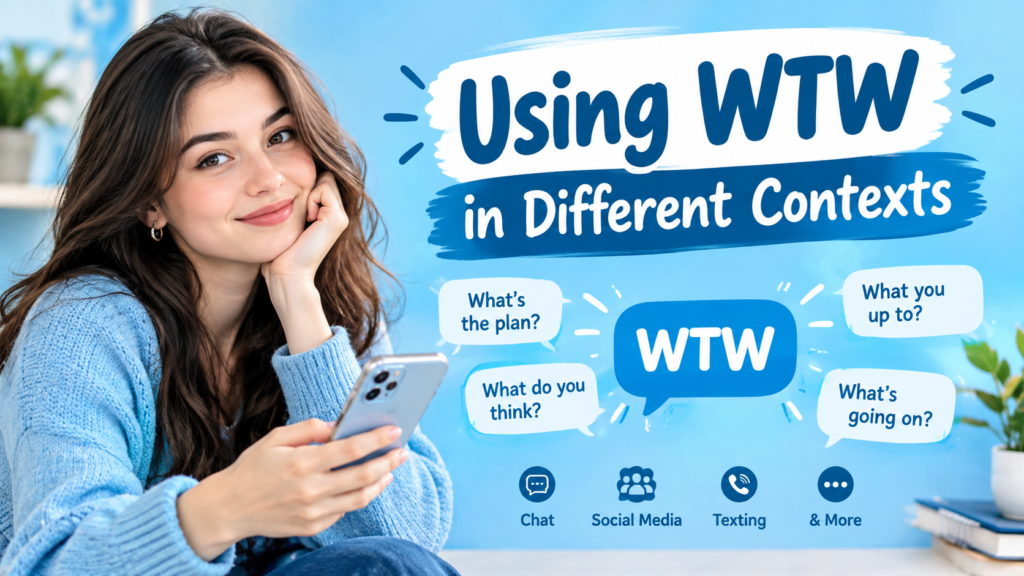
WTW fits many settings, but not all of them. A good rule is to think about who you are talking to and where. The same message can feel perfect in one chat and odd in another.
Below, you will see how WTW works across different spaces. Use these tips to avoid mix-ups and keep your messages smooth.
WTW on Social Media
On social media, WTW is common and widely understood. You will see it in DMs, story replies, comments, and group chats. Platforms reward short and casual talk, so it fits well.
In public comments, be clear. If you mean “Where to watch,” add a few extra words, like “WTW this movie?” That stops people from guessing. In DMs, plain WTW is fine if you already know the person.
Also, remember that public posts can be seen by many people. Keep your tone friendly and avoid private details in comments.
WTW Between Friends
Between friends, WTW is a natural greeting. It fits group chats, game lobbies, and weekend plans. Friends often reply with short, funny answers.
It also works as a plan starter. “WTW later?” can turn into dinner, a game night, or a late drive. The relaxed vibe keeps pressure low.
Friends also read the tone well. They know your style, so a simple WTW rarely feels cold. It often feels warm and familiar.
WTW in Relationships and Dating
In dating, WTW is a good opener. It feels casual and gives the other person space to answer in their own way. It can also be a safe way to restart a chat after a quiet day.
Still, a steady stream of plain WTW texts can feel lazy. If you like someone, add a little effort. Try, “WTW? Thinking tacos tonight.” That shows interest and gives them something easy to respond to.
In long-term relationships, WTW can feel playful. Couples use it as a quick check-in during a busy day. It keeps things light and shows they are thinking of each other.
WTW at Work or in Professional Settings
At work, avoid WTW unless you mean the company. Slang can look unprofessional in emails, client chats, and messages to managers. A clear sentence is safer and shows respect.
Try these swaps:
- “How are things going?”
- “Any updates on this?”
- “What’s the plan for today?”
Some teams are very casual. If your office chat is full of slang and memes, a friendly WTW to a close coworker may be fine. When in doubt, skip it. It is better to sound polished than to risk a bad impression.
Casual vs. Serious Tone
WTW is a casual phrase. It does not suit serious talks like bad news, apologies, or formal requests. Using it in those moments can seem careless or cold.
If someone is upset, use a softer opener. Try “Hey, are you okay?” or “Can we talk?” These show care and give the moment the weight it needs.
| Situation | Is WTW okay? | Better option |
| Hanging out with friends | Yes | “WTW?” |
| Texting a crush | Yes, with care | “WTW tonight?” |
| Group chat plans | Yes | “WTW this weekend?” |
| Emailing a boss | No | “How are things going?” |
| Talking to a client | No | “Do you have any updates?” |
| Serious conversation | No | “Can we talk?” |
Common Misunderstandings About WTW
Because WTW has many meanings, mix-ups happen all the time. Here are the most common ones, with simple fixes.
1. Thinking it is rude. Some people read a short WTW as cold. It is usually just casual. Do not assume bad intent. Most senders are friendly.
2. Confusing it with other slang. WTW looks like WTF or WYD. They are not the same. WTF is a strong reaction. WYD asks what you are doing right now. WTW is more open and relaxed.
3. Assuming it always means a date. WTW can start a plan, but it is not always romantic. Friends, cousins, and teammates use it all the time.
4. Mixing it up with the company. In finance or business news, WTW is Willis Towers Watson. It has no slang meaning there.
5. Reading too much into it. One WTW does not prove feelings. Look at the full conversation before you decide what it means.
6. Using it with the wrong person. Older relatives or new work contacts may not know the slang. They might feel confused or left out. Use full phrases with them.
If you feel unsure, ask a short question. “What do you mean?” is easy and clear. A quick check beats a long guess.
WTW Compared With Similar Texting Terms
WTW belongs to a family of check-in phrases. Each one has its own feel and use. Knowing the difference helps you pick the right one.
| Term | Meaning | Tone | Best for |
| WTW | What’s the word / wave | Casual, open | Greetings, plan checks |
| WYD | What are you doing? | Direct | Asking about right now |
| WYA | Where are you at? | Direct | Finding someone’s location |
| WDYM | What do you mean? | Neutral | Asking for clarity |
| HMU | Hit me up | Friendly | Asking someone to reach out |
| SUP | What’s up? | Very casual | Quick hello |
| WBU | What about you? | Friendly | Returning a question |
| WTF | What the f***? | Strong | Showing shock or anger |
The main difference is scope. WYD asks what you are doing at this moment. WYA asks where you are. WTW is wider. It can ask about your day, your plans, or just your mood.
That is why WTW feels softer. It does not demand one exact answer. You can reply with anything you like. You can talk about your day, share a plan, or just say hi.
Here is a simple way to remember them:
- Use WYD when you want to know the current activity.
- Use WYA when you need a location.
- Use WTW when you want a general update or a plan.
- Use HMU when you want the other person to contact you.
Variations and Related Ways to Use WTW
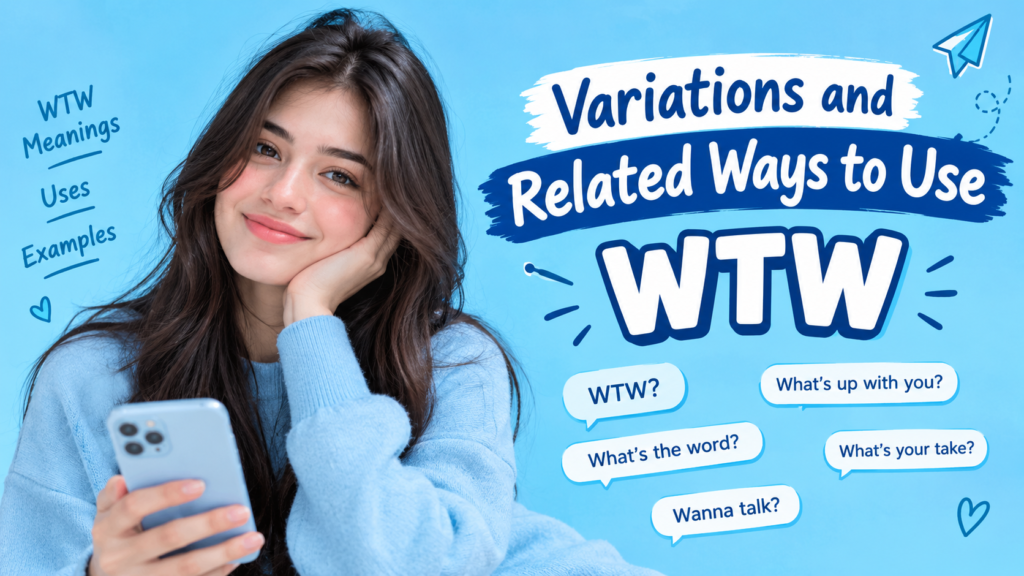
People mix WTW with other words to fit the moment. These forms are common across the U.S. Each one has a slightly different feel.
1. WTW?
This is the base form. It works as a greeting or a quick check-in. Use it with friends or people you text often. It is short, friendly, and open.
2. WTW Tonight?
This asks about plans for the evening. It is a casual invite. Expect a reply about food, hangouts, or going out. It is also a gentle way to check if someone is free.
3. WTW later?
This one looks ahead. The sender wants to know if you are free later today. It is flexible and low pressure. You can answer with a time or say you are not sure yet.
4. WTW This Weekend?
This asks about Saturday or Sunday plans. It is common on Thursday and Friday. Friends use it to line up events, trips, and hangouts. It also works well in group chats.
5. WTW With You?
This asks what is going on in your life. It can feel a bit more personal. It may also be a playful way to say, “What’s your deal?” Tone and emojis show which meaning fits.
6. WTW With That?
This reacts to something odd or funny. It means “What’s going on with that?” Use it when a photo, post, or comment surprises you. It often comes with a laughing emoji.
7. So WTW?
Adding “so” makes it feel like a follow-up. It pushes the chat forward. It often appears when someone has gone quiet or when a plan is unclear. It can show gentle impatience.
8. Ayo, WTW?
“Ayo” adds energy and grabs attention. It is common with close friends and in group chats. It feels loud and fun, like waving at someone across the room.
9. WTW Then?
This asks for the final plan. It shows up when people have talked for a while and still need a decision. It can sound a little impatient, so watch your tone.
10. WTW Bro?
This is a casual greeting between male friends. It feels warm and familiar. It is not meant for formal settings or people you just met.
Here is a quick summary of all ten:
| Version | Best use | Tone |
| WTW? | General check-in | Relaxed |
| WTW Tonight? | Evening plans | Friendly |
| WTW Later? | Plans later today | Flexible |
| WTW This Weekend? | Weekend plans | Excited |
| WTW With You? | Asking about your life | Personal |
| WTW With That? | Reacting to something | Playful |
| So WTW? | Following up | Slightly pushy |
| Ayo, WTW? | Getting attention | Energetic |
| WTW Then? | Final plan | Direct |
| WTW Bro? | Friends only | Casual |
How to Respond When Someone Uses WTW
Replying to WTW is easy. Match the tone and share a little. Then, if you want, ask something back. This keeps the talk going and shows you care.
A good reply does three things. It answers the question. It sounds like you. It leaves room for the other person to continue.
Think about who is asking before you reply. A close friend can handle a joke. A new contact may need a polite answer. A crush may need a bit of charm. Below are four styles, each with examples you can copy.
Casual Replies
Casual replies are best with friends. Keep them short and natural.
- “Not much. You?”
- “Just chilling. What’s up with you?”
- “Same old. Wanna hang out later?”
- “Working on stuff. Free after 6.”
- “Nothing yet. Got any ideas?”
- “Just got home. What’s the plan?”
Funny Replies
Humor makes chats fun. Use it when you know the person well.
- “Just me, my couch, and snacks.”
- “Plotting world domination after lunch.”
- “Existing. It’s going okay.”
- “Ask me after coffee.”
- “The word is pizza.”
- “Currently losing a fight with my laundry.”
Mature and Confident Replies
These replies sound calm and clear. They work well with someone you like or want to impress.
- “Good day so far. How about you?”
- “Open tonight. What did you have in mind?”
- “Busy but free later. Want to catch up?”
- “Doing well. Glad you texted.”
- “Not much planned. Let’s do something fun.”
- “Pretty good. I was just thinking about you.”
Private or Respectful Replies
Sometimes you do not want to share details. You can stay polite and still set a boundary.
- “Just a quiet night. Talk later?”
- “Pretty busy right now. I’ll text you soon.”
- “Nothing big. Thanks for checking in.”
- “I’m good. How are you?”
- “I’d rather keep it low-key tonight.”
- “Not sure yet. I’ll let you know.”
Use this table to pick the best style fast.
| Who sent it | Best reply style | Example |
| Close friend | Casual or funny | “Just chilling. You?” |
| Crush | Confident | “Open tonight. What’s the plan?” |
| New contact | Respectful | “Doing well. How are you?” |
| Coworker | Polite | “All good. Need anything?” |
| Group chat | Short and fun | “Down for anything. Ideas?” |
A few extra tips will help:
- Reply in a similar length to their message.
- Use emojis if they use them.
- Ask one question to keep the chat alive.
- Do not feel forced to share plans if you are not ready.
Regional and Cultural Usage of WTW
Slang changes from place to place. WTW is most common in English-speaking online spaces, but how people use it shifts by region and culture. Here is a quick look at the big picture.
Western Culture
In the United States, Canada, and the UK, WTW is popular with teens and young adults. It appears in texts, DMs, and group chats. The “What’s the wave?” form is stronger in urban and hip-hop influenced circles.
Across the U.S., regional flavor varies. In some areas, “What’s the word?” feels more natural. In others, “What’s the wave?” leads. Both are widely understood by younger users.
Western users also use WTW as a friendly hello between people of all genders. It is rarely seen as formal. Most people see it as a light, social phrase.
Asian Culture
In Asia, English slang spreads through social media, gaming, and streaming. Young people in countries like India, the Philippines, and Pakistan may use WTW in chats with friends. The meaning is usually the same: “What’s up?”
Local languages often mix in. A message may blend WTW with words from Hindi, Tagalog, or Urdu. This mix of languages is a normal part of online talk.
Formal chats stay more polite. Older users may not know the slang. In family and school settings, full phrases are usually the safer choice.
Middle Eastern Culture
In the Middle East, English slang is common among younger, online-savvy groups. WTW may appear in chats beside Arabic phrases. The meaning stays close to “What’s going on?”
People tend to be more careful in mixed or formal settings. Respect and polite tone carry a lot of weight. When talking with elders or in professional chats, full phrases are better.
Gaming and social apps help spread the slang here too. Many young users pick it up from friends and creators around the world.
Global Internet Usage
Online, WTW has crossed borders. Gamers, streamers, and social media users share it in global spaces. A teen in Texas and a gamer in Dubai may use it the same way.
The shared meaning makes it easy to use across cultures. Still, confusion can happen. When chatting with people from other regions, a short clarification helps. A quick “WTW, as in what’s up?” keeps things clear.
Here is a short view of how it looks around the world:
| Region | Common meaning | Where it appears |
| United States | What’s the word / wave | Texts, DMs, Snapchat |
| UK and Canada | What’s up / What’s the plan | Group chats, social media |
| South Asia | What’s up | Gaming, Instagram, WhatsApp |
| Middle East | What’s going on | Mixed-language chats, gaming |
| Global online | Varies by space | Discord, TikTok, streaming chats |
Frequently Asked Questions
What does WTW mean in a text message?
WTW usually means “What’s the word?” or “What’s the wave?” It is a casual way to ask what is up or what the plan is.
What does WTW mean from a guy or a girl?
From either, WTW means the same thing: a friendly check-in or a plan question. Tone and timing show whether it is casual or flirty.
Does WTW mean “where to watch”?
Yes, sometimes. In posts about shows, movies, or sports, WTW can mean “Where to watch.” The topic tells you which meaning applies.
How do I reply when someone texts WTW?
Share a short update and ask back. For example, “Not much, what about you?” works well in most chats.
Is WTW appropriate for work?
No, avoid slang like WTW in professional chats. The one exception is when WTW refers to the company Willis Towers Watson.
Final Thoughts
WTW is a small phrase with a friendly purpose. Most of the time, it means “What’s the word?” or “What’s the wave?” It asks for a quick update and invites a chat. Its other meanings, like “Where to watch” or the company Willis Towers Watson, depend on where you see it. Context is the key to getting it right.
Read the setting, notice the tone, and reply in a way that feels like you. Keep it casual with friends and clear in mixed company. Skip it in professional or serious moments. With these tips, you can use WTW with ease and answer it without second-guessing.

Hi, I’m Munaza, the creator of RTMeaning.com. I’m passionate about explaining internet slang, abbreviations, texting terms, and modern language in a simple and easy-to-understand way. Through this website, I help readers discover the meanings behind trending words, social media expressions, and online communication. My goal is to make learning new terms quick, clear, and enjoyable for everyone.