


You’re chatting with a friend, a partner, or maybe a coworker. The message ends with a small, lowercase “x.” Nothing else. No explanation.
If you’ve ever paused and wondered what that tiny letter is supposed to mean, you’re not alone. It’s one of the most common and most misunderstood in modern texting.
This guide walks through everything worth knowing about “x” in messages: its origins, its everyday meaning, how it changes across different apps, and when it’s actually appropriate to use.
The Basic Meaning of “X”
At its simplest, an “x” at the end of a message stands in for a kiss. It’s a quick, informal way to add warmth to a text, similar to signing off with “take care” or “love” at the bottom of a letter.
This isn’t a new invention of the smartphone era, either. Long before texting existed, people would place an “X” beside their signature on letters as a symbol of a kiss or a sealed promise. That old habit simply carried forward into emails, texts, and now direct messages on social media.
In everyday use, “x” generally falls into a handful of categories:
- A casual, friendly closing between friends or relatives
- A romantic gesture between partners or people who are interested in each other
- A neutral placeholder, such as an unknown value in math or code
- A mark meaning “no” or “incorrect,” similar to a red cross
- An uncommon, context dependent slang term unrelated to affection
For most everyday conversations, though, the warm, affectionate meaning is by far the most likely one.
Where You’ll See It Most
The letter “x” shows up across nearly every messaging platform, though its tone can shift slightly depending on where it appears.
In standard text messages, it usually closes out a goodnight, a goodbye, or a thank you. On Instagram, it tends to appear in a lighter, more casual way, often between people who already follow or know each other. On WhatsApp, it’s especially common among users in the UK and parts of Europe as a routine, friendly goodbye.
Even in email, it occasionally slips in between close colleagues who have a relaxed working relationship. And in comment sections on social platforms, it often shows appreciation or encouragement rather than romance.
Geography matters here more than people realize. In the UK and much of Europe, ending a message with a single “x” or a double “xx” is considered completely ordinary, not a romantic signal at all. In other parts of the world, the same symbol can carry a bit more weight.
Breaking Down the Different Versions

People searching for the meaning of “x” in a text are usually trying to decode a specific message they just received. Fortunately, the logic behind it isn’t complicated once you know the pattern.
A single “x” is the lightest version, a casual, friendly sign-off.
A double “xx” feels slightly warmer, and is common between close friends or romantic partners alike.
A triple “xxx” carries more affection, and tends to show up more often in romantic exchanges.
“Xoxo” combines hugs and kisses into one expression, making it a warmer variation of a plain “x.”
None of these rules are absolute, though. The relationship between the two people texting always matters more than the symbol itself.
Seeing “X” in Real Conversations
Context makes the meaning of “x” much easier to understand. A few everyday examples help illustrate this.
Friendly example: Someone thanks a friend for helping them move, and the friend replies casually, adding an “x” at the end as a warm, easygoing touchnothing romantic implied.
Romantic example: Two partners exchange goodnight messages, and the “x” reinforces the affection already present in the conversation.
Family example: A parent reminding their child about an appointment might close the message with an “x,” simply as a small gesture of care.
In every case, the letter softens the tone of the message. It doesn’t automatically signal romance; the surrounding conversation usually makes the intent clear.
Also Read This Meaning FS Meaning in Text Messages
When It Makes Sense to Use It

Not every message calls for an “x,” and dropping it into the wrong setting can send a confusing signal.
It generally works well when texting close friends or family members, especially as a warm goodbye. It also fits naturally in messages to a partner or someone you’re romantically interested in. Casual conversations that already have a friendly tone are another good fit, particularly around sign offs like “goodnight” or “see you soon.”
On the other hand, it’s best avoided in professional emails, workplace messages, or formal customer service exchanges. It can also feel out of place in a first conversation with someone you don’t know well, or in any situation where the nature of the relationship isn’t clear yet.
When in doubt, it’s usually safer to leave the “x” out until you have a better sense of how the other person communicates.
“X” on Instagram and Social Media
On Instagram, the letter behaves much like it does in regular texting, though it tends to show up even more casually, since direct messages there are often less formal than a standard SMS conversation.
People commonly use it at the end of a compliment, as a lighthearted acknowledgment in a quick reply, or as a friendly way to close out a conversation. Because Instagram exchanges usually happen between people who already know each other, the tone tends to lean friendly rather than deeply romantic though the emojis or wording around it can shift that impression.
Beyond direct messages, “x” also appears in broader ways across social platforms. It shows up in comment sections as a quick way to express support, and occasionally as a soft closing line in a caption.
There’s also a modern wrinkle worth mentioning: some users now associate the capital letter “X” with the social media platform formerly known as Twitter. This has created a bit of overlap in how people search for the term online, though the surrounding context usually makes clear which meaning is intended: a kiss, or the platform.
Other Meanings Worth Knowing
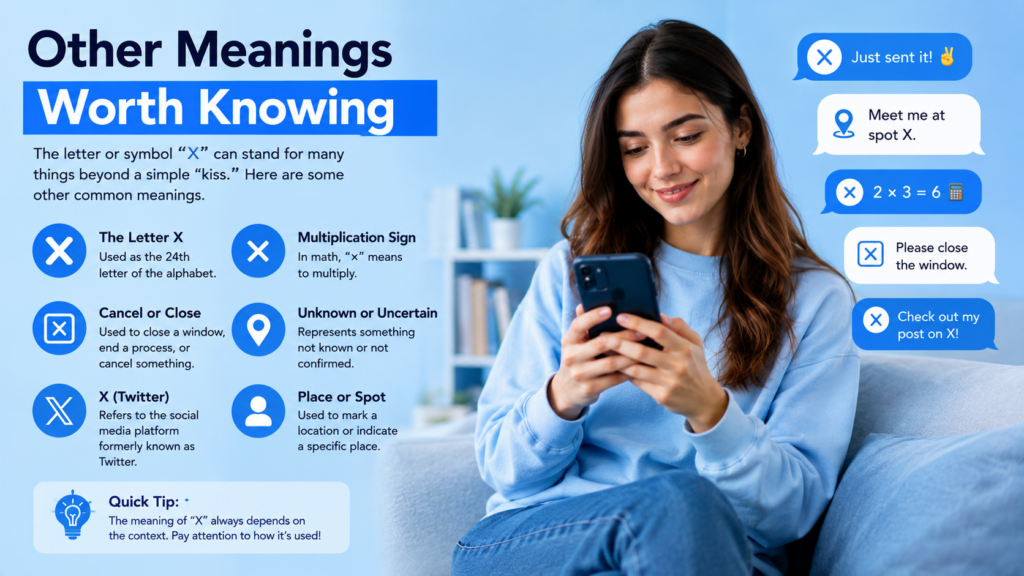
Affection is the most common meaning, but it isn’t the only one. Depending on the setting, “x” can also represent:
- An unknown variable in math, algebra, or programming
- A mark for something incorrect, similar to a red cross on a test
- A multiplication sign, as in measurements like “10 x 10”
- A symbol used to censor or redact part of a name or word
- A rare, context-dependent slang term unrelated to any of the above
In nearly every case, the words surrounding the letter make the intended meaning obvious. Genuine confusion is uncommon once the full message is read in context.
Alternatives and Similar Sign Offs
For those who want to vary how they sign off, there are several common alternatives to a plain “x.”
“XO” or “xoxo” adds hugs into the mix alongside kisses. A double “xx” is often used between close friends or partners as a slightly warmer version. The kiss emoji and the “blowing a kiss” emoji act as visual standings for the same idea, and are sometimes paired directly with an “x.” Phrases like “ily x” combine an expression of love with the letter for extra warmth, while “night x” or “morning x” have become common casual sign offs.
All of these serve the same basic purpose adding a small emotional touch to what would otherwise be a plain, flat message.
Frequently Asked Questions
Does “x” always mean romantic interest?
No. It’s frequently used in a completely platonic way between friends and family, and only suggests romance when the rest of the conversation points in that direction.
Is “xx” more romantic than a single “x”?
Sometimes, but not always. It’s also common between close friends, so the relationship and tone matter more than the number of letters used.
Should “x” be used in work emails?
Generally, no. It’s best reserved for casual, personal conversations rather than professional communication.
What does it mean if a stranger sends an “x”?
It usually signals friendliness rather than anything deeper, though it’s worth reading the full message before assuming intent.
Is “x” used the same way everywhere?
Not exactly. It’s especially common in the UK and parts of Europe as a routine sign-off, while its use elsewhere can vary quite a bit.
Final Thoughts
At the end of the day, “x” is a small symbol carrying a surprising amount of meaning. Whether it closes a casual message between friends, adds warmth to a romantic goodnight, or simply reflects an old habit passed down from handwritten letters, its core purpose stays consistent adding a touch of warmth to a message.
Context remains the most important factor. The very same letter can mean affection, friendliness, or nothing romantic at all, depending entirely on who sent it and how the rest of the conversation unfolds. Once that’s clear, decoding an “x” in any message becomes second nature.

Hi, I’m Munaza, the creator of RTMeaning.com. I’m passionate about explaining internet slang, abbreviations, texting terms, and modern language in a simple and easy-to-understand way. Through this website, I help readers discover the meanings behind trending words, social media expressions, and online communication. My goal is to make learning new terms quick, clear, and enjoyable for everyone.