
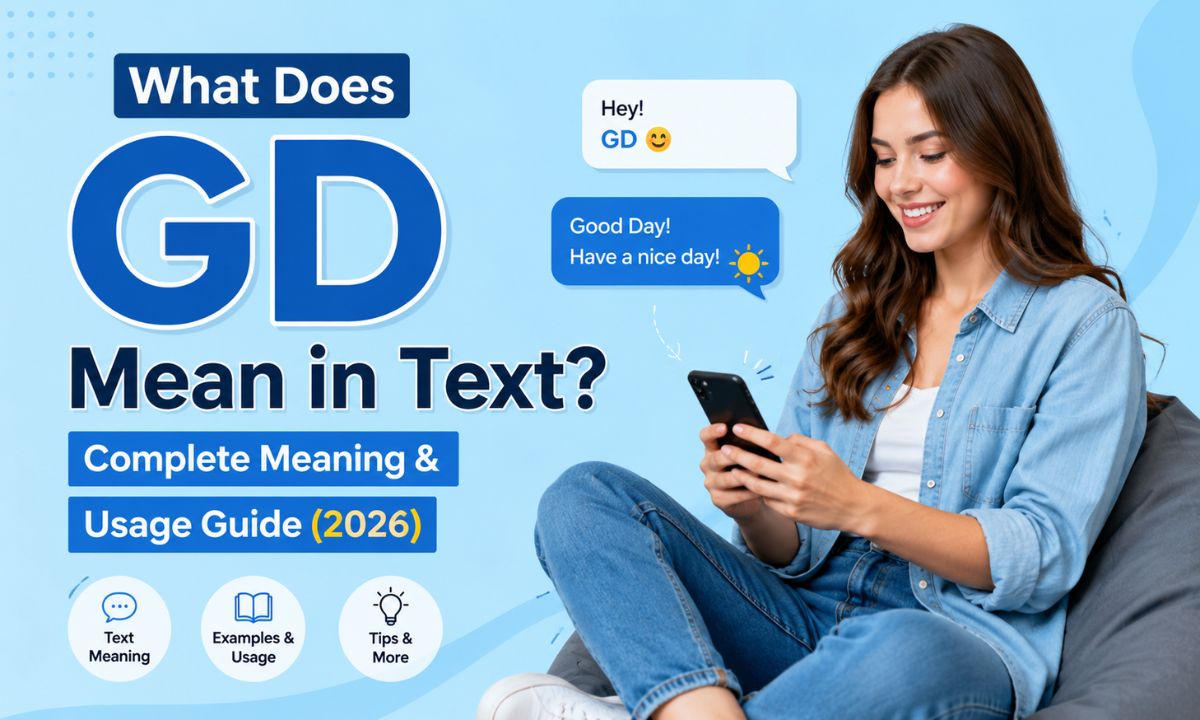

If you’ve ever been texting a friend and suddenly seen “GD” pop up in the middle of a sentence, you’ve probably paused for a second wondering what it actually means. It’s one of those short texting abbreviations that can carry completely different meanings depending on who’s typing it and what mood they’re in.
Texting culture moves fast. New abbreviations appear almost every week, and old ones shift meaning as they spread across different apps and communities. GD is a perfect example of this. It looks harmless at first glance, just two letters, but it can shift from something sweet to something sharp in a heartbeat.
In this guide, we’ll break down everything you need to know about GD, from its most common meanings to real examples, when it’s okay to use, and when it’s better to avoid it altogether. By the end, you should be able to spot exactly what someone means the moment you see it pop up on your screen.
What Does GD Mean in Text?
GD is a two-letter abbreviation used in texting and social media, and it almost always means one of two things: “Good Day” or “God Damn.” The actual meaning depends entirely on the context of the conversation.
These two meanings sit at completely opposite ends of the emotional spectrum. One is a cheerful, polite greeting. The other is closer to a mild curse word, often used to express shock, annoyance, or emphasis. That contrast is exactly why context matters so much when you come across it.
Here’s a quick breakdown of the two most common uses:
Example of Good Day: “GD! Hope you’re having an awesome morning.”
Example of God Damn: “GD, that traffic was insane today.”
Because GD can swing from a friendly greeting to a frustrated exclamation, it’s important to read the surrounding message before assuming what someone means. Look at the words right before and after it, the punctuation used, and whether emojis are involved. All of these small clues usually make the intended meaning obvious within a second or two.
Where Is GD Commonly Used?
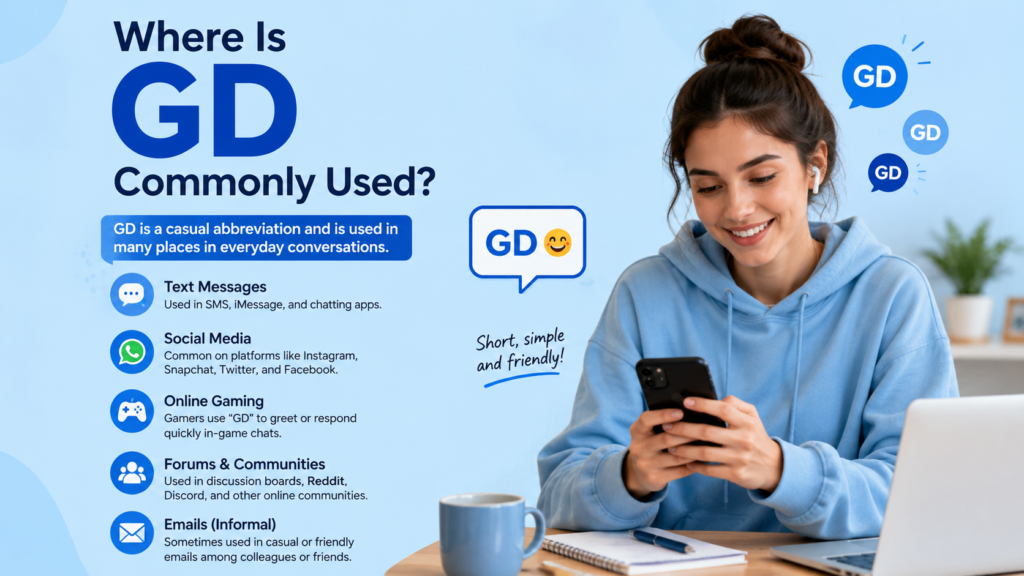
GD shows up across almost every messaging platform, but it tends to appear more often in casual, fast paced conversations rather than formal writing. It thrives in places where people type quickly and don’t overthink their wording.
Platforms where you’ll spot it most often include:
Instagram comments and direct messages Snapchat chats WhatsApp group texts Twitter/X replies TikTok comment sections Discord servers
Each of these platforms rewards speed and brevity, which is exactly why an abbreviation like GD fits in so naturally. Nobody wants to type out a full sentence when a quick reaction gets the same point across.
In terms of tone and style, GD is almost always informal. It fits naturally into casual texting slang, quick replies, and social media banter, but it rarely appears in professional emails or formal writing. You won’t usually see it in a business report, a cover letter, or a message to a client, since it simply doesn’t match the tone those settings require.
What Does gd Mean in Text Messages
Lowercase or uppercase, “gd” carries the same meaning, capitalization doesn’t change anything here. Whether someone types GD in all capitals or gd in lowercase, the intended message stays exactly the same. Capitalization in texting is usually a stylistic choice rather than something that changes meaning.
In everyday text messages, gd usually shows up as a quick reaction word, similar to an exclamation of surprise or mild frustration, or as a breezy way to say good day or good work without typing the whole phrase out. It works almost like a placeholder for a bigger emotion, packed into a couple of letters.
Some people prefer lowercase because it feels more casual and less like shouting, while others default to uppercase simply out of habit or because their phone’s autocorrect capitalizes it automatically. Either way, the underlying meaning is identical, and readers rarely notice or care about the difference.
Examples of GD in Conversation
To really understand how GD works, it helps to see it in different real-life texting scenarios. Each example below shows how tone, punctuation, and surrounding words shape the meaning.
Good Day: “GD everyone, let’s crush this workweek.”
God Damn: “GD, I forgot my charger again.”
Mixed in Social Media: “GD this edit is fire” used here almost like an intensifier, similar to “omg.”
Casual Group Chat: “GD who ate the last slice of pizza.”
Playful or Sarcastic Tone: “GD, look who finally showed up.”
As you can see, tone and punctuation, like emojis or exclamation marks, play a huge role in shaping what GD is meant to convey. A single exclamation point after GD often signals excitement or a greeting, while a comma right after it, followed by a complaint, almost always points toward frustration.
The people you’re texting also affect how GD lands. Among close friends, it’s rarely taken seriously in either direction, it’s just part of the natural rhythm of the conversation. Among strangers or acquaintances, the same message might read a bit more ambiguous, so extra context becomes even more important.
When to Use and When Not to Use GD
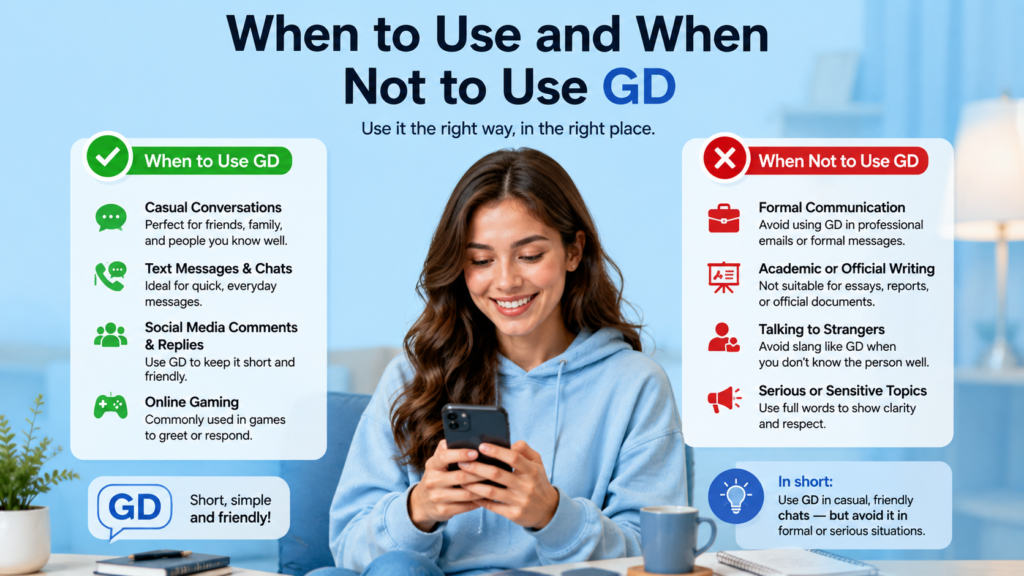
Since GD carries a mild curse-word meaning in one form, it’s worth knowing where it’s appropriate before you fire it off in any conversation.
Texting close friends: recommended Casual social media captions: recommended Group chats with peers: recommended Workplace emails: not recommended Messaging elders or teachers: not recommended Formal documents or resumes: not recommended
When to use GD:
In casual chats with friends who understand slang On social media where an informal tone is expected When greeting someone quickly, such as “GD guys!” In light-hearted, joking exchanges
When not to use GD:
In professional or workplace communication When texting someone religious who may find “God Damn” disrespectful In formal writing, essays, or official messages With people who might not know the abbreviation at all
A good rule of thumb is to think about how the recipient would react if they took the message literally. If there’s any chance it could come across as disrespectful or unprofessional, it’s safer to spell things out fully instead of relying on the abbreviation.
Also Read This Meaning X Mean in Text
Other Meanings of GD in Text
GD isn’t limited to just “Good Day” or “God Damn.” Depending on the community or context, it can also stand for several other things entirely unrelated to greetings or frustration.
Geometry Dash: a popular mobile and PC rhythm based game Grand Daddy or Grandad: used in some family group chats Gangster Disciples: a reference used in certain slang or regional contexts Group Discussion: common in academic or interview settings Graphic Design: used by artists and students online General Discussion: used on forums and Discord servers
Because GD has so many possible meanings, context is everything. A gamer typing GD in a Discord server dedicated to platformer games almost certainly means Geometry Dash, while a student mentioning GD before a job interview is almost certainly talking about a Group Discussion round. The surrounding conversation topic is usually the fastest way to figure out which meaning applies.
Similar Slang Words or Alternatives
If you’re looking for other ways to express the same feelings, here are some common alternatives people use instead of GD, grouped by the emotion or meaning they convey.
Good Day: GM (Good Morning), HAGD God Damn: OMG, WTH, SMH Frustration: FFS, UGH Excitement: OMG, LFG
These alternatives can be useful if you want to avoid any ambiguity altogether. Since GD carries multiple meanings, swapping it out for a clearer abbreviation can help make sure your message lands exactly the way you intend, especially with people who aren’t familiar with all of GD’s possible interpretations.
Why People Use GD in Texting

Texting slang like GD exists for a simple reason: speed and ease. Here’s why it’s become so popular across so many different platforms and age groups.
Quick: Typing two letters is faster than typing a full phrase, which matters in fast back-and-forth conversations where every second counts.
Convenient: It fits perfectly into small chat bubbles and character-limited platforms like Twitter/X, where shorter messages are often easier to read at a glance.
Casual and relatable: Using GD instantly signals a relaxed, informal tone between texters, making conversations feel more natural and less rigid.
Social media friendly: Short abbreviations like GD perform well in captions, comments, and quick reactions, since they don’t take up much space and are easy to scan.
Flexible: Because it can mean multiple things, GD adapts easily to different moods and situations, which makes it useful across a huge range of conversations.
Is GD Friendly or Rude?
This really depends on which meaning is being used and the tone of the message surrounding it.
Friendly: When used as “Good Day,” GD is warm, polite, and welcoming. It works well as a greeting among friends, coworkers in casual settings, or even strangers on social media.
Neutral: In many social media posts, GD is used casually without any strong emotional charge, just a filler expression that adds emphasis without meaning much on its own.
Strong or surprised: When used as “God Damn,” GD reflects frustration, shock, or emphasis, and can come across as rude to some readers, particularly those who take the phrase literally.
Frequently Asked Questions
What does GD mean from a girl in texting?
It usually means “Good Day” as a friendly greeting, unless the context suggests frustration, in which case it means “God Damn.”
Is GD a bad word?
Not exactly. GD is only mildly informal slang, though “God Damn” can be considered disrespectful in religious contexts.
What does GD mean on Snapchat or Instagram?
On social media, GD is typically used casually to mean “Good Day” or as an exclamation similar to “OMG.”
What does GD stand for in gaming?
In gaming communities, GD most often refers to Geometry Dash, a popular rhythm-based platformer game.
Can GD mean Group Discussion?
Yes, especially in academic, interview, or professional contexts, GD commonly stands for Group Discussion.
Is it okay to text GD to a teacher or boss?
It’s best to avoid it. GD is informal slang and isn’t suitable for professional or respectful communication.
Conclusion
So, what does GD mean in text? It really depends on the context. It could be a friendly “Good Day” greeting, a frustrated “God Damn,” or even a reference to something like Geometry Dash or a Group Discussion. The best way to understand it is to look at the tone of the conversation, the platform being used, and who you’re talking to.
Once you get the hang of spotting these context clues, decoding GD, and similar texting slang, becomes second nature. The next time it shows up in your messages, you’ll know exactly how to read it.

Hi, I’m Munaza, the creator of RTMeaning.com. I’m passionate about explaining internet slang, abbreviations, texting terms, and modern language in a simple and easy-to-understand way. Through this website, I help readers discover the meanings behind trending words, social media expressions, and online communication. My goal is to make learning new terms quick, clear, and enjoyable for everyone.