


If someone has texted you “hru” and you’re not sure how to reply, you’re not alone. It’s one of the most common pieces of internet shorthand in use today.
Once you know what it stands for, you’ll start noticing it everywhere. It shows up in group chats, gaming lobbies, DMs, and even quick check ins between coworkers on casual channels.
This guide breaks down exactly what HRU means, where it’s used, and how to respond to it. It also covers the small details, like tone and context, that decide whether it comes across as friendly, flirty, or just plain lazy.
Texting shorthand evolves fast, and HRU is one of the few abbreviations that has stayed relevant across nearly every generation of digital communication. Understanding it properly can help you avoid awkward misreads in conversation.
🧠 What Does HRU Mean in Text?
HRU stands for “How are you?” It’s a shortened, typing friendly version of one of the most common greetings in everyday conversation.
Instead of typing out four separate words, people condense the phrase into three simple letters. Each letter maps directly onto a word in the original question.
H = How R = Are U = You
You’ll usually see it written in lowercase, as “hru,” since capitalization rarely matters in casual texting. Most people don’t bother capitalizing shorthand unless they’re being deliberately expressive or emphatic.
It’s worth noting that HRU is almost always used as a question on its own, rather than blended into a longer sentence. That keeps it quick to type and quick to answer.
Why People Use HRU
People use HRU because it’s quick, low effort, and instantly understood by anyone familiar with texting culture. It saves keystrokes without losing the meaning or warmth of the original question.
In fast-paced conversations, especially on mobile keyboards, shaving off a few characters adds up over time. Multiply that saved effort across dozens of daily messages, and the appeal becomes obvious.
There’s also a social element. Using shorthand like HRU signals familiarity and casualness with the person you’re texting, which can make a conversation feel more relaxed from the very first message.
📱 Where Is HRU Commonly Used?

HRU shows up across nearly every messaging platform, though the tone can shift slightly depending on where it’s used. The platform often shapes how playful or neutral the phrase feels.
📲 Text Messages
The most common home for HRU. It’s typically used to check in on a friend or restart a conversation that’s gone quiet for a while.
Because texting is often between people who already know each other well, HRU here tends to feel warm and genuine rather than rushed.
Common in both one on one chats and group conversations, often paired with emojis to soften the tone. WhatsApp’s international user base also means HRU frequently mixes with other languages in the same message.
👻 Snapchat
Frequently used as a quick reply to a snap or story, keeping the streak-and-chat rhythm going. On Snapchat, HRU often functions less as a deep question and more as a way to keep engagement alive.
🎵 TikTok
Shows up in comment sections and DMs, usually in a playful, low stakes way. It’s rarely meant to start a serious conversation here and works more as a friendly nudge.
Common in DMs after someone views a story or reacts to a post. It’s a light way to open a conversation without seeming too forward or formal.
🎮 Gaming Chats
Used between teammates during loading screens or lobby downtime, often as small talk before a match. It helps break the silence while players wait for a game to start.
🤖 Discord
Popular in server chats and DMs, especially among communities that already lean heavily on abbreviations and slang. Discord’s fast moving text channels make short forms like HRU almost the default style.
Is HRU Formal or Casual?
HRU is strictly casual. It belongs in texts, DMs, and social chats, not in emails, cover letters, or professional messages.
In any professional or semi formal setting, “How are you?” should always be spelled out in full. Using HRU in a work email, for example, can come across as careless or overly informal, even if that’s not the intent.
The rule of thumb is simple: if you wouldn’t use other internet slang in that conversation, don’t use HRU either.
💬 Examples of HRU in Conversation
Here’s how HRU typically plays out in real conversations, across a range of everyday situations.
Example 1 “Hey! Hru?” “I’m good, just got back from class. Hru?”
Example 2 “Long time no talk lol hru” “Been busy with work, but doing okay! You?”
Example 3 “morning☀️ hru today” “Tired but surviving 😅”
Example 4 “hru, feeling better after yesterday?” “Much better, thanks for checking in”
Example 5 “yo hru doing” “pretty good, just chilling”
Example 6 “hru? saw your story, looked fun haha it was! I’m good, hru”
Example 7 “hru holding up with the move?” “stressed but almost done lol”
Notice how in each case, HRU adapts naturally to the surrounding tone. It can be paired with emojis, slang, or plain text and still make sense.
❤️ Why HRU Is So Popular
A few simple reasons explain why this three-letter phrase has stuck around for so long, even as texting trends have come and gone.
| Reason | Why It Matters |
| Faster | Fewer characters mean quicker replies, especially on small keyboards |
| Convenient | Easy to type with one hand or while multitasking |
| Familiar | Almost everyone who texts regularly recognizes it instantly |
| Friendly | Feels warmer and more casual than a formal “How are you?” |
| Great Conversation Starter | Low-pressure way to open or restart a chat |
These qualities together explain why HRU has outlasted many other short lived texting trends. It’s simple enough that it never really goes out of style.
🕒 When to Use and When Not to Use HRU

Knowing the right context keeps your texting style natural instead of awkward. HRU works well in some situations and poorly in others.
✅ When to Use HRU
Texting friends, siblings, or close contacts is the most natural fit for HRU. It also works well when chatting on social media or gaming platforms with people you already know.
It’s a good choice when casually checking in after some time apart, or when you simply want to keep a light, informal conversation going without overthinking your wording.
❌ When Not to Use HRU
Avoid HRU in professional emails or workplace messages, where it can seem unpolished. It’s also best skipped in first conversations with someone you don’t know well, since not everyone will immediately understand it.
Steer clear of HRU in formal or serious situations, such as discussing bad news, and never use it in messages to teachers, clients, or authority figures.
🤔 Does HRU Have a Flirty Meaning?
On its own, HRU is neutral; it simply means “how are you.” But context, tone, and who’s sending it can shift its meaning considerably.
Casual Example “hru? just got home from work” This is a plain, friendly check in with no hidden meaning behind it.
Flirty Example “hru cutie 😉 missed talking to u” Here, the added emoji and wording turn a basic question into a flirty opener.
So HRU itself isn’t inherently flirty. It’s the surrounding words, emojis, and relationship between the people texting that set the actual tone of the message.
Also Read This Meaning TY Mean in Text
🌎 Why Text Slang Like HRU Exists
Text slang like HRU exists because digital conversations favor speed and efficiency over formality. Early texting had strict character limits, and typing on small phone keypads was slow and tedious.
People naturally shortened common phrases to save time and effort. Over years of daily use, these shortcuts became embedded in everyday digital language.
Even though modern smartphones make typing easier, with autocorrect and predictive text, the habit has stuck. Abbreviations like HRU, WYD, and OMW remain popular because they feel quick, casual, and familiar across generations of texters.
In many ways, this shorthand has become its own dialect of digital communication, understood almost universally despite never being taught in a classroom.
🔄 Other Meanings of HRU
While “How are you?” is the dominant meaning in texting, HRU can stand for different things outside of casual chat.
| Context | Meaning |
| Texting/Social Media | How are you |
| Hydrology | Hydrologic Response Unit (used in watershed modeling) |
| Computer Security | HRU model (Harrison-Ruzzo-Ullman), an access-control security framework |
| Aviation | Airport code for Herington Regional Airport, Kansas |
| Academic/Organizational | Human Resources University, part of a U.S. federal agency |
These alternate meanings rarely overlap with texting contexts, so confusion is uncommon in practice. Still, it’s a useful reminder that abbreviations can carry very different meanings depending on the field.
📊 HRU Usage Comparison Table
| Platform | Common Usage | Tone |
| Text Messages | Checking in on someone | Neutral/Friendly |
| Group or 1-on-1 chats | Casual | |
| Snapchat | Replying to snaps/stories | Playful |
| Instagram DMs | Opening a conversation | Casual/Flirty (context-based) |
| Discord | Community/gaming chats | Casual |
| Gaming Chats | Small talk during matches | Casual |
This table is a handy quick reference if you’re unsure how HRU might land on a particular platform.
🔄 Similar Slang Words or Alternatives
If you want variety in your texting, several alternatives carry the same or a similar meaning as HRU.
WYD means “What you are doing.” HBU means “How about you.” SUP is short for “What’s up.” WBU stands for “What about you.” HAY is a less common variant of “How are you.”
Example: “hru today?” “Good! hbu?”
Mixing these alternatives into your texting can keep conversations feeling fresh instead of repetitive.
💡 How to Reply to HRU
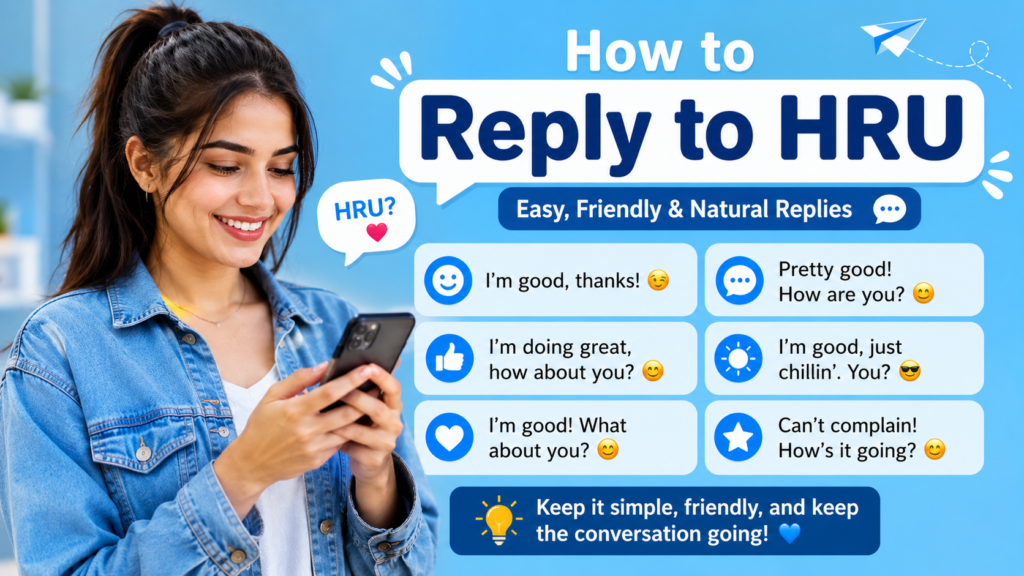
How you respond depends on your mood, the relationship, and how detailed you want to be in your answer.
Positive Responses
“I’m good, thanks! Hru?” “Doing great today 😊 you?” “Pretty good, just relaxing”
Neutral Responses
“I’m okay, nothing much going on” “Same as usual, hbu?” “Alright, just busy with work”
Honest Responses
“Not gonna lie, kind of a rough day” “A bit tired but hanging in there” “Stressed with exams but managing”
Choosing which type of response to give often depends on how much you want to share and how close you are with the person asking.
🚫 Common Mistakes When Using HRU
A few small missteps can make HRU feel out of place, even in otherwise casual conversations.
Using It in Professional Emails
Slang like HRU has no place in formal writing. Always spell out “How are you?” in professional contexts, no matter how relaxed the workplace culture might seem.
Assuming Everyone Knows It
Not every generation or every contact will instantly recognize HRU, especially in first-time conversations. Using it too early with someone unfamiliar with texting slang can cause confusion.
Overusing Slang
Stacking too many abbreviations in one message, such as hru, wyd, hbu, and sup together, can make texts feel cluttered or hard to read. A little shorthand goes a long way.
Conclusion
HRU is a simple, widely understood piece of texting shorthand for “How are you?” It’s fast, friendly, and fits naturally into casual conversations across texting apps, social media, and gaming platforms.
While it’s not appropriate for formal or professional messages, it’s a perfectly normal, even expected, way to check in on someone in everyday digital conversation.
Whether you’re the one sending HRU or replying to it, the key is matching the tone of the conversation. Keep it casual with friends, skip it in professional settings, and pay attention to context if you’re ever unsure whether it’s meant to be friendly or flirty.

Hi, I’m Munaza, the creator of RTMeaning.com. I’m passionate about explaining internet slang, abbreviations, texting terms, and modern language in a simple and easy-to-understand way. Through this website, I help readers discover the meanings behind trending words, social media expressions, and online communication. My goal is to make learning new terms quick, clear, and enjoyable for everyone.