
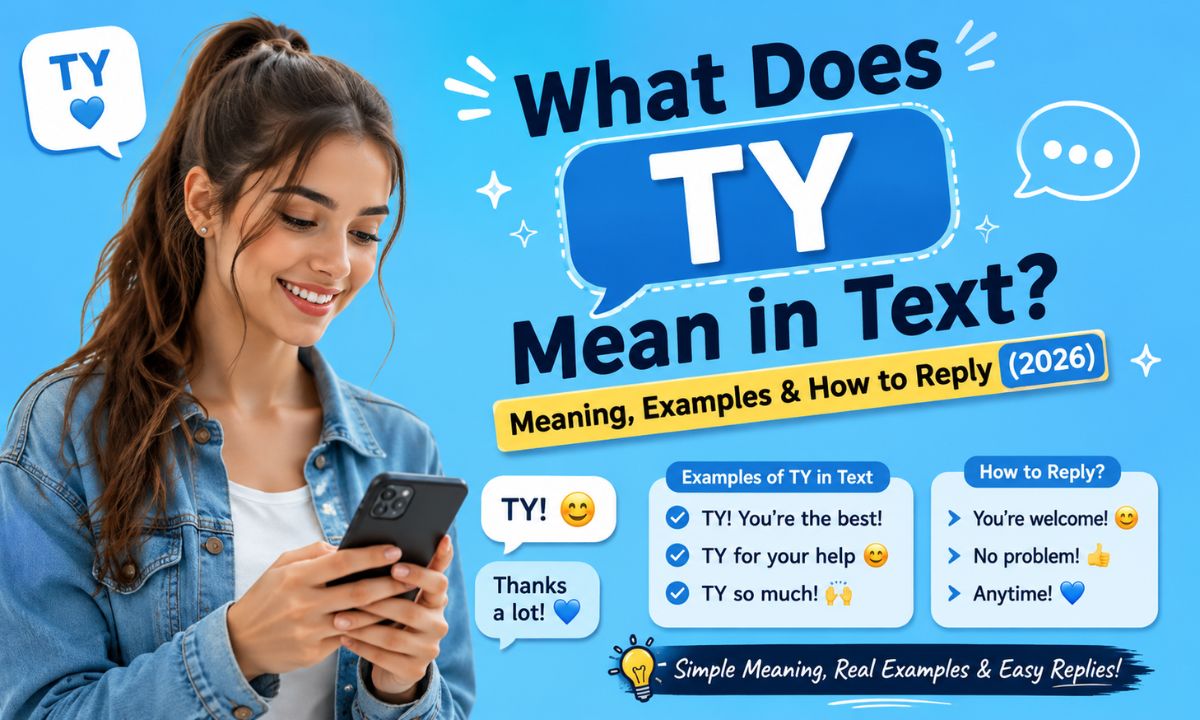

Scrolling through your DMs and spotted a quick “ty!” at the end of a message? You’re not imagining things, it’s everywhere right now, from Instagram comments to Discord servers, from group chats to comment sections on TikTok.
Almost everyone who spends time online has typed it, received it, or both, often without even thinking twice about it.If you paused for even a second wondering what it meant, this guide clears it up completely, with real examples and reply ideas you can use today.
By the end, you’ll not only know what TY stands for, but also when it fits, when it doesn’t, and how it compares to other similar abbreviations that show up in everyday digital conversation.
🧠 What Does TY Mean in Text?
TY is short for “Thank You.” It’s one of the simplest and most widely used abbreviations in texting and online chats. It belongs to a huge family of shorthand expressions that people rely on to keep conversations moving quickly, without losing the core meaning of what they want to say.
💡 Simple Breakdown:
T = Thank Y = You Meaning = A quick, casual way to say thanks Tone = Friendly, informal, and to the point
There’s no hidden meaning or trick behind it. When someone types “TY,” they’re simply expressing gratitude without spelling out the full phrase. It’s not sarcastic, it’s not coded language, and it doesn’t require any special context to understand. It is exactly what it looks like: a shortened, casual version of saying thank you.
What makes TY interesting is not its meaning, but how naturally it has slipped into daily communication. It’s become so common that many people type it automatically, almost like a reflex, whenever someone does something helpful, kind, or appreciated, even in the smallest way.
📱 Where Is TY Commonly Used?
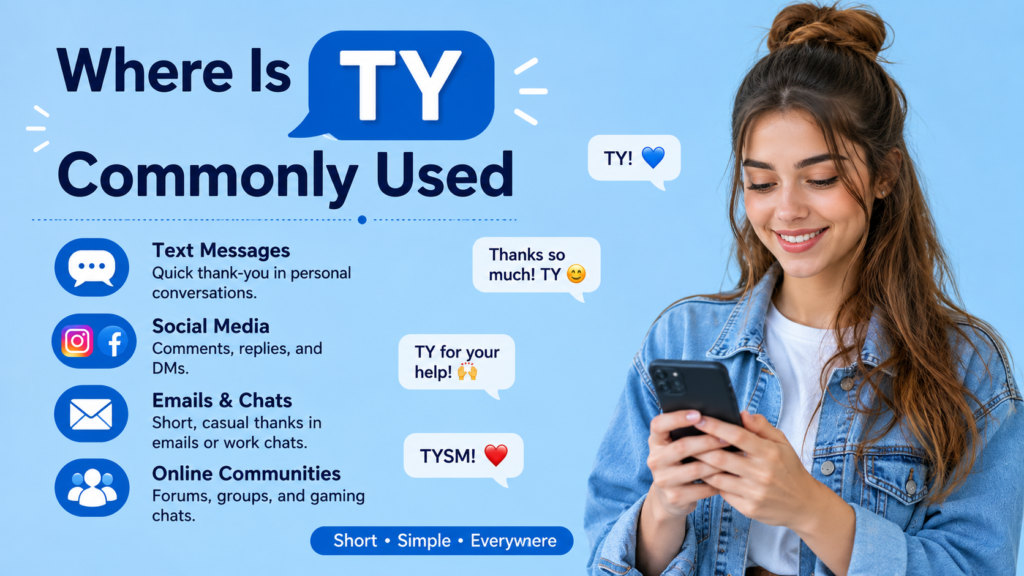
TY shows up almost anywhere people type quicklytexts, comments, gaming chats, and social platforms. Because it saves time and effort, it tends to appear most often in places where conversations move fast and people are typing on the go.
📍 Popular Platforms:
| Platform | How TY Is Typically Used |
| Quick replies in personal chats | |
| Comment replies and DMs | |
| TikTok | Comment sections, creator replies |
| Snapchat | Casual chat threads |
| Discord | Gaming and community servers |
| Twitter/X | Replies and quote tweets |
On WhatsApp, TY often appears at the tail end of a longer message, almost like a quiet closing note. On Instagram and TikTok, it’s frequently used by creators replying to dozens of comments, since typing “thank you” fully each time would take far longer.
Discord communities lean on TY heavily too, especially in gaming servers where players are focused on the game itself and don’t want to break concentration by typing out full sentences. Twitter and X users often use it in quick replies, especially when acknowledging retweets, shares, or supportive comments.
🧩 Tone & Style:
Casual and friendly Fast-paced, low effort typing Common among younger, digitally native users Rarely used in formal writing
Overall, TY fits naturally into environments where speed and informality are expected. It’s less about laziness and more about matching the rhythm of the platform it’s used on.
💬 Examples of TY in Conversation
Seeing TY in context makes it much easier to understand how natural it feels in everyday chats. Once you notice a few real examples, the abbreviation stops looking unusual and starts looking like an obvious shortcut.
Friend: “Here’s that photo you wanted.” You: “ty! 😊” Teammate: “I covered your shift today.” You: “ty so much, I owe you one” Comment: “Loved this post!” Reply: “ty 💛” Group chat: “Sent the notes over.” You: “ty!!”
Notice how TY often pairs with emojis or extra punctuation to add warmth, since the abbreviation alone can feel a little flat without it. A plain “ty” can sometimes come across as rushed or distracted, while “ty!! 😊” instantly feels warmer and more personal.
🕓 When to Use and When Not to Use TY
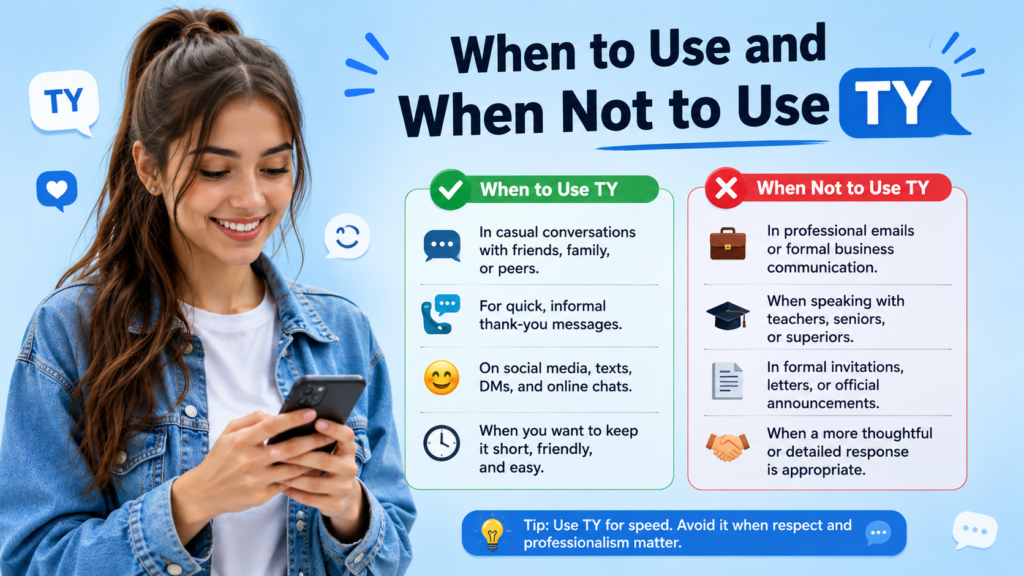
Knowing where TY fits helps you avoid sounding careless in the wrong setting. Like most internet slang, it works well in some spaces and poorly in others, and the difference usually comes down to how much the tone of the message matters.
✅ When to Use TY
Texting friends or family Replying to casual social media comments Gaming or Discord chats Quick acknowledgments where formality isn’t needed
In these situations, using TY is completely normal and often expected. Nobody reading a casual group chat is going to be offended or confused by a quick “ty,” and in fact, typing out a full “thank you” in every message might even feel a bit stiff or overly formal for the setting.
❌ When Not to Use TY
Professional emails Job applications or interviews Messages to teachers, clients, or bosses Any situation where tone matters and you want to sound sincere
In more serious or professional contexts, TY can come across as careless, rushed, or even slightly disrespectful, even though that’s rarely the intention behind it. A short abbreviation might suggest that you didn’t put much thought into the message, which isn’t the impression you want to leave with an employer, teacher, or client.
Writing out “Thank you” in full, in these situations, signals that you took the message seriously and respected the person you were writing to. It’s a small difference in effort, but it can noticeably change how a message is received.
🔄 Other Meanings of TY in Text
While “Thank You” is by far the most common meaning, TY can occasionally stand for something else depending on context, such as an initial, a shortened name, or “This Year” in niche threads. In everyday texting and social media, though, assume it means “Thank You” unless the conversation clearly points elsewhere.
For example, in a forum discussing personal names or usernames, TY might simply be someone’s initials or a short version of a name like Tyler or Tyson.
In some niche online communities, particularly ones discussing schedules, dates, or events, “TY” is occasionally shorthand for “This Year,” though this usage is far less common and usually only appears when the surrounding sentence makes the meaning obvious.
Context is really the deciding factor here. If someone says “ty” right after you’ve helped them with something, it’s almost certainly gratitude. If it appears in a sentence describing dates or people, it might mean something else entirely.
Also Read This Meaning THE Mean in Texting
🔄 Similar Slang Words or Alternatives
TY isn’t the only shorthand way to express thanks online. Several other abbreviations exist that carry a similar meaning but with slightly different levels of intensity or formality.
| Abbreviation | Meaning |
| TYSM | Thank You So Much |
| TYVM | Thank You Very Much |
| THX | Thanks |
| TNX | Thanks |
| 10Q | Sounds like “Thank You” |
| TYT | Thank You Too |
TYSM and TYVM are typically used when someone wants to express stronger appreciation than a plain “ty” would convey. THX and TNX are more casual, almost playful variations of “thanks,” often used interchangeably depending on personal texting habits.
“10Q” is a more unusual, phonetic version that plays on how the numbers sound when read aloud, and it tends to show up more often in playful or humorous contexts rather than serious ones.
Choosing between these alternatives usually comes down to how much gratitude someone wants to express and how casual the overall conversation feels.
🧾 Why People Use TY Instead of “Thank You”
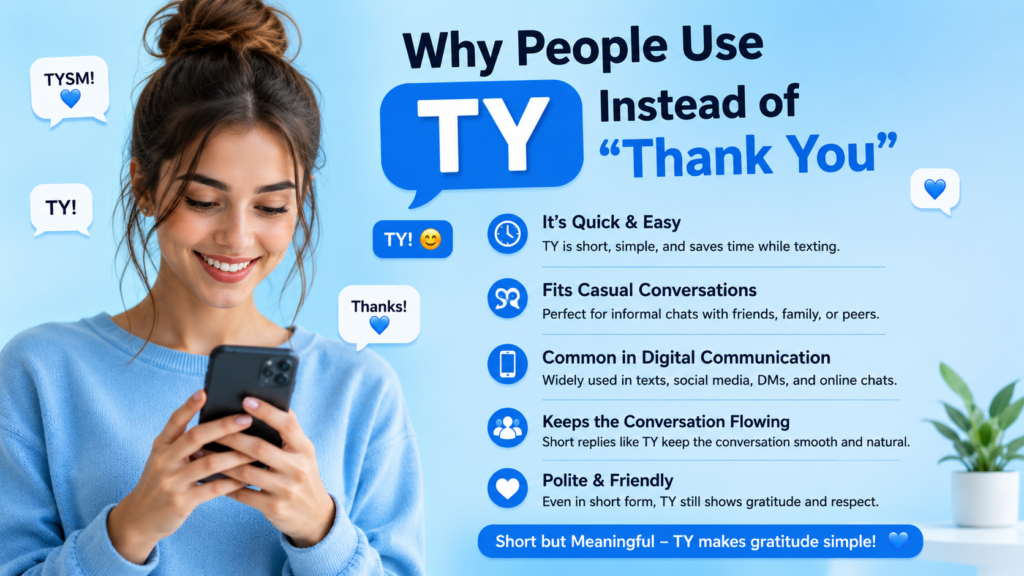
Abbreviations like TY didn’t appear randomly they grew out of how people actually communicate online today. Understanding why they exist helps explain why they’ve become such a permanent part of digital conversation rather than just a passing trend.
⚡ 1. Speed
Typing two letters is faster than typing a full sentence, especially mid conversation. When someone is juggling multiple chats at once, every second saved on typing adds up, and TY offers a quick way to acknowledge something without slowing down the flow of conversation.
📱 2. Mobile Communication
Small keyboards and quick replies naturally push people toward shorter phrases. Typing on a phone screen is inherently slower and more error-prone than typing on a full keyboard, so shortcuts like TY reduce the effort needed to communicate the same idea.
😎 3. Casual Tone
TY keeps conversations light and relaxed instead of overly formal. In friendly, informal settings, spelling out full sentences can sometimes feel unnecessary or even slightly awkward, while a quick abbreviation matches the relaxed energy of the conversation.
🌐 4. Internet Culture
Years of chat rooms, texting, and social apps have normalized abbreviations as a communication style, not just a shortcut. What started decades ago in early instant messaging and text messaging has evolved into an entire shared vocabulary that most internet users instinctively understand, regardless of age or platform.
🧠 Is TY Formal or Informal?
TY is informal. It works well in relaxed digital spaces but isn’t suited for professional or official communication. This distinction is worth remembering, since using the wrong tone in the wrong setting can unintentionally send the wrong message about how seriously you’re taking a conversation.
😊 Informal Use:
Friends and family chats Social media replies Gaming communities
In these spaces, TY blends in perfectly and often goes completely unnoticed, simply because it matches everyone else’s typing style.
🧑💼 Formal Use (Avoid):
Business emails Client communication Academic or professional writing
In these spaces, sticking to the full phrase “thank you” is almost always the safer, more respectful choice, since formal communication generally values clarity and completeness over speed.
💡 Emotional Meaning of TY
The same two letters can carry very different emotional weight depending on how they’re written. This is one of the more interesting aspects of texting culture: identical words can feel completely different depending on punctuation, spacing, and added emojis.
💛 Neutral:
“ty”is a simple, polite acknowledgement with no extra emphasis. It communicates gratitude without adding much personality or warmth beyond the basic message itself.
💙 Friendly:
“ty!! 😊”warmer, more personal, often between people who know each other well. The extra punctuation and emoji signal genuine enthusiasm rather than a quick, automatic reply.
❤️ Strong gratitude:
“TYSM 🙏❤️”signals real appreciation, usually reserved for bigger favors. This version is typically used when someone feels a stronger sense of thankfulness, such as after receiving significant help or a meaningful gesture.
📊 TY vs Full Phrase Comparison
| Feature | TY | “Thank You” |
| Length | 2 letters | 2 words |
| Tone | Casual | Neutral to formal |
| Best for | Texts, social media | Emails, professional settings |
| Speed | Very fast | Slower to type |
| Emotional depth | Light | Can feel more sincere |
This comparison highlights why both versions continue to exist side by side. Neither one is universally “better”; they simply serve different purposes depending on the setting, the relationship between the people involved, and how much weight the message needs to carry.
Final Thoughts
TY is a small abbreviation that carries a simple message of appreciation. It’s fast, friendly, and perfectly suited for everyday digital conversations just not for formal writing. Once you know the meaning, those quick “ty” replies stop feeling confusing and start feeling like exactly what they are: someone saying thanks, the modern way.
As digital communication continues to evolve, abbreviations like TY are likely to remain a permanent fixture of how people talk online. They reflect a broader shift toward efficiency and casualness in everyday language, without taking away from the genuine meaning behind the words.
Whether it’s a quick “ty” in a group chat or a heartfelt “TYSM” after a big favor, the underlying sentiment stays the same gratitude, expressed in whatever form fits the moment best.

Hi, I’m Munaza, the creator of RTMeaning.com. I’m passionate about explaining internet slang, abbreviations, texting terms, and modern language in a simple and easy-to-understand way. Through this website, I help readers discover the meanings behind trending words, social media expressions, and online communication. My goal is to make learning new terms quick, clear, and enjoyable for everyone.