
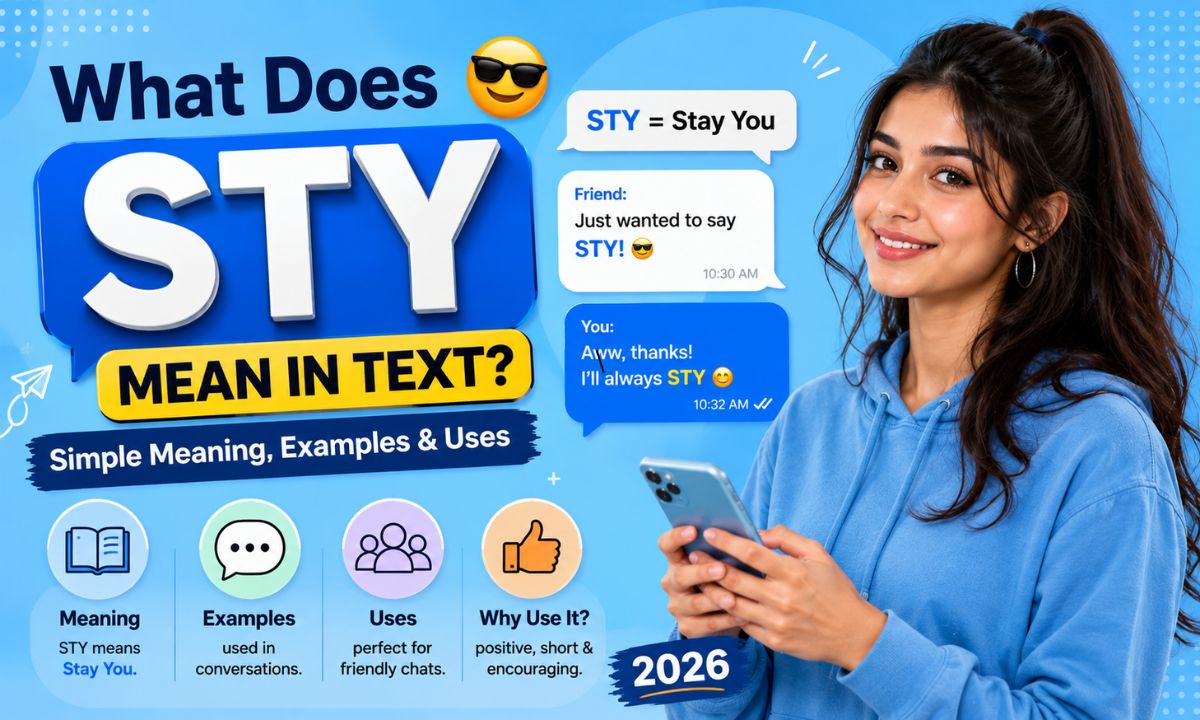

Texting slang moves fast, and if you’ve ever gotten a text that just says “STY” with no explanation, you’ve probably paused for a second wondering what your friend is actually trying to say.
You’re not alone. Abbreviations like this pop up constantly in group chats, Snapchat streaks, and Instagram DMs. They can leave even frequent texters scratching their heads for a moment.
Here’s the short version: STY almost always means “Same To You.” It’s a quick, casual way to return a greeting, a wish, or even a jab without having to type out a full sentence.
This guide breaks down everything you need to know about STY: where it comes from, how people use it, real conversation examples, other possible meanings, and when it’s actually a good idea to use it.
🧠 What Does STY Mean in Text?
When someone asks “what does STY mean in text,” the answer is almost always “Same To You.” It’s an initialism, meaning you say each letter individually (“EssTeeWhy”) rather than pronouncing it as one word.
That’s an important distinction from acronyms like “LOL,” which are read as a single word. STY is always spelled out letter by letter when spoken aloud, which is part of why it feels so casual and quick.
People use STY to echo back whatever the other person just said: a compliment, a wellwish, a greeting, or sometimes even something less friendly. It works almost like a verbal mirror, bouncing the same energy right back at the sender.
Why People Use STY
There are a handful of practical reasons this short abbreviation has become so popular in everyday texting.
- It’s faster to type than “same to you”
- It keeps the conversation light and casual
- It works as a natural, loweffort reply
- It fits the fast paced rhythm of texting and social media chats
- It avoids the awkwardness of repeating someone’s exact words back to them
Together, these reasons explain why STY shows up so often in casual digital conversations rather than fading away like other short lived slang terms.
📱 Where Is STY Commonly Used?

STY shows up mostly in informal digital spaces. You won’t typically see it in emails or workplace messages, but it’s everywhere in casual conversation between friends, family, and even acquaintances.
The platforms where STY thrives all share one thing in common: they’re built for quick, casual back and forth exchanges rather than formal communication.
📲 Popular Places You’ll See STY
| Platform | How Common Is STY? |
| Texting (SMS/iMessage) | Very common |
| Snapchat | Very common |
| Instagram DMs | Common |
| Group chats | Very common |
| TikTok comments | Common |
| Discord | Somewhat common |
| Email or work chat | Rare |
Snapchat and SMS tend to see the heaviest use of STY because both platforms encourage quick, back and forth streaks of short messages. Discord sees a bit less of it since conversations there often run longer and cover more detailed topics.
Communication Style
STY fits best in relaxed, friendly conversations between people who already know each other. It’s casual by nature, so it feels out of place in more formal or professional settings.
Using STY with a close friend feels natural and effortless. Using it in a message to a boss, teacher, or someone you’ve just met can come across as too informal or even a little careless.
💬 Examples of STY in Conversation
The easiest way to understand STY is to see it in action. Here are a few realistic texting scenarios that show how naturally it slots into everyday exchanges.
Example 1 A: Have a great day at work! B: STY 😊
Example 2 A: Good luck on your exam tomorrow! B: Thanks, STY!
Example 3 A: Merry Christmas! B: STY, hope you have a good one too.
Example 4 A: Have a safe flight! B: STY, see you when I land.
Example 5 A: You looked amazing tonight. B: STY 😉
Example 6 A: Hope your surgery goes well. B: STY, thank you for checking in.
Example 7 A: I hope your day sucks as much as mine did lol. B: STY.
Notice how STY almost always comes right after a wish, compliment, or greeting. It’s a mirror response, reflecting whatever sentiment was just sent, whether that sentiment is warm, playful, or even a little sarcastic.
🕓 When to Use and When Not to Use STY
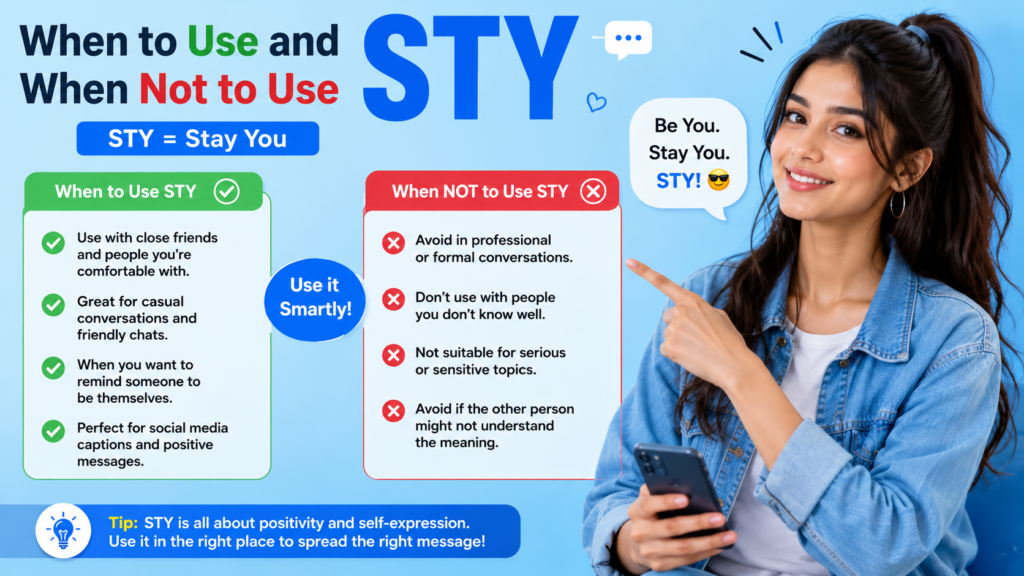
Like most slang, STY works great in the right context and falls flat in the wrong one. Knowing the difference can save you from an awkward or confusing exchange.
✅ When to Use STY
- Replying to a friend’s holiday or birthday wish
- Responding to a casual compliment
- Wrapping up a text exchange with good vibes
- Keeping a lighthearted back and forth going
- Reacting quickly to a Snapchat streak message
Examples
“Have a great weekend!” “STY!”
“Good luck with the interview!” “STY, thanks!”
❌ When Not to Use STY
- In professional emails or work Slack messages
- When texting someone you don’t know well
- In situations that call for a genuine, detailed response
- When the original message deserves more than a oneliner
- When discussing something sensitive or emotionally heavy
Better Alternatives
If the setting feels a bit too formal for STY, try one of these slightly more polished options instead.
- “You too!”
- “Same to you!”
- “Right back at you!”
- “Wishing you the same!”
These alternatives carry the same meaning as STY but read as a touch more thoughtful, which makes them safer choices for new acquaintances or semiformal conversations.
Also Read This Meaning YW Mean After Thank You in Text
🔄 Other Meanings of STY in Text
While “Same To You” is by far the most common meaning, STY can occasionally mean something else depending on the context of the conversation.
Sty (the eye condition) a small, painful bump on the eyelid, medically called a hordeolum, usually caused by a blocked oil gland or bacterial infection. If someone texts “I have a sty on my eye,” they’re talking about this, not slang.
In some casual or trenddriven conversations, “sty” is used as a shortened, playful version of “style,” especially when talking about outfits or aesthetics.
Stay is occasionally used as a quick shorthand for “stay,” particularly in fast typing or autocorrect slips where the letters get compressed.
Example
“Love your sty today” here, sty likely means style, not “same to you,” based on the context of the sentence.
This is exactly why context matters so much when decoding text slang. A three letter abbreviation can carry very different meanings depending on what surrounds it in the conversation.
🎯 Why Is STY So Popular?
STY has stuck around because it fits perfectly with how people actually communicate today: fast, casual, and low effort without losing warmth.
Texting habits have shifted heavily toward short bursts of communication rather than long, thoughtful messages, and STY fits neatly into that pattern.
Benefits of Using STY
- Speed three letters instead of a full sentence
- Familiarity once you know it, it becomes second nature
- Universality used across age groups, not just by teens
- Efficiency mirrors a sentiment without much typing
- Flexibility works in friendly, playful, or lightly sarcastic contexts
Texting culture rewards brevity, and STY delivers a full, friendly reply in a fraction of the effort it would take to type out a complete sentence.
😊 Is STY Friendly, Flirty, or Formal?
The tone of STY depends entirely on the conversation surrounding it, but here’s the general breakdown of how it tends to read in different settings.
Friendly
Most of the time, STY is simply warm and casual, a polite way to return good vibes without overthinking a reply.
Flirty
In a conversation that already has a flirty undertone, STY can carry that same energy. The acronym itself isn’t flirtatious; the surrounding context is what makes it feel that way. A winking emoji or playful compliment right before it usually sets the tone.
Formal
STY is never formal. In professional or unfamiliar settings, spelling out “same to you” is always the safer, more polished choice, since abbreviations can come across as careless in those situations.
🔄 Similar Slang Words or Alternatives
STY isn’t the only way to reciprocate a message quickly. Several other abbreviations serve a similar purpose across different platforms and age groups.
| Slang | Meaning |
| U2 | You too |
| SD | Same, dude / Same difference |
| YW | You’re welcome |
| NP | No problem |
| GN | Good night |
Most Similar Alternative
U2 is probably the closest match to STY. Both are quick ways to say “you too” or “same to you” without extra typing, and both work well in casual, friendly exchanges.
🌟 Why Context Matters When Reading STY
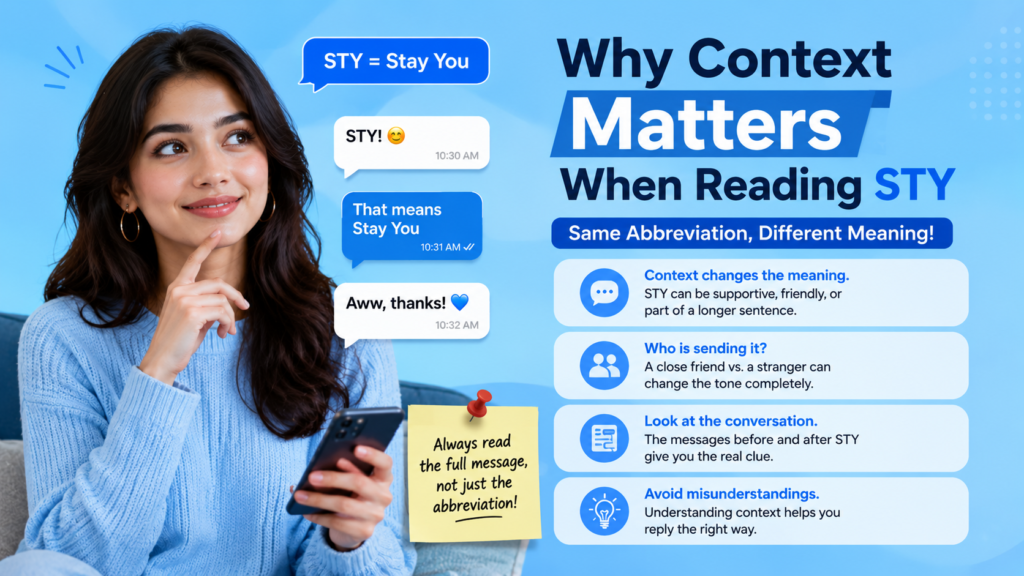
Because STY can technically mean more than one thing, reading the full conversation is the only reliable way to know exactly what someone means.
Conversation A A: Hope your headache goes away soon. B: STY, thanks. (Here, STY clearly means “Same To You,” reciprocating a wellwish.)
Conversation B A: My eye has been so swollen and red lately. B: Ugh, is it a sty? (Here, STY refers to the eye condition, not the slang term.)
Without context, “STY” alone could be confusing, but paired with the rest of the message, its meaning becomes obvious almost every time.
Sty Meaning in Chat From a Boy
When a guy sends “STY” in a chat, it usually carries the same core meaning “Same To You” but the tone often leans a bit more playful or flirty depending on the conversation.
If he’s replying to a compliment or a “good night” text, it’s typically just a warm, casual way of returning the sentiment. Paired with emojis or paired with a longer followup message, it can read as more affectionate, but on its own it usually stays fairly neutral.
What Does Sty Mean in Text Urban Dictionary
Urban Dictionary generally defines STY the same way most texting slang guides do: “Same To You.” Some entries also note its use as a quick jab or sarcastic comeback when someone sends an insult, making the tone highly dependent on context.
Because Urban Dictionary entries are crowdsourced, definitions can vary slightly from one submission to another, but the core meaning stays consistent across nearly all of them.
Sty Slang Style
In some casual or fashion focused conversations, “sty” is used informally as shorthand for “style,” especially when commenting on someone’s outfit, look, or aesthetic choices online.
This usage tends to show up more often in comment sections and captions than in one on one texting, where the “Same To You” meaning still dominates.
Sty Meaning Eye
Outside of texting slang, a sty (or stye) is a small, painful red bump that forms on or near the eyelid due to a blocked oil gland or bacterial infection.
It’s a completely different meaning from the “Same To You” slang and is usually clear from context, especially when the surrounding conversation mentions eyes, swelling, or discomfort.
Final Thoughts
STY is one of those small texting abbreviations that packs a lot into just three letters. Most of the time, it simply means “Same To You” a fast, friendly way to return a greeting, compliment, or wish.
But because language is flexible, STY can occasionally mean something else entirely, like a reference to style or even the eye condition.
The key takeaway: pay attention to the conversation around it. Once you get the hang of spotting the context, you’ll never be confused by an “STY” text again.

Hi, I’m Munaza, the creator of RTMeaning.com. I’m passionate about explaining internet slang, abbreviations, texting terms, and modern language in a simple and easy-to-understand way. Through this website, I help readers discover the meanings behind trending words, social media expressions, and online communication. My goal is to make learning new terms quick, clear, and enjoyable for everyone.