

If you have come across a message like “ion know what to do” or “ion care anymore” and paused to figure out what it means, you are not alone. Thousands of people search for this term every single day, especially after seeing it pop up on TikTok, Snapchat, or in a friend’s text message.
At first glance, it looks like it might be a science term, a random typo, or some kind of coded abbreviation. In reality, it is one of the most common and widely used slang expressions in modern digital conversation, and once you understand it, you will start noticing it everywhere.
This guide breaks down everything you need to know about “ion” — its real meaning, where it came from, how people use it in different situations, and when you should or should not use it yourself.
What Is “ion” Meaning in Text?
In texting and online slang, “ion” simply means “I don’t.” It is not an acronym in the traditional sense, even though it looks like one at first glance. It is actually a phonetic spelling of how “I don’t” sounds when someone says it quickly in casual, relaxed speech.
So when you see messages like these, the meaning becomes instantly clear:
“ion know” → I don’t know “ion care” → I don’t care “ion think so” → I don’t think so
There is no hidden acronym or complicated definition buried inside this word. It is simply a fast, informal way of writing something people already say out loud every single day, without giving it a second thought.
Why Do People Use “ion” in Digital Conversations?
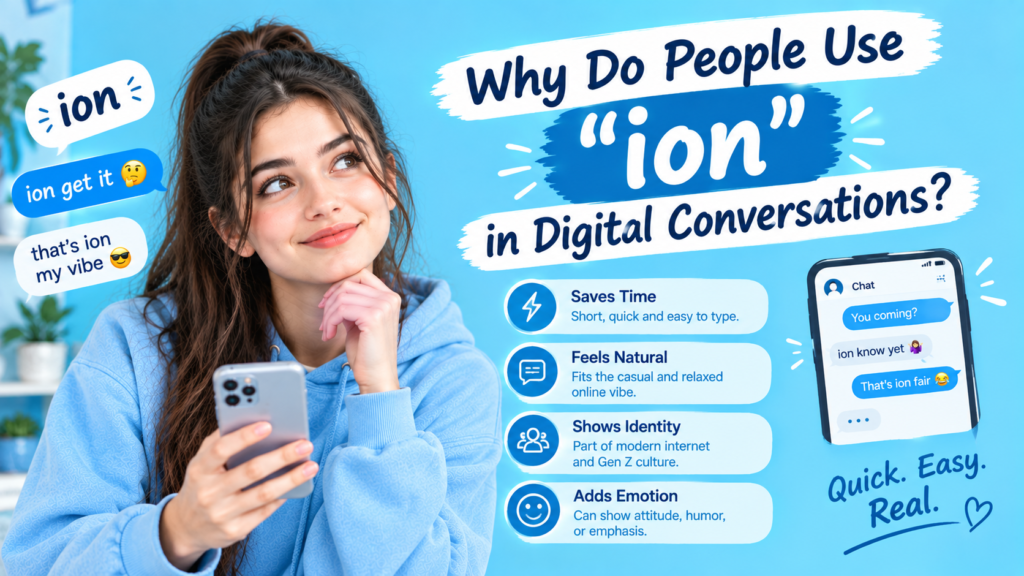
Texting culture rewards speed and tone over strict grammar rules. Full sentences can feel stiff or overly formal in a fast-moving conversation, so shortcuts like “ion” naturally start to take their place. People use “ion” for a few very practical reasons.
It is faster to type than “I don’t,” which matters a lot when conversations move quickly across multiple apps and threads. It also matches spoken rhythm, so texts end up feeling more like a real conversation instead of a written document.
Using “ion” also signals casualness, showing the other person that the conversation is relaxed rather than formal or tense. It fits naturally into mobile culture, where shorthand and phonetic spelling have become the norm rather than the exception.
In short, “ion” is not laziness. It is a deliberate stylistic choice that mirrors how people actually talk, and it carries its own tone that a full sentence simply cannot replicate in the same way.
Understanding the Rise of “ion” in Texting
“Ion” did not appear overnight, and it did not come from nowhere. It grew alongside a much broader shift in how younger generations communicate online, moving away from long, formal messages toward short, expressive ones.
As texting replaced phone calls and direct messages replaced traditional texting, language naturally became shorter, more phonetic, and more expressive overall. People started writing the way they actually speak, rather than the way textbooks teach grammar.
Platforms like TikTok, Twitter (now X), and Instagram accelerated this shift by rewarding quick, punchy captions and comments over long paragraphs. Slang that saves keystrokes while still sounding completely natural spreads extremely fast on these platforms.
“Ion” fit perfectly into that pattern, especially within Gen Z culture and AAVE-influenced (African American Vernacular English) texting styles, where phrases like this have long existed in spoken form before ever appearing on a screen.
“ion” – Quick Meaning
| Term | Meaning |
| ion | I don’t |
| ion know | I don’t know |
| ion care | I don’t care |
| ion think so | I don’t think so |
| ion want | I don’t want |
Tone: Casual, relaxed, informal Best used with: Friends, close contacts, social media captions and comments
Origin & Background
The word “ion” comes purely from pronunciation, not from any formal abbreviation rule. When people say “I don’t” quickly and casually in conversation, the two words blend together and often come out sounding like “eye-on,” which is essentially “ion.”
Over time, this spoken shortcut got typed exactly as it sounded, without anyone sitting down to officially invent it. It simply emerged the way most slang does, through repetition and shared understanding among people who talk the same way.
It works very similarly to how “going to” became “gonna” or “want to” became “wanna” in everyday speech. The internet did not invent the underlying sound of “ion” at all; it just gave that sound a written form.
Texting, comment sections, and social media captions then spread that written form until it became widely recognized slang far beyond its original communities. Today it is instantly understood by millions of people, even if they have never stopped to think about where it came from.
Also Read This Meaning MYF Meaning in Text
Real Life Conversations
Seeing “ion” in context makes its meaning much clearer than any dictionary definition could. The examples below show exactly how natural it sounds when it replaces “I don’t” in everyday exchanges between friends.
Example 1
Friend: “Are you coming to the party tonight?”
You: “I know yet, I might be busy.”
Example 2
Friend: “Did you watch the new episode?”
You: “I don’t care about that show anymore.”
Example 3
Friend: “Why didn’t you text back?”
You: “ion see your message till now.”
Example 4
Friend: “Are you still mad at him?”
You: “I think so, we’re good now.”
In every single case above, “ion” replaces “I don’t” without changing the underlying meaning of the sentence at all. What does change is the tone, which becomes noticeably lighter and more conversational.
Emotional & Psychological Meaning
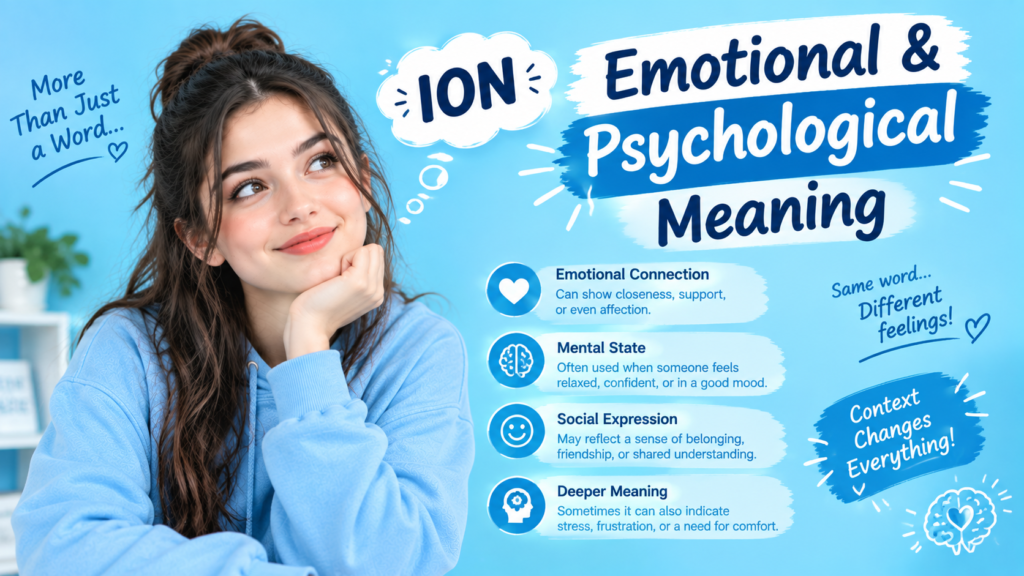
Slang like “ion” is not just about saving time when typing a message. It also carries subtle emotional signals that shape how the reader interprets what is being said, even if neither person consciously thinks about it.
When someone uses “ion,” they are often communicating comfort, since using casual slang shows they feel relaxed enough to skip formal grammar entirely. It also signals closeness, because casual slang typically appears between people who already know each other well.
There is also a low-stakes tone attached to the word, which softens statements and makes even a slightly negative response, like “ion like that,” feel less harsh than a fully spelled-out sentence would sound.
Compare the emotional weight of these two nearly identical messages. “I don’t appreciate that” sounds direct and possibly serious or upset. “ion appreciate that lol” sounds far more relaxed, even though the underlying sentiment is essentially the same.
The shorthand itself genuinely changes how a message lands emotionally, even when the core meaning behind the words stays exactly the same from one version to the other.
Usage in Different Contexts
“Ion” behaves quite differently depending on where it is used and who is reading it. Understanding these contexts helps avoid awkward misunderstandings in situations where the word simply does not fit.
With friends, it is extremely common and fully expected, fitting naturally into everyday back-and-forth texting without drawing any attention to itself. It feels like just another normal word in that kind of relaxed exchange.
On social media, it appears frequently in TikTok comments, captions, and tweets, helping people keep their responses short, punchy, and relatable to a wide audience scrolling quickly through their feed.
In group chats, “ion” adds a laid-back, informal tone that matches the fast pace of group conversation, where dozens of messages might be exchanged in just a few minutes.
In flirty or playful texting, it sometimes softens a statement or adds a bit of personality, especially when paired with emojis or other casual slang terms. In professional or formal settings, however, it is generally avoided altogether, since it can come across as unclear or simply too casual for the situation.
When NOT to Use It
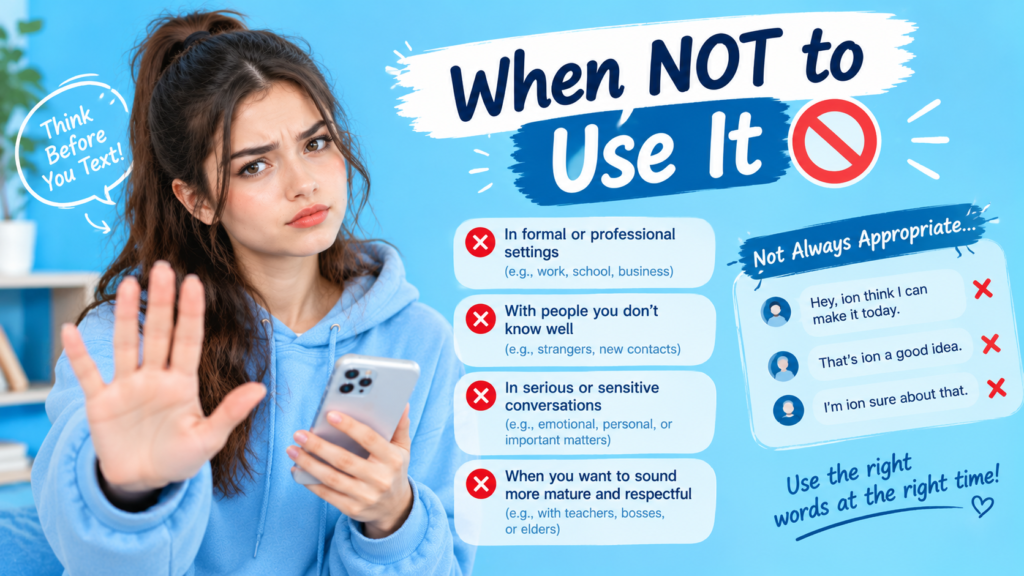
While “ion” works very well in casual settings, there are several clear situations where it is best avoided entirely. Recognizing these situations helps prevent messages from being misread or dismissed as unprofessional.
Work emails or professional messages are a major exception, since using “ion” there can look unprofessional or confusing to colleagues and supervisors who expect standard written language.
Messages to teachers, employers, or elders unfamiliar with slang are another clear exception, since these readers may not understand the term at all and could find it distracting or disrespectful.
Serious or sensitive conversations should also avoid casual slang like this, since it can unintentionally undercut the seriousness of the message being sent, even when that is not the intention at all.
First-time conversations with someone you do not know well are another situation worth avoiding, since the word may come across as overly familiar before that familiarity has actually been established. If there is any doubt about how the other person will interpret it, spelling out “I don’t” is always the safer choice.
Common Misunderstandings
Because “ion” looks unusual on the page, it leads to a few recurring mix-ups among people encountering it for the first time. Clearing these up makes the word much easier to use and understand correctly.
One common mistake is confusing it with the chemistry term. In science, an ion is a charged particle, while in texting it has absolutely nothing to do with chemistry or atomic structure whatsoever.
Another mistake is assuming it is simply a typo caused by autocorrect. In reality, it is intentional slang, not a mistake, and people type it deliberately because they know exactly what it means.
It is also sometimes mixed up with “I’m on,” since context usually clears this up quickly. For example, “ion the phone” would mean “I’m on the phone,” which is a rarer usage but does happen occasionally in real conversations.
Finally, some people mistakenly think it is a new acronym similar to “LOL” or “BRB.” Unlike those examples, “ion” is not built from initials at all; it is based purely on how the phrase sounds when spoken aloud.
Comparison Table
| Meaning | Example Sentence | Context |
| I don’t | “ion know the answer” | Most common usage |
| I’m on | “ion my way home” | Less common, context-dependent |
| Chemistry term | “A sodium ion has a positive charge” | Scientific, unrelated to slang |
Variations and Related Internet Slang
“Ion” often combines with other words to express very specific meanings, expanding well beyond the basic “I don’t” phrase into a whole family of related expressions.
Common variations include “ion know” for I don’t know, “ion care” for I don’t care, and “ion think so” for I don’t think so, all of which follow the exact same pattern established earlier.
Other versions include “ion even,” used to express shock or disbelief, along with “ion want,” “ion trust that,” and “ion feel like it,” each carrying its own slightly different shade of meaning depending on the sentence.
Related slang terms that follow a similar phonetic-shortening pattern include “idk” for I don’t know, “ngl” for not gonna lie, and “tbh” for to be honest. All of these were built for speed and casual tone rather than strict grammatical correctness.
How to Respond When Someone Uses It
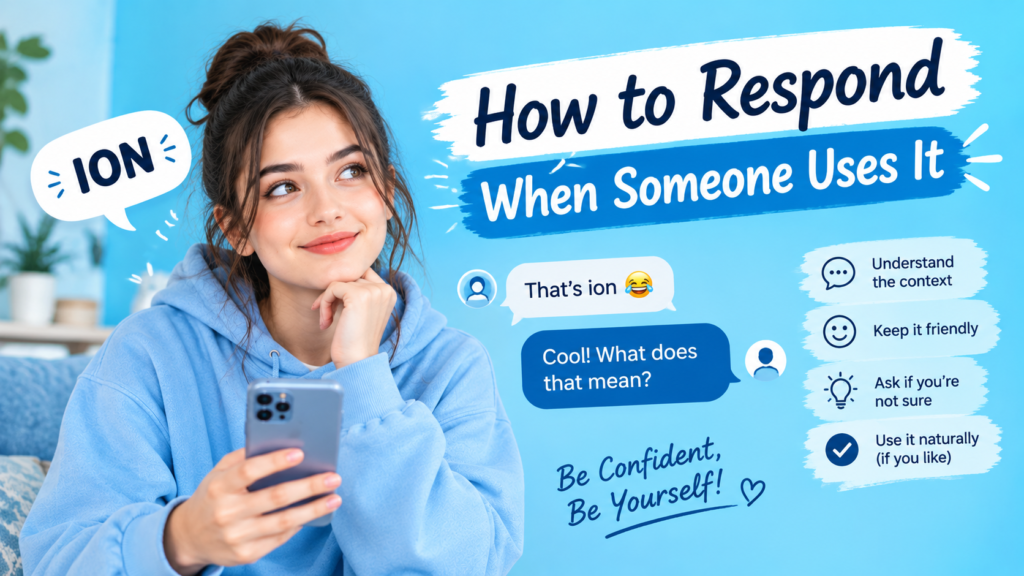
Responding to “ion” is genuinely simple. The best approach is to just reply naturally, treating it exactly as you would treat the full phrase “I don’t” in the same conversation.
If someone says “ion know,” a natural reply might be something like “That’s okay, let’s figure it out together,” which keeps the conversation moving forward without any friction.
If someone says “ion care,” a light response like “fair enough” keeps the overall tone casual and matches the relaxed energy of the original message. Matching their tone, rather than replying in an overly formal way, usually keeps the conversation flowing smoothly on both sides.
There is no special rule required for responding to this kind of slang. It should simply be treated exactly like any other normal, casual statement within the conversation.
Regional & Cultural Usage
“Ion” is especially common in American English, with strong roots in African American Vernacular English (AAVE), where phonetic contractions like this one have long been part of everyday spoken language.
From there, it spread widely through social media platforms, particularly TikTok and Twitter/X, gradually moving into mainstream youth culture across the United States and beyond its original communities.
While it remains most closely associated with American Gen Z slang, its popularity on global platforms means it is increasingly recognized, even if not always actively used, by English speakers internationally who consume the same content online.
Is It Safe for Kids?
Yes, “ion” is completely harmless slang. It carries no offensive or inappropriate meaning whatsoever, since it is simply a casual and shortened way of saying “I don’t” in everyday conversation.
That said, it does present a good opportunity for parents to talk with their kids about context and appropriate settings for different types of language.
Casual slang like “ion” is perfectly fine for texting friends, but formal language remains important for school assignments, emails, and conversations with teachers and adults who may not be familiar with texting shorthand.
Conclusion
“Ion” is a simple piece of internet slang with a straightforward meaning: “I don’t.” It grew naturally out of everyday pronunciation, spread widely through texting and social media platforms, and now shows up everywhere from TikTok comments to casual group chats among friends.
While the word has nothing at all to do with chemistry, context almost always makes its intended meaning clear within a matter of seconds. Anyone who sees it in a normal conversation will immediately understand that it simply means “I don’t,” without any confusion.
Used with friends and in casual settings, “ion” adds a relaxed, conversational tone to texting that full sentences cannot always match. Just remember to switch back to complete, formal sentences in professional or serious situations, and you will never be confused by “ion” again.

Hi, I’m Munaza, the creator of RTMeaning.com. I’m passionate about explaining internet slang, abbreviations, texting terms, and modern language in a simple and easy-to-understand way. Through this website, I help readers discover the meanings behind trending words, social media expressions, and online communication. My goal is to make learning new terms quick, clear, and enjoyable for everyone.