


If you have ever opened a message that simply read “hyy” and paused for a moment, you are far from alone. This short five letter word keeps appearing across WhatsApp, Instagram, Snapchat, and TikTok, leaving many people wondering whether it is a typo, a hidden code, or something else entirely. Here is a complete breakdown of what HYY really means and how people use it in 2026.
HYY – Quick Meaning
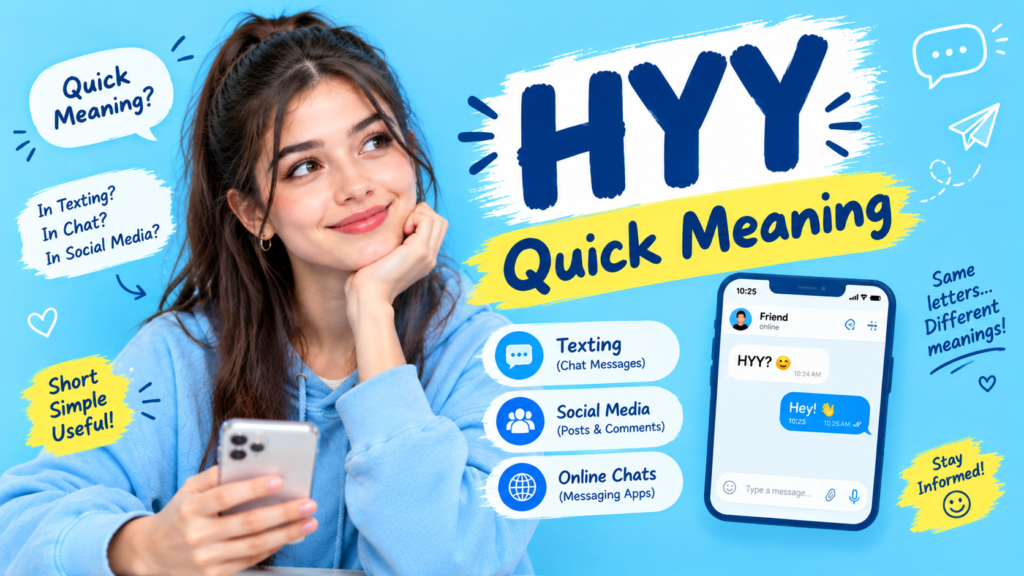
In simple terms, HYY means “hi” or “hey.” It is an informal, stretched-out spelling of a greeting rather than an acronym or abbreviation carrying a secret meaning.
Quick facts about HYY:
- Full form: None it is a stylized spelling, not letters standing for separate words
- Closest meaning: Hi / Hey / Hello
- Tone: Friendly, casual, sometimes playful or flirty
- Common platforms: WhatsApp, Instagram DMs, Snapchat, TikTok comments, texting apps
Think of it the same way you would think of “heyy” or “hiii” , someone adding a few extra letters to make an ordinary greeting feel a little more expressive and personal.
Origin & Background
HYY does not trace back to a dictionary entry or an official coinage. It grew naturally out of texting culture, where people have always experimented with spelling to give short messages more personality and warmth.
The pattern actually goes back further than most people assume:
- Early messaging era (2000s): Platforms like MSN Messenger and AIM saw users stretching words such as “hiiii” and “heyyy” to sound livelier than plain text allowed.
- Smartphone and social app era (2010s): As WhatsApp, Facebook Messenger, and Instagram DMs became dominant, letter-swapping grew even more common, and “hyy” started appearing as a quicker alternative to “heyy.”
- Short-form video era (2020s–2026): TikTok and Snapchat culture pushed casual, low-effort typing even further, turning variations like HYY into an everyday part of chat rather than something unusual.
No single person or platform can be credited with inventing HYY. It is simply one branch of a much larger habit: typing the way people naturally speak, complete with stretched sounds and a softened tone. This kind of playful spelling has always thrived in informal digital spaces, and HYY is just the latest expression of that ongoing trend.
Language evolves fastest in places where speed and emotion matter more than formality, and texting is exactly that kind of space. As new apps rise and fall, small spelling habits like HYY tend to survive because they solve a real problem: making short text feel a little more human.
Real Life Conversations
Seeing HYY in context makes its meaning obvious almost instantly. Here are a few natural examples of how it shows up in everyday chats:
- Friend to friend: “hyy!! what are you doing today”
- Someone starting a conversation on social media: “hyy, I saw your post, it was so good”
- A crush texting first: “hyy 😊 haven’t talked in a while”
- Casual check-in: “hyyy you up?”
In each of these cases, HYY performs one simple job: opening the conversation in a relaxed, non-intimidating way. It works like the digital version of a small wave or a soft “hey there,” lowering the pressure before the real conversation even begins.
These examples also show that HYY rarely appears alone for long. It usually leads into a question, a comment, or a follow-up line, functioning as a doorway into the actual conversation rather than the conversation itself.
Emotional & Psychological Meaning
Small spelling choices carry real emotional weight in texting, and HYY is no exception. Because text messages lack tone of voice or facial expression, people rely on things like extra letters, punctuation, and emojis to signal how they feel.
Here is what HYY often communicates emotionally:
- Warmth: The extra “y” softens the greeting compared to a blunt, plain “hi.”
- Low pressure: It signals a relaxed, no-big-deal opener rather than something urgent or demanding.
- Interest: In flirtier contexts, it can hint that the sender is genuinely happy to be reaching out.
- Approachability: It reads as friendlier and less stiff than a formal greeting would.
None of this is guaranteed, of course, since tone always depends on who is sending the message and the history shared between the two people. Still, compared to a flat “hi,” HYY generally reads as a touch more inviting and personal.
Psychologically, stretched-out greetings like this one also reduce the perceived risk of starting a conversation. A casual opener feels easier to send and easier to ignore if needed, which is part of why it remains so popular among people testing the waters with someone new.
Also Read This Meaning ION Stand For in Text
Usage in Different Contexts
HYY does not carry the exact same meaning in every situation. Context plays a major role in shaping how the word should be interpreted.
| Context | Likely Meaning |
| From a close friend | Casual, everyday greeting |
| From a crush or new match | Playful, possibly flirty opener |
| From a coworker or classmate | Simple, informal hello |
| In a group chat | Attention-grabbing or lighthearted greeting |
| From an unknown number | Could be a genuine greeting, a wrong number, or, rarely, spam |
| In social media comments | Friendly acknowledgment or reaction |
The word itself stays exactly the same across all of these situations; it is the relationship and the platform that shift the meaning underneath it. A message from a longtime friend will almost always be read differently than the same message from a stranger, even though both simply typed “hyy.”
When NOT to Use It
HYY is casual by nature, which means it does not fit every kind of conversation. It is worth avoiding in a handful of situations:
- Professional emails or work messages: it reads as too informal and can undercut credibility.
- First-time formal introductions, a proper: “hello” or “hi” leaves a stronger first impression.
- Serious or sensitive conversations: a playful greeting can feel mismatched if the topic that follows is heavy.
- Messaging someone you don’t know well in a formal setting: may come across as overly familiar or presumptuous.
If the setting calls for polish or professionalism, a standard “hi” or “hello” remains the safer, more reliable choice. Using HYY in the wrong setting rarely causes serious harm, but it can quietly signal a lack of awareness about the situation’s tone.
Common Misunderstandings
Because HYY looks a little unusual at first glance, it gets misread more often than people might expect. Some common mix-ups include:
- Thinking it’s an acronym people sometimes search for a “full form,” but HYY is not short for anything specific at all.
- Assuming it’s sarcastic or rude in nearly every case, it is meant warmly, not as a jab or dismissive remark.
- Confusing it with a typo some readers assume the sender meant to type “hey” and simply mistyped it, when the spelling was intentional.
- Reading too much into the tone a single HYY rarely reveals someone’s exact feelings; the surrounding conversation matters far more than the greeting alone.
When in doubt, the safest interpretation is also the simplest one: someone is just saying hello in a friendly, low key way.
Comparison Table
Here is how HYY compares to similar greetings commonly used in texting:
| Slang Term | Meaning | Typical Tone |
| Hi | Standard greeting | Neutral |
| Hey | Slightly more relaxed than “hi” | Friendly |
| Hii | Soft, cute greeting | Warm |
| Heyy | Playful or flirty | Warm/flirty |
| Hyy | Casual, expressive greeting | Friendly, sometimes flirty |
| Hy | Very short version of “hi” | Quick, casual |
Placed side by side, these variations show how small spelling tweaks can shift the emotional tone of a greeting without changing its basic meaning at all.
Variations & Types
Texting greetings evolve constantly, and HYY has a handful of close relatives that show up in similar conversations:
- Hyyy / Hyyyy extra letters push the tone toward more enthusiasm or excitement
- Hyy 😊 / Hyy 👋 paired with emojis to make the friendliness more obvious
- Hyy u combines the greeting with an immediate follow-up question
- Hy a shorter, quicker cousin of HYY, often used when someone is typing fast
These variations do not change the core meaning much. They mostly adjust the intensity or energy of the greeting, letting the sender fine-tune how enthusiastic or relaxed they want to sound.
How to Respond When Someone Uses It
Replying to HYY does not require overthinking. A few solid response options include:
- Mirror the energy: Reply with “Hyy!” or “heyy” to match the casual tone.
- Add a question: “Hyy, what’s up?” keeps the conversation moving forward naturally.
- Use a simple hi back: A plain “hi” or “hey” is completely fine if that fits your personal style better.
- Add an emoji: A wave, a smile, or a heart can soften a short reply and keep things warm.
There is no single wrong way to respond, as long as the tone roughly matches the vibe of the original message. Matching energy tends to keep the conversation feeling natural rather than forced.
Regional & Cultural Usage

HYY is not tied to one specific country or language group. It is more common wherever English-based texting culture is strong, including among younger users in the US, UK, India, Pakistan, and other regions with heavy smartphone and social media use.
A few patterns are worth noting:
- It is especially popular among Gen Z and younger millennials, who tend to favor stretched, expressive spellings in casual chat.
- It shows up more often in DM culture, such as Instagram and Snapchat, than in formal messaging apps used mainly for work.
- In multilingual texting communities, HYY often mixes naturally with local languages, since it functions more like a sound than a strict English word.
Because it is not tied to a specific slang dictionary or region, HYY spreads fairly evenly across platforms rather than staying niche to one app or country. Its simplicity is likely a big reason it travels so easily between different online communities.
Is It Safe for Kids?
Generally, yes HYY itself is harmless. It is simply a casual way of saying hello, with no hidden or inappropriate meaning built into the word itself.
That said, a few points are worth keeping in mind for parents or guardians:
- The word is safe, but context still matters. A casual “hyy” from a stranger online deserves the same caution as any unsolicited message from someone unknown.
- It is common in normal peer-to-peer texting. Kids using it with friends or classmates reflects typical, everyday chat behavior.
- Watch the conversation, not the word. If a message thread moves from a friendly “hyy” into something uncomfortable or inappropriate, that shift is the real red flag not the greeting itself.
As with most internet slang, HYY is neutral on its own. The surrounding conversation and the relationship between the two people are what actually determine whether a chat is appropriate.
Final Thoughts
HYY is one of those small texting habits that says a lot without saying much at all. It is not an acronym, it does not hide a secret meaning, and it is not something worth overanalyzing.
At its core, it is simply a warmer, more playful way of saying hi, shaped by years of people stretching greetings to sound friendlier in text. This small habit reflects a much bigger pattern in how digital communication keeps evolving over time.
Whether it lands in your DMs from a friend, a classmate, or someone you are just getting to know, the safest and most accurate reading stays the same: someone is saying hello, and probably hoping you will say it back.

Hi, I’m Munaza, the creator of RTMeaning.com. I’m passionate about explaining internet slang, abbreviations, texting terms, and modern language in a simple and easy-to-understand way. Through this website, I help readers discover the meanings behind trending words, social media expressions, and online communication. My goal is to make learning new terms quick, clear, and enjoyable for everyone.