

Few three-letter acronyms have traveled as far across internet culture as ASL. It began as a simple question typed by strangers in early chatrooms, and it has since picked up an entirely new life as a slang intensifier used by a younger generation online.
Understanding ASL today means understanding that the same letters can carry completely different messages depending on where you see them, who wrote them, and how they are styled on the screen.
Quick Answer
ASL has three common meanings depending on context: it can mean “Age, Sex, Location” (an old chatroom question), “as hell” (a modern Gen Z intensifier, like “funny asl”), or American Sign Language. The correct meaning depends entirely on where you see it and how it’s used in the sentence.
If someone texts “ASL?” As a standalone question, they are likely asking for your age, sex, and location. If you see it lowercase inside a sentence, like “that’s hilarious asl,” it means “as hell.” And if it’s used in an educational or accessibility context, it almost always refers to American Sign Language.
What Does ASL Mean?
ASL is a three letter acronym that internet users have repurposed several times over the last two decades. It started in early chatrooms, evolved through texting culture, and now lives a double life on TikTok and Snapchat as slang for emphasis.
The acronym never really disappeared between eras. Instead, each generation of internet users layered a new meaning on top of the old one, without fully retiring what came before. That is part of why confusion still happens today.
Because the abbreviation is so short, context clues capitalization, sentence position, and platform matter more than the letters themselves. A single word this small carries almost no meaning on its own; it borrows meaning entirely from its surroundings.
This is also why ASL is a useful case study in how internet slang evolves. It shows how a functional, practical phrase from the chatroom era can be reshaped into a purely expressive tool by a later generation of users.
Full Definition
Here is a quick breakdown of the three main meanings you will run into:
| Meaning | Common Use | Typical Platform | Example |
| Age, Sex, Location | Asking for basic info from a stranger | Old chatrooms, Omegle, dating apps | “ASL?” |
| As Hell | Intensifier for emphasis | TikTok, Snapchat, texting | “This test was hard asl.” |
| American Sign Language | Referring to the language itself | Education, accessibility content | “She’s learning ASL.” |
Each of these three meanings developed in a completely separate cultural moment, yet all three continue to coexist online today. None of them has fully replaced the others.
ASL as “Age, Sex, Location”
This is the original meaning of ASL, born in the 1990s and early-2000s chatrooms like AOL and later Omegle. It was a fast way for strangers to size each other up before continuing a conversation.
Back then, anonymous chat was a novelty, and asking “ASL?” was almost a social ritual. It let two strangers skip small talk and get straight to deciding whether the conversation was worth continuing.
- Usually written as a question: “ASL?”
- Common in anonymous chat rooms and early dating platforms
- Considered outdated by most Gen Z users today
Many younger users online have never actually used this meaning in a real conversation. They may recognize it historically, from memes or nostalgia content, without ever having typed it themselves.
ASL as “As Hell” (Gen Z Slang)
This is the version you will see most often in 2026. It works as an intensifier, replacing words like “extremely” or “really.”
The appeal of this usage is its casual, almost throwaway tone. It adds punch to a sentence without sounding like the user is trying too hard, which fits naturally into fast-paced comment sections and captions.
- Written in lowercase, mid-sentence: “tired asl,” “cute asl,” “cold asl”
- Popular on TikTok comments and captions
- Functions grammatically the same way “as f***” does, but without the profanity
Because it avoids profanity while still carrying a similar emphatic punch, “asl” has become a popular substitute in spaces where stronger language might be filtered, flagged, or simply feel out of place.
Also Read This Meaning Aura Mean in Text & Slang
ASL as “American Sign Language”
This is the formal, non slang meaning a complete visual language used by the Deaf and hard of hearing community in the U.S. and parts of Canada.
Unlike the other two meanings, this one is not slang at all. It refers to a fully developed language with its own grammar, syntax, and regional variations, entirely separate from spoken English.
- Used in education, interpreting services, and accessibility discussions
- Almost always capitalized
- Context is usually formal or informative, not casual texting
Because this meaning carries real linguistic and cultural weight, it is worth treating with more care than the two slang meanings. Mixing it up with casual internet slang can come across as dismissive in the wrong setting.
Context and Usage
When to Use Each Meaning
The safest rule of thumb: capitalization and sentence structure signal intent.
- “ASL?” (capitalized, standalone) → Age, Sex, Location
- “so funny asl” (lowercase, mid-sentence) → As Hell
- “I’m studying ASL” (capitalized, formal topic) → American Sign Language
None of these rules are perfectly strict, since informal texting often ignores capitalization altogether. Still, this pattern holds well enough that it works as a reliable first guess in most everyday conversations.
The Generational Divide
Older millennials and Gen X internet users tend to associate ASL with “Age, Sex, Location” because that is how they encountered it. Gen Z, on the other hand, mostly uses it as slang for “as hell” and may not even recognize the chatroom meaning.
This generational gap is exactly why the same three letters can cause confusion between a parent and a teenager texting each other. The disconnect is not really about the letters themselves, but about which internet era shaped each person’s default assumption.
Family group chats and cross generational texting are where this mismatch shows up most often. A parent asking “ASL?” out of habit can genuinely confuse a teenager who has never seen that meaning used seriously.
Real-Life Examples
Here’s how ASL shows up in actual conversations across different situations:
- ASL as Age, Sex, Location: “Hey, wanna chat? ASL first?”
- ASL as “As Hell” (Texting): “This homework is confusing asl.”
- ASL as “As Hell” (TikTok Comment): “Bro said something smart asl 💀”
- ASL on Snapchat: “That party was wild last night.”
- Mixed Generational Context: A parent asks “What’s your ASL?” thinking it means age/location, while the teen replies with a joke assuming they meant “as hell.”
These short examples highlight just how much the surrounding sentence does the work of clarifying meaning. Strip away the context, and the three letters alone would be genuinely ambiguous.
Platform-Specific Meaning
Different apps tend to favor different meanings of ASL. Here’s a general breakdown:
| Platform | Most Common Meaning |
| As Hell (casual chats) | |
| Snapchat | As Hell / occasionally Age, Sex, Location |
| TikTok | As Hell (comments and captions) |
| As Hell (captions, DMs) | |
| Dating Apps | Age, Sex, Location (older users) |
| Gaming Chats and Omegle | Age, Sex, Location |
Platform culture plays a bigger role in shaping meaning than most people realize. The same word can shift meaning entirely just by moving from a gaming lobby to a TikTok comment section.
On WhatsApp, ASL is almost always used casually as “as hell,” especially among younger users texting friends. It rarely appears as a genuine request for personal information in this setting.
Group chats on WhatsApp tend to reinforce the slang usage even further, since one person’s use of “asl” as an intensifier quickly normalizes it for the rest of the group.
Snapchat
Snapchat sees a mix, but “as hell” dominates in captions and story replies, while “Age, Sex, Location” still appears in stranger-to-stranger chats. The platform’s mix of close-friend messaging and semi-anonymous public content explains this split.
Snapchat’s Discover and public story features expose users to influencer-style captions, which tends to push the slang meaning further into everyday use among younger audiences.
TikTok
TikTok comment sections are the epicenter of the “as hell” usage; you’ll see it constantly under viral videos. Comment culture on TikTok rewards short, punchy phrasing, and “asl” fits that style perfectly.
Because TikTok trends spread so quickly across other platforms, phrases that start there, including this use of ASL, often get copied onto Instagram, X, and group chats within days.
Instagram DMs and captions mirror TikTok’s usage, favoring the slang intensifier over the older chatroom question. This is especially true among users under 25.
Instagram’s caption culture, which values short and quotable lines, aligns naturally with an intensifier like “asl” that adds emphasis without adding length.
Dating Apps
Dating platforms, especially anonymous or open-chat style apps, still use ASL in its original “Age, Sex, Location” sense. This is more common among older users of these platforms than among Gen Z daters.
Because dating apps often involve talking to complete strangers, the practical, information-seeking version of ASL still serves a real purpose there, unlike in most casual social media comment sections.
Gaming Chats and Omegle
Gaming lobbies and anonymous chat sites like Omegle keep the classic meaning alive, since strangers still use it to vet who they’re talking to. Anonymity is the common thread across these platforms.
Voice and text chat in online games often involves meeting people with no prior connection, so the original screening function of “ASL?” still has practical value in that environment.
Alternative Meanings
Beyond the three primary definitions, ASL occasionally pops up as:
- “As Stated (Late)” in some niche forum contexts
- A shorthand in legal or technical documents (rare, and industry-specific)
- “Age Sex Location” without punctuation, functioning identically to the punctuated version
These alternative uses are far less common and typically only appear in specific niche communities. Most everyday internet users will never encounter these variants at all.
If you do run into one of these rarer uses, the surrounding document or community context will usually make the intended meaning obvious fairly quickly.
Related Terms and NLP Variations
People searching for ASL often also search related slang terms, including:
- “af” (as f***) the more explicit version of “as hell”
- “fr fr” (for real, for real)
- “rizz,” “skibidi,” and other Gen Z slang terms
- “ASL check” a phrase used to ask someone to confirm their age/sex/location
These related terms are part of the same broader wave of short, expressive slang that has come to define casual internet writing over the past several years. Learning one often makes the others easier to recognize.
How to Respond to ASL
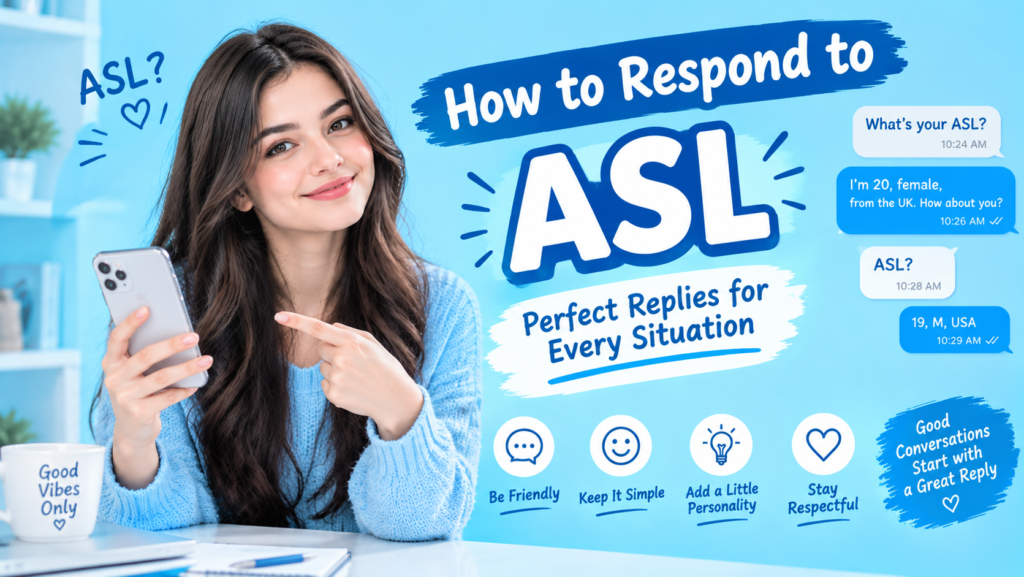
If Someone Asks “ASL?” (Age, Sex, Location)
Only share this information if you trust the person and the platform is appropriate. With strangers online, it’s generally safer to avoid answering directly.
A vague or partial answer, such as sharing only a general region instead of a specific location, is often a reasonable middle ground when you want to keep a conversation friendly without oversharing.
If Someone Uses “asl” as “As Hell”
No response needed, it’s just an intensifier. Reply naturally to the rest of the sentence, since “asl” itself isn’t a question.
Treating it as a question by accident is a common and mildly awkward mistake, especially for people who are less familiar with this newer slang usage.
Misinterpretations
1. Thinking “asl” Always Means Age/Sex/Location
Many older users assume this by default, missing the modern slang usage entirely. This can lead to confusing or even slightly embarrassing replies in casual chats with younger people.
2. Thinking “ASL” Always Means American Sign Language
This mistake often happens outside of casual chat contexts, especially in professional or academic settings. It is a reasonable assumption in formal writing, but it can misfire badly in casual texting.
3. Capitalization Confusion
Since texting often ignores capitalization rules, people sometimes can’t tell which meaning is intended without more context. When this happens, the rest of the sentence usually becomes the deciding factor.
When NOT to Use ASL
Professional Settings
Avoid slang meanings of ASL in workplace emails or messages it can come across as unprofessional or confusing. Coworkers unfamiliar with the slang may misread it entirely.
With People Who Don’t Know Slang
If you’re texting someone unfamiliar with internet slang, “asl” as an intensifier may just confuse them. This is especially common across generational or cultural gaps.
When Clarity Matters
In situations where miscommunication could cause problems, spell out what you mean instead of relying on ASL. Clear language always beats clever shorthand when stakes are high.
With Strangers (Age/Sex/Location)
Sharing personal details with strangers, especially minors, can be unsafe. Avoid answering “ASL?” questions from unknown accounts, regardless of how casual the platform feels.
Usage Tips
Tip 1: Know Your Audience
Consider who you’re talking to and what platform you’re on before using ASL casually. The same message can land very differently depending on the reader’s age and familiarity with slang.
Tip 2: Use Lowercase for “As Hell”
Writing it in lowercase mid-sentence signals the slang meaning clearly. This small styling choice does a lot of the work in avoiding confusion.
Tip 3: Use All Caps for the Question
Capitalizing “ASL?” as a standalone question keeps the classic meaning obvious. This convention, while not universal, is widely recognized enough to be useful.
Tip 4: Don’t Overuse It
Like most slang, overusing “asl” as an intensifier can make texts feel repetitive or try-hard. A little goes a long way with this kind of emphasis word.
Tip 5: Be Safe
Never share personal identifying information with strangers who ask “ASL?” online. This simple habit remains one of the most important pieces of basic internet safety advice.
Conclusion
ASL is one of those internet acronyms that has quietly evolved without most people noticing the shift. What started as a chatroom shorthand for “Age, Sex, Location” has, for a new generation, become a casual intensifier meaning “as hell.”
Meanwhile, in formal contexts, ASL still proudly refers to American Sign Language, a complete and distinct language used by millions of people. All three meanings now exist side by side, each tied to its own community and context.
The key to never misreading ASL again is context: check the platform, the capitalization, and the sentence structure. Once you know what to look for, you will not confuse a Gen Z compliment with an outdated chatroom question again.

Hi, I’m Munaza, the creator of RTMeaning.com. I’m passionate about explaining internet slang, abbreviations, texting terms, and modern language in a simple and easy-to-understand way. Through this website, I help readers discover the meanings behind trending words, social media expressions, and online communication. My goal is to make learning new terms quick, clear, and enjoyable for everyone.