
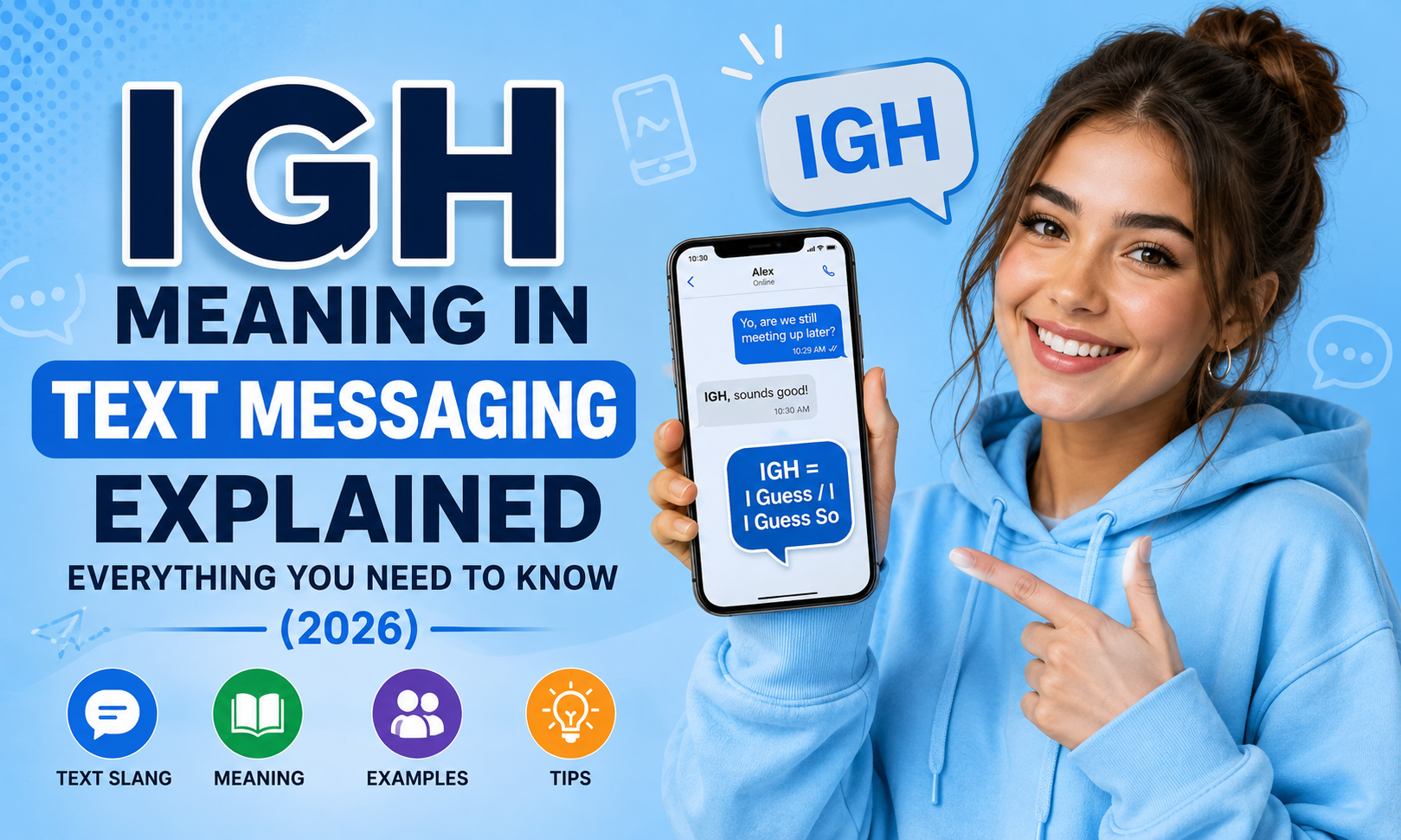

Texting moves fast, and so does slang. If you’ve ever gotten a reply that just says “igh” and wondered whether your friend is annoyed, agreeing, or just too lazy to type more, you’re not alone.
This three letter term shows up everywhere Snapchat, Instagram DMs, group chats, even TikTok comments and its meaning shifts depending on who sends it and how.Slang like this spreads so quickly because texting culture rewards speed over grammar.
People aren’t writing essays in a group chat; they’re reacting in real time, often while doing five other things at once. A word like “igh” fits perfectly into that rhythm because it takes almost no effort to type, yet it still manages to carry an emotional undertone. That’s part of what makes modern digital slang so interesting it’s less about vocabulary and more about vibe.
🧠 What Does IGH Mean in Text?
At its core, IGH is short for “alright” , a condensed, casual way of saying okay, sure, or fine. It’s part of a longer chain of shortening: “alright” became “aight,” which eventually got trimmed down to “igh.” Each step in that chain removed a little more effort from typing it out, until only the core sound of the word survived.
Depending on tone and context, IGH can express:
- Simple agreement:“Sounds good, let’s do it”
- Reluctant acceptance: “Fine, I’ll go along with it”
- Mild frustration: similar to typing “ugh” out loud
- Low-effort acknowledgment: a quick reply when you don’t want to type a full sentence
There’s no single fixed meaning. The same three letters can read as cheerful, indifferent, or annoyed depending on what came before it in the conversation. That flexibility is exactly why IGH has stuck around in everyday texting, long after other slang terms have faded out.
Part of the reason IGH works so well is that it leans on the reader’s imagination. Because there’s no punctuation, no emoji, and barely any letters, the person receiving it has to fill in the emotional gap themselves, usually based on the last few messages exchanged.
A single “igh” after good news reads completely differently from a single “igh” after bad news, even though the word itself never changes. This is fairly common with short form slang: the meaning lives more in the surrounding conversation than in the word.
Some people also use IGH as slang for “I got high,” though this is far less common and usually only appears in very specific casual or joking contexts, usually among close friends who already share that kind of humor.
The “alright” meaning dominates in nearly all everyday texting situations, so unless the conversation already has a very clear cannabis related setup, it’s safe to assume “alright” is what’s meant.
📱 Where Is IGH Commonly Used?
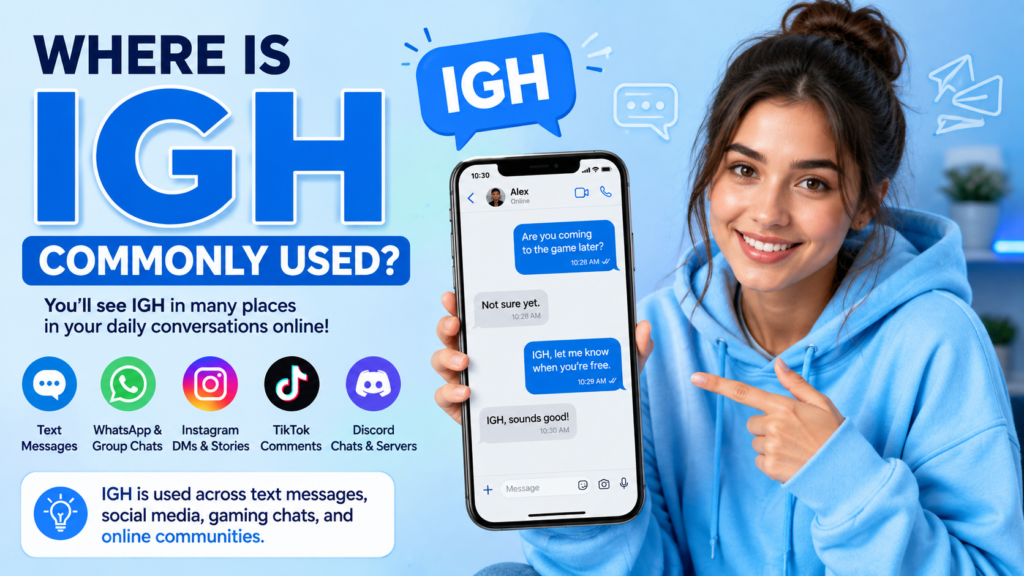
IGH isn’t tied to one single app it’s spread across nearly every messaging platform younger texters use daily. It’s less a “Snapchat word” or an “Instagram word” than a general texting habit that has simply migrated across whichever app happens to be popular at the moment.
Common platforms:
- Snapchat: One of the most common places to see IGH, usually as a quick reply to a snap or chat message. Snapchat’s streak culture practically demands short, fast replies, and IGH fits that need perfectly.
- Instagram DMs: Used casually between friends to close out a conversation or confirm plans, often as the last message in a thread before both people move on with their day.
- SMS/Text Messages: A fast way to answer a yes/no question without over-explaining, especially useful when someone is driving, busy, or simply doesn’t feel like typing a full reply.
- TikTok comments: Often used to react to a video or joke, sometimes paired with emojis for emphasis, functioning almost like a mini punchline on its own.
- Group chats: A quick way to respond to multiple messages without slowing the conversation down, letting someone acknowledge a plan without derailing the flow of the chat.
Because it’s so short, IGH thrives in fast-paced, informal spaces where full sentences would feel unnecessary or slow. In more formal messaging environments email threads, customer service chats, or workplace tools it essentially never appears, because those spaces reward clarity over speed.
💬 Examples of IGH in Conversation
Seeing IGH in context makes its meaning much clearer. Here are a few realistic examples:
- Friend: “We’re grabbing food at 6, you coming?” You: “Igh, I’ll be there.” (Meaning: casual agreement)
- Sibling: “Mom said we have to clean the garage today.” You: “Igh.” (Meaning: reluctant acceptance)
- Partner: “I have to cancel our plans tonight.” You: “Igh… that’s disappointing.” (Meaning: mild frustration)
- Classmate: “The test got moved to Monday.” You: “Igh, more time to study I guess.” (Meaning: neutral acknowledgment with a hint of relief)
Notice how the same word carries different emotional weight each time. The surrounding message and punctuation usually reveal whether it’s positive, neutral, or a little annoying. A trailing ellipsis (“Igh…”) tends to signal disappointment, while an exclamation-free, flat “Igh.” on its own line often reads as quiet resignation rather than excitement.
It also helps to look at how quickly the reply comes. A fast “igh” right after a question usually reads as easy agreement, almost like a verbal nod. A delayed “igh,” sent several minutes after the original message, can carry a slightly different weight sometimes read as hesitation before accepting something the person isn’t thrilled about.
🕓 When to Use and When Not to Use IGH
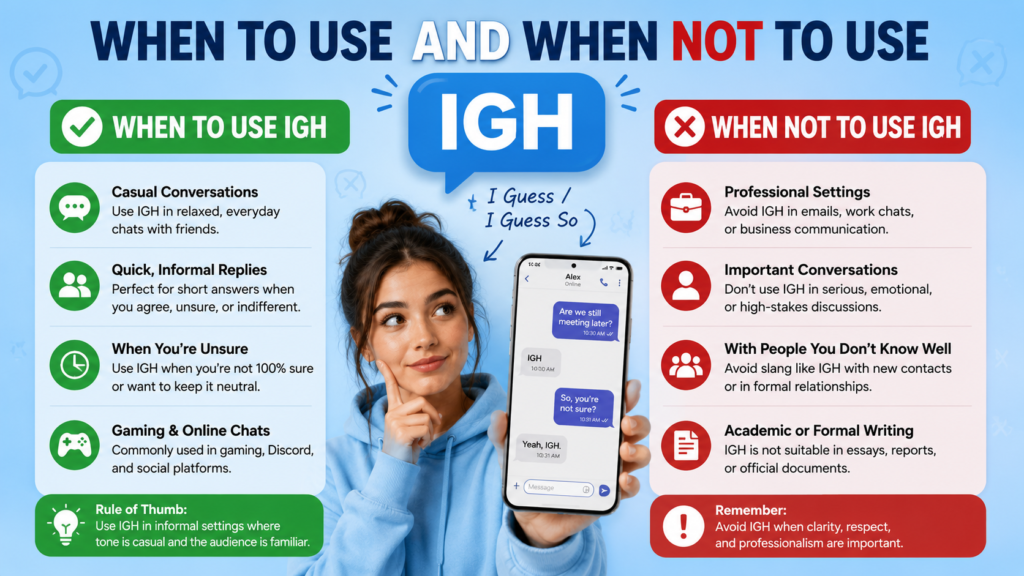
Like most slang, IGH fits some situations far better than others. Knowing the difference is really just a matter of reading the relationship and the setting before you hit send.
✅ When to Use
- Texting close friends or people you’re casual with
- Replying quickly to plans, questions, or confirmations
- Reacting to something mildly annoying without escalating the conversation
- Keeping a fast-moving group chat flowing naturally
❌ When Not to Use
- Professional emails or workplace messaging
- Texting someone you don’t know well, especially in a formal context
- Situations where clear, detailed communication matters (scheduling something important, resolving a conflict)
- Messages to older relatives or coworkers who may not recognize the term
Using IGH in the wrong setting can come across as dismissive or unclear, so it’s worth reading the room before sending it. A manager reading “igh” in response to a project deadline, for instance, might not know whether that means agreement, frustration, or simple laziness and any of those readings could create an awkward impression.
Context Comparison Table
| Situation | Recommended? | Why |
| Texting a friend about weekend plans | ✅ Yes | Casual, fast, appropriate tone |
| Replying to a work email | ❌ No | Too informal, unclear for professional settings |
| Reacting to a mildly annoying update | ✅ Yes | Captures a “meh, okay” feeling well |
| Confirming an important appointment | ❌ No | Risks sounding careless about a serious matter |
| Group chat with friends | ✅ Yes | Keeps the pace quick and natural |
| Messaging a new acquaintance | ⚠️ Use with caution | May be misread without established context |
This table is a useful quick-reference, but the underlying rule is simple: the closer and more casual the relationship, the safer IGH is to use. The more formal or unfamiliar the relationship, the more it risks being misread or coming across as careless.
Also Read This Meaning IMC Mean in Chat
🔄 Similar Slang Words or Alternatives
If you want variety in your texting vocabulary, several other terms carry a similar energy to IGH, even though the tone shifts slightly for each one.
| Slang | Meaning | Tone |
| Bet | Okay, agreed, count on it | Confident, enthusiastic |
| FR (For Real) | Genuine agreement or emphasis | Sincere, energetic |
| Aight | Alright, okay | Neutral, relaxed |
| K | Okay | Short, sometimes flat or dismissive |
| Ight | Alright | Nearly identical to IGH, slightly less condensed |
| Sure | Agreement, sometimes reluctant | Neutral to mildly indifferent |
IGH tends to sit in that neutral-to-reluctant zone, while terms like “Bet” and “FR” lean more upbeat and confident. Choosing between them usually comes down to the vibe you’re going for in that specific conversation.
If you want to sound genuinely excited about a plan, “Bet” communicates that far better than “Igh” ever could. If you want to sound like you’re simply going along with something without much enthusiasm, IGH or “K” does the job more precisely.
It’s also worth noting that these words aren’t fully interchangeable even when they technically mean the same thing. “K” on its own, without any punctuation or emoji, often reads as colder or more dismissive than “Igh,” even though both technically mean “okay.”
Tone in texting is built from tiny details like this spelling choices, capitalization, and even how many letters someone bothers to type.
Why Slang Like IGH Keeps Evolving
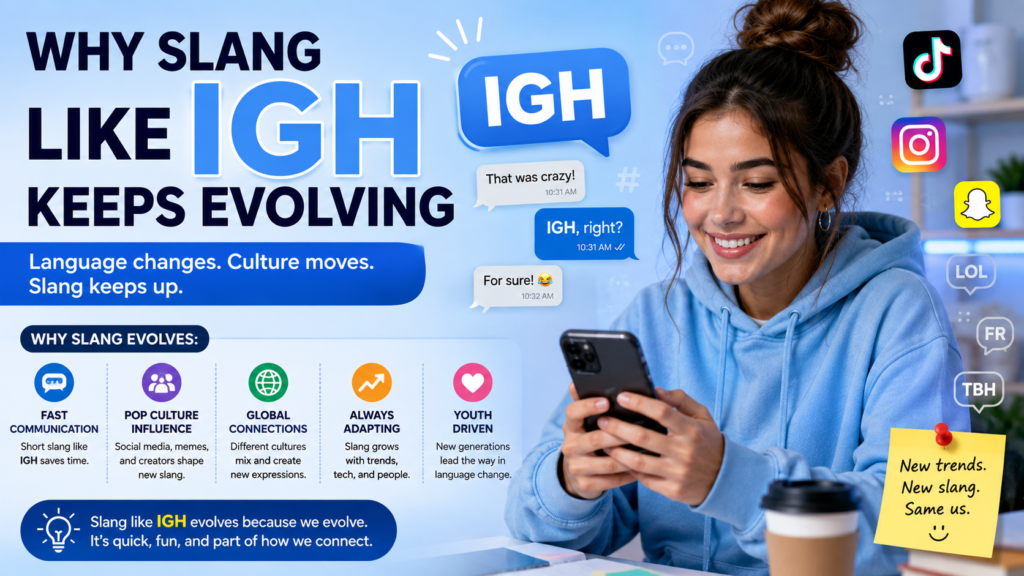
Texting culture rewards speed. The fewer keystrokes needed to express an idea, the faster conversations move especially on platforms built around quick replies like Snapchat and Instagram Stories. IGH is a good example of this evolution: a full word (“alright”) got trimmed down repeatedly until only the essential sound remained.
This pattern isn’t unique to IGH. Slang across generations has followed the same path:words get shortened, blended, or turned into acronyms as digital communication speeds up. “Because” became “cuz,” “you” became “u,” and full sentences increasingly got replaced by abbreviations, emojis, or single words carrying an entire emotional context.
Understanding terms like IGH isn’t just about knowing one word; it helps you keep up with how casual online language continues to shift year after year.There’s also a social layer to this evolution. Using the “right” slang at the right moment signals familiarity with a particular online culture, almost like a shared shorthand between people who spend time in the same digital spaces.
As new apps and communication styles emerge, new versions of these shortcuts will likely keep appearing, following the same basic pattern: take something long, strip it down, and let context do the rest of the work.
Frequently Asked Questions
What does IGH mean from a girl?
Usually the same as general usage “alright” or “okay” often signaling casual agreement or mild acceptance depending on context.
What does IGH mean from a guy?
It typically means he’s fine with something or agreeing casually, often keeping the reply short and low-key.
Is IGH a positive or negative response?
It can be either context and tone that decide whether it reads as cheerful agreement or mild annoyance.
Does IGH mean the same thing on every platform?
Yes, the core meaning (“alright”) stays consistent across Snapchat, Instagram, SMS, and TikTok, though usage style may vary slightly.
Can IGH mean something other than “alright”?
Occasionally it’s used as slang for “I got high,” but this meaning is far less common than the standard “alright” usage.
Is it rude to reply with just “igh”?
Not usually among friends, but it can come across as short or indifferent with people you don’t know well.
Final Thoughts
IGH is a small word carrying a lot of flexibility. Whether it shows up as a laid-back “okay,” a reluctant “fine,” or a quiet expression of frustration, its meaning almost always ties back to casual acceptance. The key to using it well and understanding it when you receive it is paying attention to tone, platform, and the relationship between the people texting.
As digital slang keeps evolving in 2026, terms like IGH show just how creative language can get when brevity matters. What started as a full, formal word has been worn down over time into something almost unrecognizable on paper, yet instantly understood by anyone active in casual texting culture.

Hi, I’m Munaza, the creator of RTMeaning.com. I’m passionate about explaining internet slang, abbreviations, texting terms, and modern language in a simple and easy-to-understand way. Through this website, I help readers discover the meanings behind trending words, social media expressions, and online communication. My goal is to make learning new terms quick, clear, and enjoyable for everyone.