

PDA Meaning in Text Quick Meaning
If you’ve seen “PDA” pop up in a text, DM, or comment section, here’s the short answer: PDA stands for Public Display of Affection. It describes romantic behavior kissing, hugging, hand holding, or even mushy text exchanges done where other people can see it.
In texting culture, it’s often used playfully to tease someone about being “too lovey-dovey” in public or online. The tone is rarely harsh; it’s more of a nudge between friends who notice a couple acting extra close. This short acronym carries a surprising amount of social weight. A single word can describe everything from a quick hand squeeze at a bus stop to a five-minute hug outside a coffee shop.
Because it shows up so often in casual chats, understanding PDA properly helps you read the room, respond appropriately, and avoid sounding awkward or out of touch when the term comes up in conversation. The beauty of slang like PDA is that it evolves with the platform it’s used on. A word born from sociology textbooks now lives comfortably inside Instagram captions, group chats, and TikTok comment sections.
Whether you’re new to texting slang or just want a refresher, this guide breaks down everything: definition, origin, real conversations, emotional meaning, cultural differences, and how to respond when someone uses it around you.
What Does PDA Mean?
Simple Definition
PDA is an acronym for Public Display of Affection. It refers to any romantic gesture, physical or digital shown openly instead of privately.
In text conversations, it’s usually used casually, not as a formal term. Nobody types “PDA” expecting a dictionary-level explanation; it’s shorthand meant to be understood instantly by whoever reads it.
The term applies broadly. It doesn’t require kissing or dramatic gestures; even standing a little too close while whispering can earn the label from an observant friend.
Most people learn the meaning of PDA through context rather than a formal definition, picking it up from friends, memes, or overheard conversations long before they ever look it up.
Common Examples in Text
Here’s how PDA typically shows up in real conversations:
“They were giving major PDA at the mall today 😳”
“No PDA at grandma’s house, please.”
“Their Instagram is basically nonstop PDA.”
“I’m not big on PDA, I prefer keeping things private.”
Each of these examples shows a slightly different flavor of the word surprise, a boundary being set, mild judgment, or personal preference. The acronym flexes depending on who’s using it and why.
Some people also stack it with modifiers for emphasis, like “extreme PDA,” “next-level PDA,” or “unnecessary PDA,” each nudging the meaning toward something a bit more intense or less welcome.
How It’s Usually Used
PDA is almost always used casually, often with a teasing or joking tone. It can describe:
Physical affection (holding hands, kissing)
Digital affection (mushy comments, couple posts)
Excessive affection that others find “too much”
The tone can shift from affectionate to sarcastic in a single sentence, which is part of what makes PDA such a flexible piece of slang across different group chats and comment threads.
It’s rarely meant as a serious accusation. Most of the time, it’s simply a quick, recognizable way to comment on a couple’s behavior without writing out a whole paragraph explaining what you saw.
Origin & Background
Where the Term Came From
The phrase “Public Display of Affection” originated as a sociological term describing how couples express intimacy in shared spaces. Over time, the full phrase got shortened to the acronym “PDA” for everyday convenience.
Sociologists and psychologists originally used the full phrase to study how cultural norms shape acceptable physical affection in public. It appeared in academic papers long before it ever appeared in a text bubble.
As casual conversation absorbed the concept, people naturally reached for the acronym instead of the full phrase, the same way “as soon as possible” became “ASAP” in everyday speech.
By the time texting became widespread, PDA had already shed its academic tone and turned into an easy, recognizable shorthand anyone could use without needing to explain what it meant.
Cultural Influence
Different cultures have different comfort levels with public affection. What’s considered normal PDA in one country might be viewed as inappropriate elsewhere, which is part of why the term carries so much social weight.
In some regions, holding hands in public is a completely unremarkable gesture, while a similar act elsewhere might draw stares or social disapproval. This cultural gap is exactly why PDA sparks so many debates online.
Because global platforms mix users from vastly different backgrounds, a comment that reads as harmless teasing in one culture can come across as judgmental or even offensive in another.
Understanding this cultural layer helps explain why some people react strongly to PDA-related comments while others barely notice them at all.
Social Media Changed Everything
Platforms like Instagram and TikTok gave PDA a second life. Now it doesn’t just mean physical affection in public it also includes couples showing off their relationship online through posts, captions, and comments.
Before social media, PDA was limited to what strangers could physically witness on a street or in a restaurant. Now, an entire online audience can “witness” a relationship through curated photos and captions.
This shift turned affection into something that can be planned, edited, and shared for maximum effect, rather than something that simply happens spontaneously in public.
As a result, “digital PDA” has become just as common a topic of conversation as the physical kind, sometimes even more so, since it’s visible to hundreds or thousands of people at once.
How the Meaning Evolved
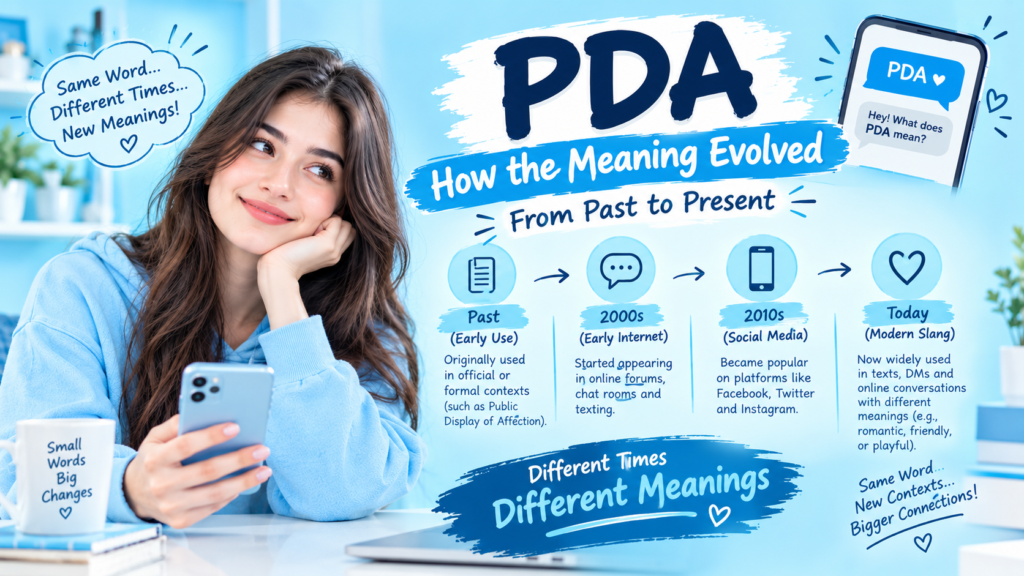
| Era | Meaning of PDA |
| Pre-internet | Physical affection shown in public places |
| Early texting era | Shorthand for talking about public affection |
| Social media era | Includes online affection captions, comments, couple posts |
| Current usage | Covers both physical and digital romantic display |
Each era added a new layer to the word without erasing the older meaning. Physical PDA is still very much a real concept, even as digital PDA has grown alongside it.
This layered history is why the term feels so flexible today; it can describe an old fashioned kiss on a park bench or a modern couple’s matching Instagram grid, and everyone instinctively understands both.
Also Read This Meaning SG Mean in Text
Real Life Conversations
WhatsApp Conversation
Mia: saw you and Jake at the park 👀 Sara: omg was it that obvious Mia: full PDA mode, no cap
This kind of exchange is extremely common between close friends. Mia isn’t criticizing Sara; she’s simply teasing her about being noticeably affectionate in a public place.
Sara’s reply shows a bit of embarrassment, which is a typical reaction when someone realizes their affection was more visible than they intended it to be.
Instagram DM Conversation
User1: your anniversary post was so cute User2: haha yeah we don’t usually do PDA but I made an exception
Here, PDA refers to the digital kind of sharing a couple’s moment publicly on social media rather than keeping it private between partners.
User2’s response also reveals a common attitude: many people see occasional PDA as an exception to their usual privacy, reserved for meaningful moments like anniversaries.
TikTok Comments
“The PDA in this video is unmatched 😭❤️”
“Not me needing PDA like this in my life”
TikTok comments tend to be more expressive, often mixing emojis and exaggerated language to react to a couple’s affectionate video content.
The second comment shows how PDA can also spark a wistful or envious reaction, with viewers wishing they had a similarly affectionate relationship of their own.
Text Message Conversation
Alex: can you tone down the PDA at my cousin’s wedding lol Jordan: no promises 😏
This is a lighthearted example of setting a boundary. Alex isn’t seriously upset; the “lol” softens the request and keeps the tone playful.
Jordan’s flirty response shows that the boundary is being acknowledged but not necessarily taken too seriously, which is typical of PDA-related banter between partners.
Emotional & Psychological Meaning
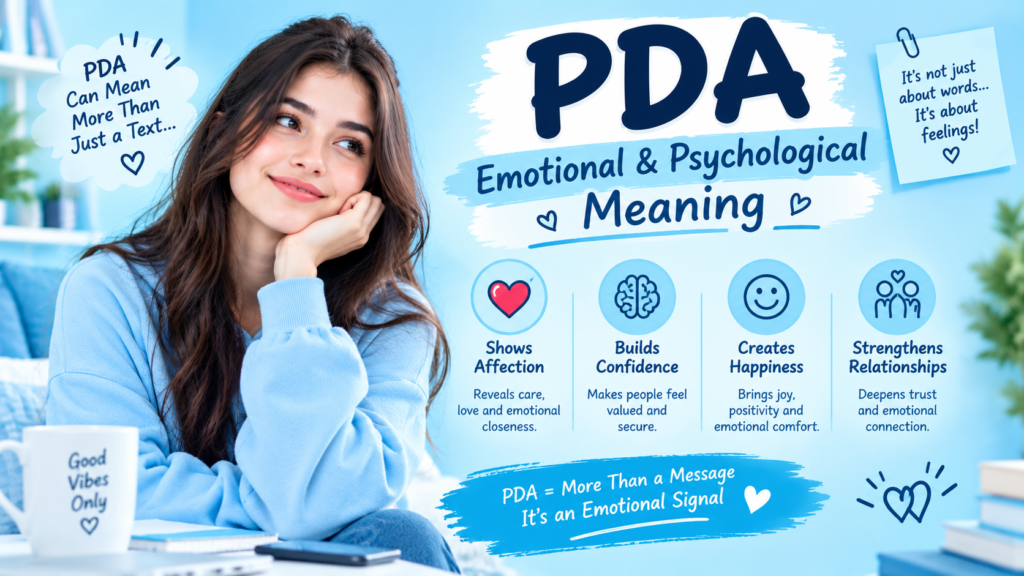
What Emotion Does PDA Express?
At its core, PDA signals confidence in a relationship and a desire to openly express love, pride, or closeness with a partner.
It often reflects a sense of security. People who feel safe in their relationship are usually more comfortable showing affection where others can see it.
For some, PDA is also tied to excitement, especially in the early stages of dating, when the urge to publicly acknowledge a new partner feels almost irresistible.
Why People Use PDA
People express PDA for several reasons:
To show emotional security in the relationship
To signal commitment to others
To feel closer to their partner
To express excitement about a new relationship
Beyond these core reasons, some people use PDA almost instinctively, without consciously thinking about how it will be perceived by others around them.
Others use it more deliberately, especially online, where a public post can serve as a clear signal to friends, family, or even ex-partners that the relationship is serious and thriving.
What It Reveals About Modern Communication
Digital PDA reveals how relationships are now partly performed for an audience. Affection isn’t just private anymore it’s often shared, curated, and viewed by friends, followers, and strangers alike.
This performative aspect isn’t necessarily negative; many couples genuinely enjoy sharing happy moments and see it as a natural extension of celebrating their relationship.
At the same time, it raises interesting questions about authenticity whether the affection shown online always matches what’s happening behind closed doors, or whether it’s sometimes exaggerated for likes and comments.
A Realistic Scenario
Imagine a couple posting a series of loved-up selfies captioned “always in PDA mode.” Friends comment with heart emojis, while others jokingly ask them to “get a room.”
This mix of admiration and teasing is a common social media pattern around PDA content. It shows how the same post can generate both warm support and lighthearted mockery at once.
Scenarios like this play out constantly across social platforms, illustrating just how normalized digital affection has become in everyday online culture.
Usage in Different Contexts
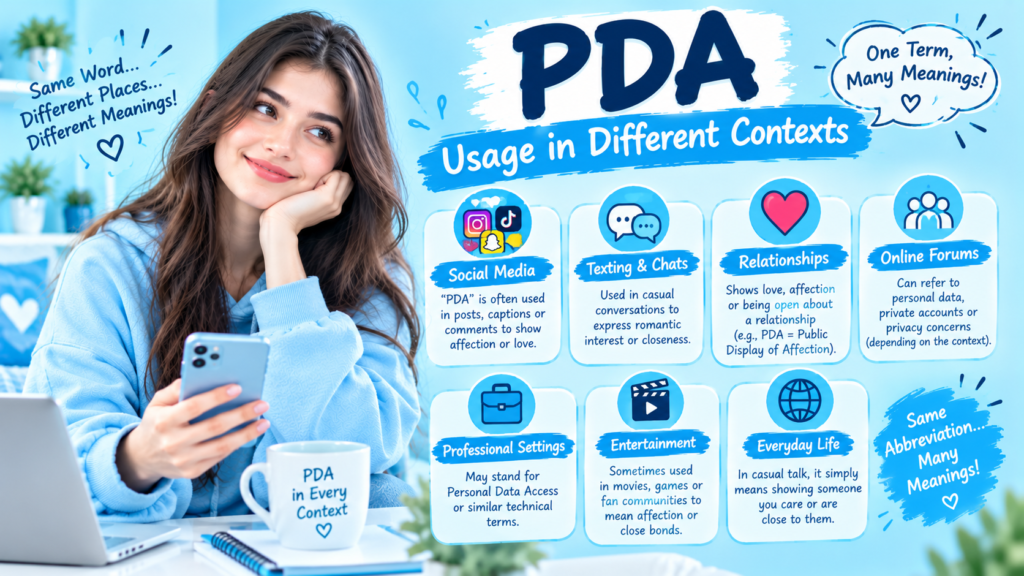
Social Media
Used to describe couple posts, affectionate captions, or comment exchanges between partners. It’s one of the most common contexts where the term appears today.
On platforms built around visual content, PDA often takes the form of matching outfits, cute captions, or affectionate replies left publicly in each other’s comment sections.
Friends & Relationships
Often used jokingly among friends to comment on a couple’s behavior, whether affectionately or as playful mockery.
Among close friend groups, PDA comments are often a running joke, especially if one couple in the group is known for being particularly affectionate in public settings.
Work & Professional Settings
Rarely appropriate. If used at all, it’s usually in casual chat with coworkers, not in official communication.
Using the term in a professional context, such as an email or meeting, would likely seem out of place, since PDA belongs firmly to informal, relationship-related conversation.
Casual vs Serious Tone
| Tone | Example Usage |
| Casual | “Ew, PDA alert 🙈” |
| Serious | “I’m not comfortable with PDA in public.” |
The same three letters can carry very different emotional weight depending on tone, punctuation, and the relationship between the people talking.
Recognizing which tone is being used helps prevent misreadings, especially in text-based conversations where vocal cues and facial expressions are completely absent.
When NOT to Use It
Formal Situations
Avoid using PDA in professional emails, official documents, or workplace announcements; it’s slang, not formal vocabulary.
Even in workplaces with a casual culture, using the term in written company communication could come across as unprofessional or simply confusing to readers unfamiliar with it.
Sensitive Cultural Environments
In cultures where public affection is discouraged, casually referencing PDA (even in text) may come across as disrespectful.
Being mindful of cultural context matters, especially in mixed group chats or international friendships where norms around affection can differ significantly.
During Serious Conflict
Using PDA jokingly during an argument about affection or boundaries can come across as dismissive of someone’s genuine feelings.
If a partner has expressed real discomfort about public affection, turning that concern into a joke using the term could unintentionally minimize their feelings.
Situations That Cause Misunderstanding
Using PDA sarcastically in a serious conversation can confuse the other person about your real intent.
Sarcasm doesn’t always translate well over text, so it helps to add extra context or a clarifying emoji when the tone might otherwise be misread.
Common Misunderstandings
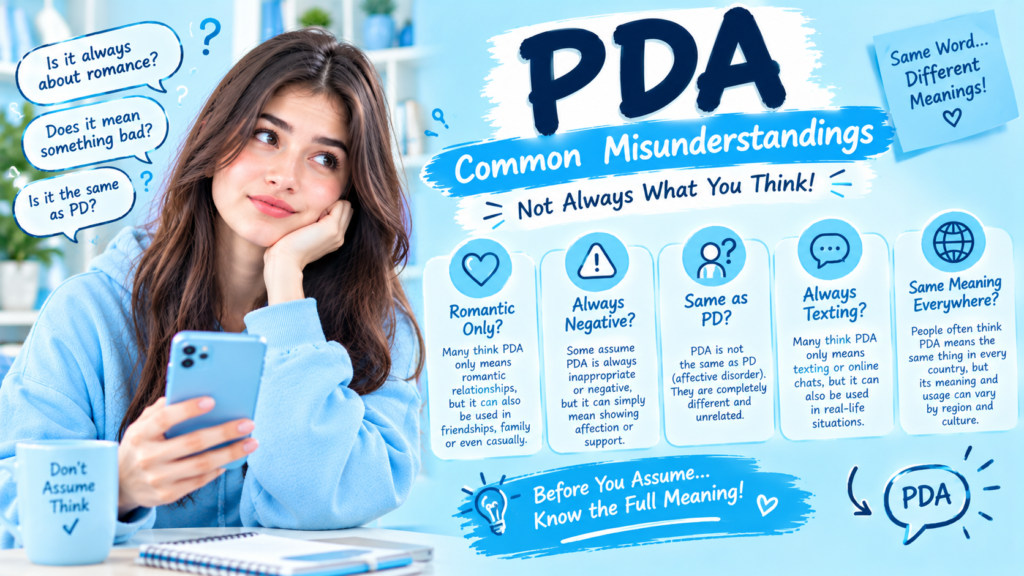
People Think PDA Always Means Kissing
PDA covers a wide range of affection from hand-holding to sweet texts, not just physical intimacy like kissing.
This misconception often leads people to assume the term is more intense than it actually is, when in reality it can describe something as small as an arm around a shoulder.
Tone Gets Misread Online
Because text lacks vocal tone, a joking “so much PDA lol” can be misread as judgmental or sarcastic criticism.
Adding emojis, punctuation, or a friendly follow-up message can help clarify that a comment was meant playfully rather than critically.
Literal vs Figurative Meaning
Sometimes PDA is used loosely to describe any couple-related content online, even without actual physical affection involved.
A simple matching profile picture or a shared inside joke in the comments might get labeled “PDA” even though no physical or explicitly romantic gesture took place.
Comparison Table
| Meaning | Example |
| Literal PDA | Kissing or hugging in public |
| Figurative PDA | Sweet captions or couple photos online |
| Sarcastic PDA | “Get a room” style teasing comments |
Key Insight
Context and tone matter more than the word itself. The same message can be sweet, teasing, or critical depending on how it’s phrased.
Reading the surrounding conversation, the relationship between the people involved, and any accompanying emojis usually reveals the true intent behind a PDA comment far better than the word alone.
Variations / Types
Here are the most common types of PDA seen in modern conversations:
Physical PDA: hand-holding, hugging, kissing in public
Digital PDA: affectionate posts, comments, or DMs
Mild PDA: small gestures like holding hands
Extreme PDA: intense makeouts or over-the-top affection
Cute PDA: sweet, wholesome affection people enjoy seeing
Cringe PDA: affection seen as excessive or uncomfortable to witness
Celebrity PDA: public figures showing affection, often covered by media
Social Media PDA: couple content shared for followers to see
Accidental PDA: affection caught on camera unintentionally
Performative PDA: affection shown mainly for outside attention rather than genuine feeling
Each of these variations highlights a different angle of the same core idea, showing just how many shades of meaning can fit inside one small acronym.
Recognizing which type is being referenced in a conversation makes it much easier to respond appropriately, whether the moment calls for humor, sympathy, or simple acknowledgment.
How to Respond When Someone Uses It
Casual Replies
“Lol yeah we’re extra like that.”
“Guilty as charged 😂”
These replies work well in lighthearted conversations where the comment was clearly meant as harmless teasing rather than genuine criticism.
Funny Replies
“PDA is our love language, sorry not sorry.”
“We run on PDA and coffee.”
Humor is often the easiest way to defuse any awkwardness and keep the conversation fun, especially among close friends.
Mature Replies
“We just like showing we care about each other.”
“It’s not for everyone, but it works for us.”
These responses work well when someone wants to explain their perspective calmly, without being defensive or dismissive of the other person’s opinion.
Respectful Replies
“I get that it’s not for everyone, we’ll tone it down.”
“Thanks for understanding our vibe.”
This type of reply is useful when the comment came from someone who genuinely felt uncomfortable, showing willingness to acknowledge their feelings.
Regional & Cultural Usage
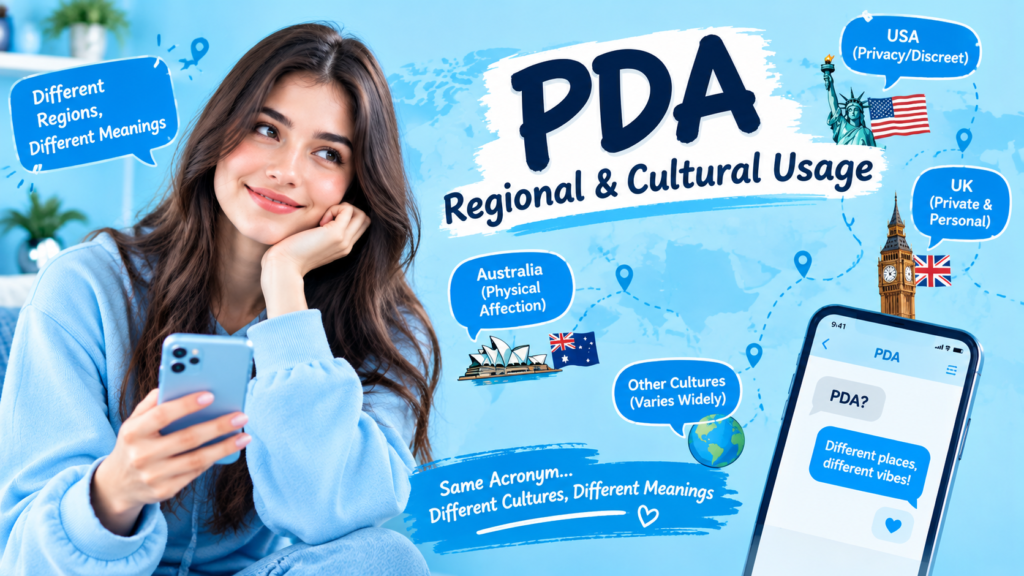
Western Culture
Generally more accepting of public affection, especially among younger generations and on social media.
Holding hands, hugging, or a quick kiss in public is often seen as normal rather than remarkable in many Western social settings.
Asian Culture
Many Asian cultures tend to view public affection as more private or reserved, making overt PDA less common.
In these contexts, couples may express affection more subtly, favoring quiet gestures over visibly public displays.
Middle Eastern Culture
Public affection is often more conservative, with digital PDA sometimes replacing physical displays.
Couples in these regions may lean more heavily on private messages or carefully shared online posts rather than visible public gestures.
Global Internet Usage
Online, PDA is understood almost universally in youth culture, even when in-person norms differ by country.
The internet has effectively created a shared vocabulary around relationships that transcends many real-world cultural boundaries, at least among younger, digitally connected users.
Generational Differences
Gen Z
Tending to normalize digital PDA posting relationships openly is common and often expected.
For many in this generation, sharing a relationship online is simply part of how a relationship is validated and celebrated among friends and followers.
Millennials
More balanced approach comfortable with some public affection but often more private about relationship details online.
Millennials often grew up straddling both pre-social-media and social-media-heavy periods, which shapes a more cautious approach to sharing relationship content publicly.
Is It Safe for Kids?
The term itself is harmless slang, but conversations involving PDA can reference romantic or physical content, so context should be age-appropriate when kids are involved.
Parents and guardians may want to be aware of how the term is used around younger audiences, especially since it can appear casually across many mainstream platforms.
Understanding the Context Matters
Whether PDA is sweet, funny, or inappropriate depends entirely on tone, relationship, and setting the word itself is neutral.
Paying attention to who is speaking, how well they know the people involved, and the platform where the comment appears will almost always clarify the intended meaning.
Conclusion
PDA in texting simply means Public Display of Affection, a term that’s expanded from physical gestures to include digital affection across social media and messaging apps.
Whether it’s a couple’s cute Instagram caption or a friend teasing another about holding hands in public, PDA reflects how openly people choose to express love in today’s blended physical and digital world.
Understanding tone, culture, and context is key to using and interpreting this slang term correctly, so the next time it shows up in your messages, you’ll know exactly what’s being said.

Hi, I’m Munaza, the creator of RTMeaning.com. I’m passionate about explaining internet slang, abbreviations, texting terms, and modern language in a simple and easy-to-understand way. Through this website, I help readers discover the meanings behind trending words, social media expressions, and online communication. My goal is to make learning new terms quick, clear, and enjoyable for everyone.