

If you have ever opened a text or a DM and seen just one word “sup” you already know how much meaning a tiny word can carry. It is short, casual, and shows up everywhere from group chats to gaming lobbies to Instagram comments.
For anyone new to texting culture, or anyone who simply wants to reply the right way, understanding the real meaning of “sup” makes conversations flow much more smoothly. It removes the guesswork from a word that looks simple but carries a lot of social weight.
This guide breaks down everything about “sup”: what it means, where it came from, how people use it across different apps, and how you should reply when someone sends it your way. By the end, you should be able to use it naturally in any casual setting.
What Does Sup Mean in Text & Chat?
“Sup” is a shortened, casual version of “What’s up?” It works as a quick greeting or an easy way to check in on someone without typing a full sentence. Instead of writing out a complete question, people use “sup” to say hello and ask what is going on, all in three letters.
It saves time and keeps the tone light.It is not really an acronym or a formal abbreviation. It is more of a spoken language shortcut that made its way into texting because it is fast, familiar, and friendly.
Because it strips away almost every unnecessary syllable, “sup” has become one of the laziest, and therefore most efficient, greetings in modern digital communication.
Quick Chat Examples
Friend: “Sup?”
You: “Nothing much, just relaxing. You?”
Crush: “Sup 👀”
You: “Heyy, just saw your story lol”
Gamer: “Sup, ready to queue?”
You: “Yeah, give me 2 min”
Full Form, Stands For & Short Meaning of Sup
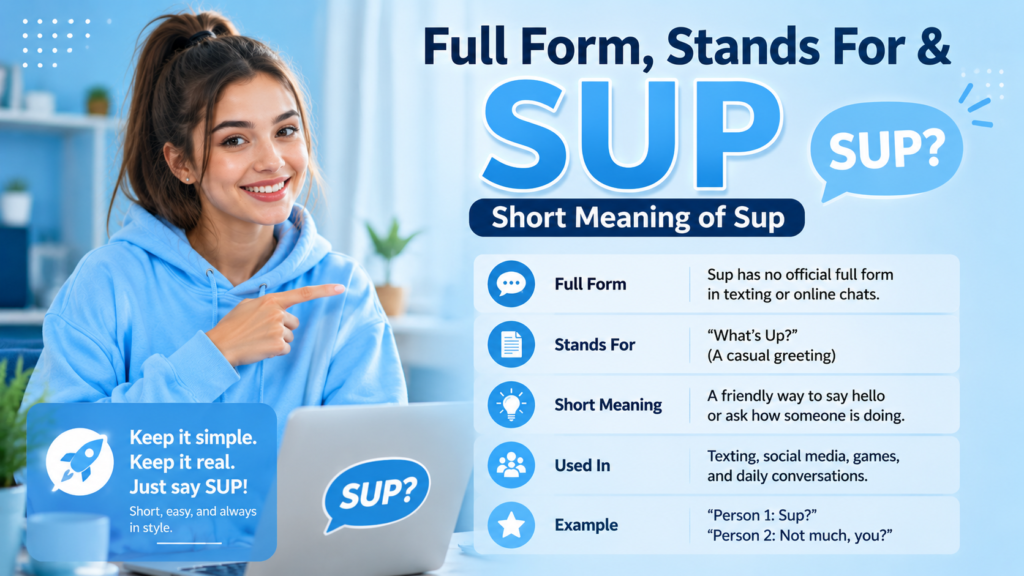
“Sup” does not stand for anything technical. It is simply a clipped version of “What’s up?” with most of the sound removed.
People drop the “what’s” and the “‘s,” leaving just the core sound: sup. There is no hidden acronym or deeper abbreviation behind it.
Short Meaning of Sup
In one line: “Sup” means a casual way of saying “Hello, what’s going on?”
Different Ways People Write It
| Spelling | Common Use |
| Sup | Most common, neutral casual greeting |
| Wassup | Slightly more energetic or playful |
| Whaddup | Common in spoken slang and gaming chats |
| S’up | Rare, stylized texting version |
Each spelling variation carries a slightly different energy, even though the underlying meaning stays the same across all of them.
Is It Formal?
No. “Sup” is strictly informal. It works well with friends, classmates, or gaming buddies, but it is not something you would send to a boss, teacher, or client.
Using it in the wrong setting can make a message feel careless, even if that was never the intention behind sending it.
Origin, History & First Known Use of Sup
“What’s up?” has been part of everyday spoken English for decades, used as a casual way to greet someone or ask how they are doing. It long predates texting itself.
As SMS texting and early internet chat rooms became popular in the 1990s, people began shortening common phrases to type faster. “What’s up” naturally became “sup” through this process of digital compression.
Why It Became Popular
Texting speed: Fewer characters meant faster replies, especially on old flip-phone keypads where every letter took effort to type.
Youth and street slang: It caught on quickly in casual, informal speech before it ever moved online, making the jump to texting feel natural.
Pop culture push: The famous “Whassup?” advertising campaigns in the early 2000s helped spread similar greetings into mainstream use across the country.
Gaming culture: Online multiplayer games normalized quick, low-effort greetings between teammates, giving “sup” a permanent home in voice and text chat.
First Known Use
There is no single official record of when “sup” was first used. Slang dictionaries and online language trackers generally place its rise during the 1990s and early 2000s.
This period lines up closely with the growth of instant messaging and mobile texting, which is exactly the environment where a word like “sup” thrives.
Also Read This Meaning IHHT Meaning
How People Use Sup in Daily Conversations
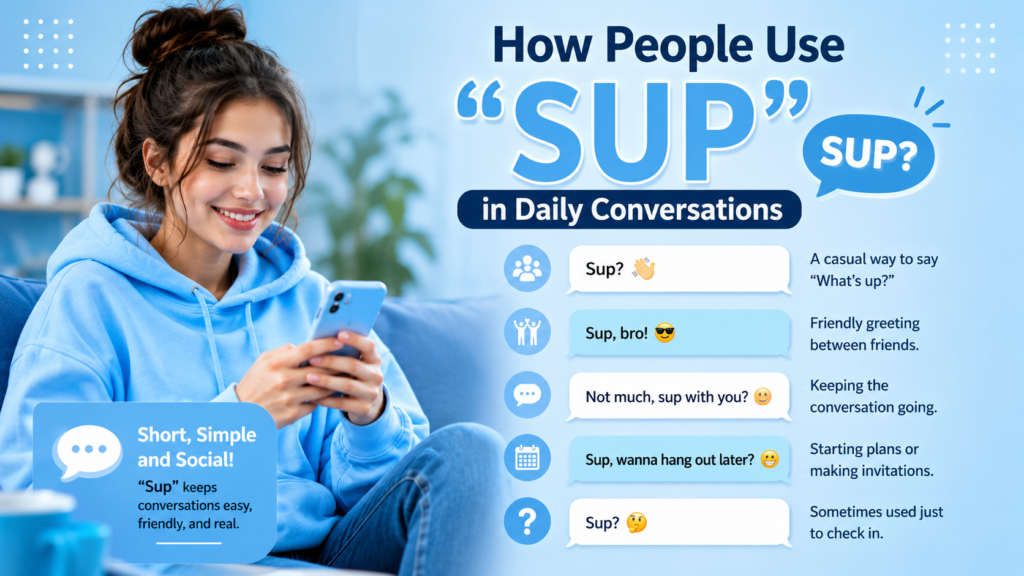
“Sup” fits into almost any casual digital conversation. It is less about literally asking “what is happening” and more about opening the door to a chat.
Common Daily Uses
Greeting a Friend
It works exactly like “hey” or “hi,” just with a bit more casual, relaxed energy attached to it.
Starting a Chat
Many people use “sup” as the very first message when messaging someone, especially on social apps where a longer opener might feel forced.
Checking on Someone
Sometimes it genuinely means “how are you doing” or “what’s new with you,” rather than just being a filler greeting.
Gaming Conversations
Players often type “sup” in lobby chats or use it as a voice greeting before a match starts, treating it almost like a team ritual.
Tone Matters
The same word can feel friendly, flirty, or even dismissive depending on who is sending it, the emojis attached, and the conversation history behind it.
Context always shapes how “sup” should be read, so it is worth paying attention to the bigger picture before assuming the worst about a short reply.
Common Replies
“Not much, you?”
“Just chilling”
“Nm, wbu”
“Heyy 😊”
Sup Meaning Across WhatsApp, Instagram, TikTok & Snapchat
The core meaning of “sup” stays the same everywhere, but the vibe shifts slightly depending on the platform being used.
Platform Comparison
| Platform | Typical Vibe |
| Casual check-in between friends or family | |
| Often flirty, especially in DMs | |
| TikTok | Playful, used in comments and duets |
| Snapchat | Quick, informal, often paired with a snap |
Sup on WhatsApp
On WhatsApp, “sup” usually means someone is casually reaching out to see what you are up to or if you are free to talk.
Sup on Instagram
In Instagram DMs, “sup” can carry a flirty undertone, especially after someone views a story or likes a post beforehand.
Sup on TikTok
On TikTok, “sup” often shows up in comment sections as a light, friendly way to interact with creators or other users on a video.
Sup on Snapchat
On Snapchat, “sup” is typically a quick, low-pressure way to start a snap conversation or reply to someone’s story update.
Different Meanings of Sup in Other Fields
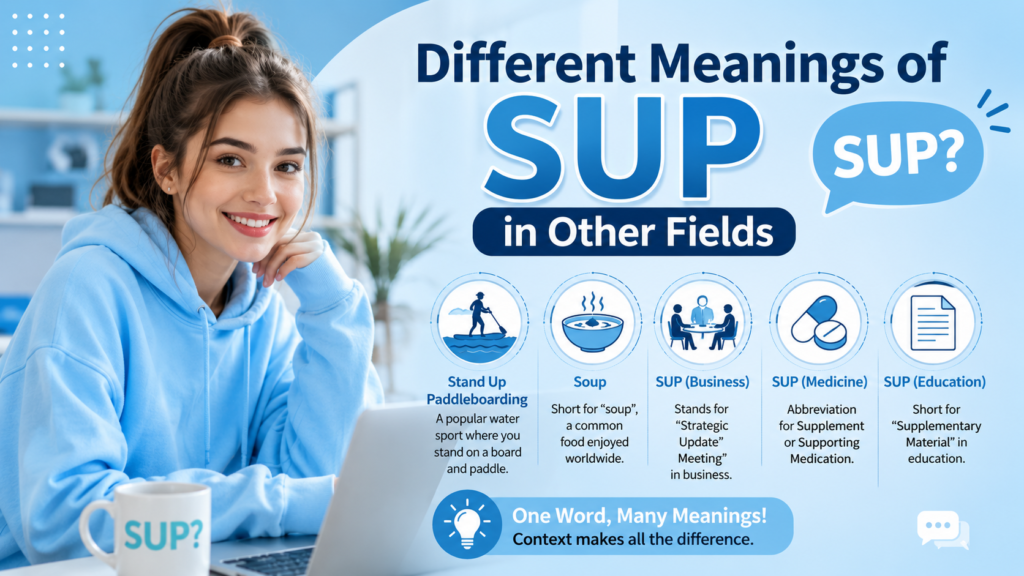
Outside of texting, “SUP” usually capitalized means something completely different depending on the industry it appears in.
SUP in Sports
SUP stands for Stand-Up Paddleboarding, a popular water sport that uses a paddle and a large board out on open water.
SUP in Business or Work
In some workplace contexts, SUP can be shorthand for “supervisor,” especially inside internal memos or scheduling systems.
SUP in Technology
In tech settings, SUP can refer to specific software, protocols, or internal system abbreviations depending on the company using it.
How to Know the Right Meaning
Example 1:
“Grab the SUP boards, we’re heading to the lake.” This clearly means paddleboards, not a greeting of any kind.
Example 2:
“My SUP approved the schedule change.” Here, SUP means supervisor rather than anything related to texting.
Context and capitalization usually make the intended meaning obvious within a sentence or two.
Common Confusions, Mistakes & Wrong Interpretations
Common Mistakes
Thinking It Is an Acronym
“Sup” is not an acronym. It is a shortened spoken phrase, not a set of letters standing for separate words.
Confusing It With “SUP” in Sports
Lowercase “sup” in a text is a greeting, while capitalized “SUP” in a sports context usually means paddleboarding instead.
Using It in Formal Situations
Sending “sup” to a teacher, client, or in a professional email comes across as far too casual for the setting.
Misreading the Tone
Some people misread “sup” as cold or lazy when it is actually meant as a friendly, low-key greeting between two people.
Wrong Interpretations
“Sup” does not mean “supper,” “support,” or “suspicious,” despite sharing similar letters. Context in a chat almost always points back to “what’s up.”
Similar Terms, Alternatives & Related Slang
Popular Alternatives
Wassup, Whaddup, Yo, Hey, Wyd
Related Internet Slang
Wyd
Short for “what you doing,” often used similarly to “sup” but slightly more direct in tone.
Yo
A simple, punchy greeting with the same casual energy as “sup,” often used to grab someone’s attention first.
Wassup
A more expressive, drawn-out version of “sup,” often used for emphasis or excitement in a conversation.
Example Comparisons
| Term | Meaning | Common Setting |
| Sup | What’s up / hello | General texting |
| Wyd | What are you doing | Casual check-ins |
| Yo | Hey / attention-grabbing greeting | Friends, gaming |
| Wassup | Energetic version of “sup” | Social media, memes |
Which One Is Most Common?
“Sup” remains one of the most widely used casual greetings online because it is short, familiar, and works in almost any casual context.
Examples of Sup in Real Chat Situations
Friendly Chat:
“Sup dude, long time no talk!”
Gaming Chat:
“Sup, are you queuing for ranked or casual?”
Flirty Conversation:
“Sup stranger 👀 saw your new pic”
Group Chat:
“Sup everyone, who’s free this weekend?”
Snapchat Example:
“Sup, sending you something funny rn”
Instagram DM:
“Sup, love your last post!”
How to Reply When Someone Says Sup
Simple Replies
“Not much, you?”
“Just got home, wbu?”
Funny Replies
“The sky, mostly”
“Living the dream, apparently”
Flirty Replies
“Sup yourself 😏”
“Just thinking about you, actually”
Busy Replies
“Kinda busy, run, talk later?”
“In class, text you soon”
Tips for Replying
Match the tone of the sender, keep the reply short, and add an emoji if you want to signal warmth or humor in the exchange.
Is Sup Still Popular? Trends & Online Usage

Why It Still Works
“Sup” survives because it is efficient, low pressure, and universally understood across texting and social platforms of every kind.
Younger Users vs Older Users
Younger users tend to use “sup” constantly and casually, while older users may use it less often or reserve it mainly for close friends.
Will It Disappear?
Unlikely. Short, casual greetings like “sup” tend to stick around because they save time and fit naturally into fast paced digital conversation.
Conclusion
At its core, “sup” is just a fast, friendly way of saying “What’s up?” It has survived decades of changing slang trends because it does exactly what a good greeting should do: it opens a conversation without asking for much effort from either side.
Whether you see it on WhatsApp, Instagram, TikTok, or Snapchat, the meaning stays mostly the same. It functions as a casual greeting or a quick check in, and it rarely needs to be overanalyzed beyond that simple purpose.
The tone, platform, and relationship between the two people texting are what really shape how “sup” should be understood in any given moment. Once you know the context, replying naturally becomes second nature, and the word stops feeling like a puzzle and starts feeling like just another normal way to say hello.

Hi, I’m Munaza, the creator of RTMeaning.com. I’m passionate about explaining internet slang, abbreviations, texting terms, and modern language in a simple and easy-to-understand way. Through this website, I help readers discover the meanings behind trending words, social media expressions, and online communication. My goal is to make learning new terms quick, clear, and enjoyable for everyone.