
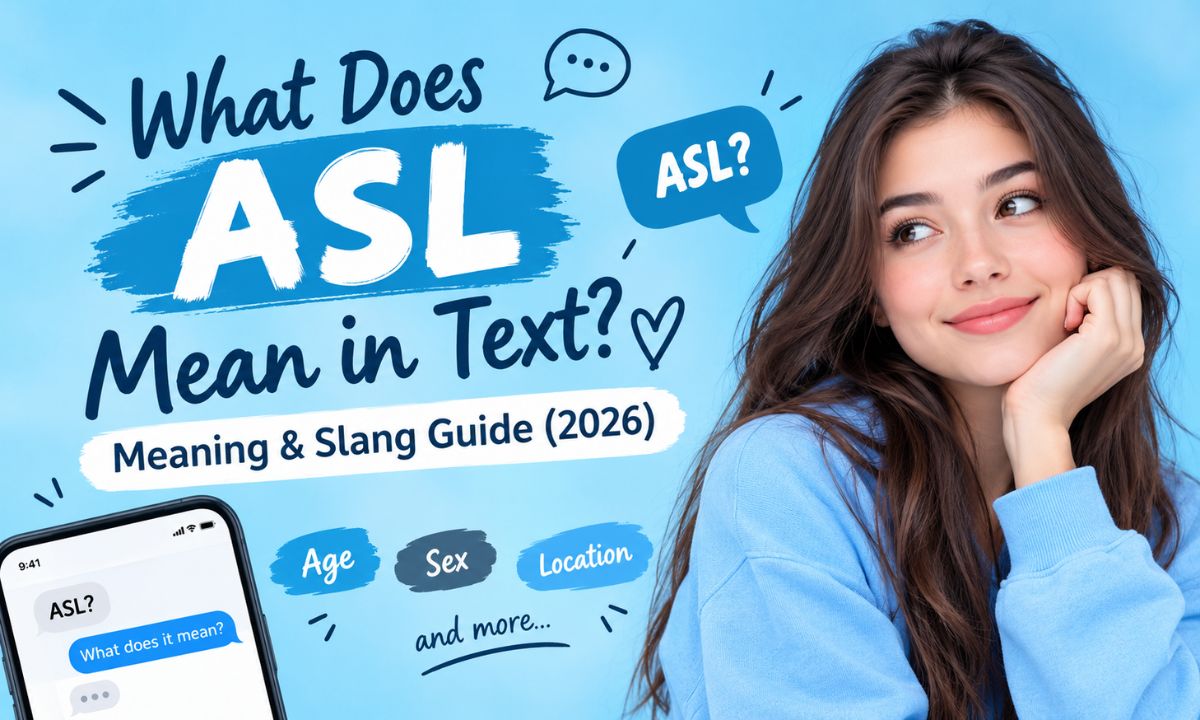

You open a message and see two words: “tired asl.” Or maybe a stranger simply writes “asl?” and wait.
Same three letters. Two very different messages.
If you have ever wondered what ASL means in text, you are not alone. The abbreviation has a double life in internet slang, and the right meaning depends on how it is written, who sent it, and where you saw it.
This guide explains every meaning of ASL, shows real examples, and tells you how to reply. You will also learn when to avoid it and what parents should know.
What Does ASL Mean in Texting? – Quick Meaning
ASL in text most often means “as hell.” It works as an intensifier, like “very” or “extremely.” In older chat rooms, ASL meant “age, sex, location.”
Here is the short version:
| Meaning | Full Form | Where You See It | Typical Example |
| Modern slang | As hell | TikTok, Instagram, Snapchat, WhatsApp | “I’m tired asl” |
| Old internet slang | Age, sex, location | Chat rooms, anonymous apps, random DMs | “asl?” |
| Language | American Sign Language | Education, accessibility, deaf community | “She teaches ASL” |
Quick rule: If ASL follows a feeling or description (tired, cute, broke), it means “as hell.” If it stands alone with a question mark, it asks for personal details.
Simple Examples
- “This pizza is good asl.” (Really good.)
- “I’m so sleepy asl today.” (Extremely sleepy.)
- “asl?” (What’s your age, gender, and location?)
- “My cousin interprets in ASL.” (American Sign Language.)
People search for this term in many ways. You may have typed what does asl mean, asl meaning in text, what does asl mean texting slang, or asl in text meaning. Some people even mix it up with other slang, such as asking what chat means in slang. (In streaming and gaming culture, “chat” often means the live audience, as in “chat, is this real?”) The answers below cover the ASL side of that confusion.
Why the Meaning Changes
Slang shifts because people reuse short forms for new needs. ASL is a perfect case.
Here is why one abbreviation carries several meanings:
- Short words get recycled: Three-letter acronyms are easy to reuse.
- Generations change habits: Older users learned “age, sex, location” first. Younger users grew up with “as hell.”
- Platforms shape language: A comment on TikTok reads differently from a message in an anonymous chat room.
- Context does the heavy lifting: Punctuation, position, and the word before ASL changes everything.
Think of ASL like the word “light.” It can mean weight, color, or a lamp. You know which one from the sentence around it.
Origin & Background
The Early Internet Era
In the 1990s and early 2000s, chat rooms and instant messengers were new. Services like AOL Instant Messenger, Yahoo Messenger, and IRC channels put strangers in the same virtual room.
There were no profile photos in many of these spaces. Nobody could glance at a bio. So people typed “a/s/l?” to get quick facts.
The reply usually looked like this:
16/f/Texas
It was fast, efficient, and a little awkward. It worked as the standard icebreaker for a whole generation of early internet users.
The Cultural Impact
“A/S/L?” became more than a phrase. It turned into a pop culture joke about early internet life. Comedians, sitcoms, and memes poked fun at it for years.
It also raised safety concerns. Because the question invited strangers to share personal details, parents and teachers began warning kids about it. That warning still matters today, and we will cover it below.
How Social Media Changed It
Then profiles took over. Facebook, Instagram, Snapchat, and TikTok let people share age, photos, and location tags without being asked. The old question lost its purpose.
At the same time, younger users started clipping “as hell” into “asl.” It was quick to type and strong in tone. Social platforms, especially short-video apps, spread fast. By the 2020s, the “as hell” meaning had become the one most teens recognized first.
Real-Life Conversations
Seeing slang in action makes it easier to remember. Here are four sample chats.
WhatsApp Conversation
Sam: Did you finish the report?
Riya: Finally. I’m exhausted asl 😩
Sam: Go sleep. You earned it.
Meaning: Riya is extremely tired.
Instagram DM
Maya: Your new haircut is cute asl!!
Jordan: Stop 😭 thank you!
Meaning: Maya is giving a strong compliment.
TikTok Comments
“The beat drop was clean asl” “Not me crying at this ad, it’s wholesome asl”
Meaning: Viewers are using ASL to add emotion to short comments.
Text Message Between Friends
Ali: Pizza tonight?
Zara: Yes. I’m hungry asl.
Ali: Same. 8 pm?
Meaning: Zara is very hungry.
Emotional & Psychological Meaning
ASL is not only about words. It carries a feeling.
When someone writes “happy asl” or “annoyed asl,” they are showing how strongly they feel. It adds a spark that plain words sometimes lack in text. Without voice or facial expression, people use slang like this to add volume and mood.
Why People Use It
- Speed: Three letters beat two words.
- Emphasis: It makes me feel louder.
- Belonging: Using current slang signals you are part of the group.
- Humor: Exaggeration often lands as funny.
- Casual tone: It makes a message feel relaxed and friendly.
A Real-Life Style Scenario
Imagine a college student after a long exam week. A friend asks how she is.
She types: “Honestly? Relieved asl.”
She could have written “very relieved.” But the slang version feels more honest and more like how she actually talks. That small difference is why the term stuck.
Also Read This Meaning Serendipity Meaning
Usage in Different Contexts
Social Media
On TikTok, Instagram, X, and Snapchat, “as hell” is the default reading. You will see it in captions, comments, and stories. It often pairs with emojis and lowercase letters.
Friends & Relationships
Among friends, ASL feels playful. It also shows up in flirty messages, such as “you look good asl.” With a partner, it adds warmth and teasing.
Between people who do not know each other well, keep it light. A compliment that includes “as hell” may read as bold.
Work or Professional Settings
ASL is rarely used at work. In a casual team chat with younger colleagues, you might see “swamped asl.” Even then, it is better to follow your team’s tone first.
Casual vs Serious Tone
| Situation | Is ASL a good fit? | Better Option |
| Chat with close friends | Yes | None needed |
| Social media comment | Yes | None needed |
| Casual team Slack with peers | Maybe | “very busy” |
| Email to a manager | No | “extremely busy” |
| Job application | No | Formal wording |
| Sympathy message | No | Warm, plain words |
When NOT to Use It
Slang is fun, but timing matters. Skip ASL in these cases.
Professional Environments
Emails, reports, client chats, and interviews need clear language. “Excited asl” can make you look careless. Use “very excited” instead.
Conversations With Older Adults
Many older adults know only the “age, sex, location” meaning, or they may think of sign language. Your grandparent might be confused or even alarmed by a message like “I’m so happy asl.”
Formal Situations
School essays, official forms, and public announcements call for standard English.
Sensitive Conversations
When someone is grieving, sick, or upset, slang can sound flippant. Even “sorry asl” may feel too casual. Choose gentle, plain words.
Common Misunderstandings
Confusion Between Two Meanings
The biggest mix-up is between “as hell” and “age, sex, location.” A person who sees “asl” alone may think it is a personal question, while the sender meant something harmless like a quick reaction.
The reverse also happens. A teen may type “asl?” to a stranger without realizing the old meaning is still used by people looking for personal information.
Tone Misinterpretation
“As hell” includes the word “hell,” so some readers think ASL is rude. In most cases it is not meant that way. It is mild and common among teens and adults. Still, some families, schools, or workplaces prefer cleaner language.
Literal vs Figurative Usage
“Cold asl” does not mean the air is literally hell-like. It simply means very cold. ASL is figurative, an exaggeration.
Comparison Table
| Feature | ASL = As Hell | ASL? = Age, Sex, Location | ASL = American Sign Language |
| Position | After an adjective | Alone or as a question | In a sentence about language |
| Tone | Casual, expressive | Direct, sometimes risky | Neutral, educational |
| Typical Users | Teens, young adults | Older internet users, strangers | Learners, interpreters, deaf community |
| Common Platforms | TikTok, Snapchat, WhatsApp | Anonymous chats, random DMs | Schools, health and accessibility contexts |
| Risk Level | Low | Higher | None |
Key Insight
Look at what comes before ASL. If it follows a word like “tired,” “cute,” or “broke,” it means “as hell.” If it stands alone, think “age, sex, location.” If the topic is language or hearing, think “American Sign Language.”
Variations / Types
ASL pairs with almost any adjective. Here are the most common forms.
ASL = As Hell
This is the main modern use. It makes the word before it stronger.
“That movie was long asl.”
ASL? = Age, Sex, Location
This is the classic version. It is a question with a question mark, usually sent by someone you do not know.
Funny ASL
Means very funny.
Example: “This meme is funny asl.”
Tired ASL
Means extremely tired.
Example: “Monday made me tired asl.”
Cute ASL
Means very cute.
Example: “Your puppy is cute asl.” (Note: in sign language contexts, “cute” is also a sign made near the chin. The slang and the language are unrelated.)
Mad ASL
Means very angry.
Example: “I’m mad asl right now.”
Loud ASL
Means very noisy.
Example: “The neighbors are loud tonight.”
Weird ASL
Means extremely strange.
Example: “That dream was weird asl.”
Happy ASL
Means very happy.
Example: “I’m happy asl you made it.”
Broke ASL
Means very low on money.
Example: “Payday is far, and I’m broke asl.”
Quick Reference List
| Phrase | Meaning |
| Hungry asl | Extremely hungry |
| Sad asl | Very sad |
| Fine asl | Very attractive (or very okay, based on tone) |
| Lazy asl | Extremely lazy |
| Boring asl | Very boring |
| Cool asl | Really cool |
| Cringe asl | Extremely awkward |
How to Respond When Someone Uses It
Your reply should match the meaning and the person.
Casual Replies
When a friend says “tired asl”:
- “Same, honestly.”
- “Go rest!”
- “Long day?”
Funny Replies
- “Tired asl? Join the club.”
- “Plot twist: so am I.”
- “Sleep is calling you, answer it.”
Mature Replies
- “Sounds like you need a break.”
- “Take care of yourself today.”
- “Want to talk about it?”
Respectful Replies
When you are not sure what the person means, ask:
- “Do you mean ‘as hell’?”
- “Sorry, I didn’t catch that. Which ASL do you mean?”
If a stranger sends “asl?”, you do not have to answer. You can say, “I don’t share personal details with people I don’t know.” That is a smart, safe response.
Reply Quick Guide
| What They Wrote | Safe Reply |
| “hungry asl” | “Let’s get food!” |
| “cute asl” (compliment) | “Thank you, that’s kind!” |
| “asl?” from a friend | “Haha, old school. 24, here.” |
| “asl?” from a stranger | “I’d rather not share.” |
Regional & Cultural Usage
Western Culture
In the United States, the UK, Canada, and Australia, “as hell” is a widely understood teen and young adult slang. The older “age, sex, location” is now seen as retro.
Asian Culture
In countries such as India, Pakistan, the Philippines, and Singapore, English slang spreads through social media and streaming. Young users often adopt “asl” in English-language chats, while mixing it with local languages. Older family members may not recognize it.
Middle Eastern Culture
In Gulf and Levant countries, many young people text in English, Arabic, or a mix of both. “Asl” may appear in English phrases within mixed chats. Cultural norms about language differ, so people tend to be more careful around elders and in formal settings.
Global Internet Usage
Online gaming, short-video apps, and global streaming platforms flatten borders. A teen in Seoul and a teen in Chicago may use the same slang in a game chat. That is why ASL is easy to spot almost anywhere online.
Gen Z vs Millennials
| Group | Likely Reading of “ASL” | Typical Comment |
| Gen Z | “As hell” | “I’m hyped asl.” |
| Younger Millennials | Both meanings | “Wait, ASL as in the old chat room?” |
| Older Millennials | Often “age, sex, location” | “Haven’t heard that since AIM.” |
| Gen X and older | Age, sex, location or sign language | “I thought it meant sign language.” |
Is It Safe for Kids?
The “as hell” meaning is mostly harmless, but it does contain a mild swear word. Some parents may prefer their younger children to avoid it.
The bigger concern is the old “age, sex, location” question. When a stranger sends it to a child, it can be a way of collecting personal information. This is a common risk on anonymous chat apps and random DMs.
Tips for Parents
- Talk about it openly: Explain both meanings in a calm way.
- Set privacy rules: Kids should never share age, address, school, or photos with strangers.
- Use privacy settings: Keep profiles private and limit who can message.
- Teach the “no reply” rule: If a stranger asks “asl?”, the child should ignore, block, and report.
- Keep the conversation going: Children who feel safe telling a parent are safer online.
Tips for Teens
- Do not answer personal questions from strangers.
- Do not move to a private app because someone asks you to.
- Tell a trusted adult if a message feels strange.
Red Flags to Watch
- A stranger asking for age and location right away
- Requests for photos
- Pressure to keep chats secret
- Gifts or promises from someone you have never met
Tips for Using ASL Naturally
If you want to use the slang without sounding forced, keep these in mind:
- Use it with close friends and casual chats: It fits best there.
- Place it after an adjective: “Sleepy asl” works. “Asl sleepy” does not.
- Do not overuse it: One per message is enough.
- Know your audience: Skip it with older relatives or at work.
- Lowercase feels natural: “ASL” usually looks better than “ASL” in casual text.
Conclusion
ASL is a small abbreviation with a big range. Today, it most often means “as hell” and adds emphasis to feelings, from “happy asl” to “broken asl.” Its older meaning, “age, sex, location,” still appears in anonymous chats, and it deserves caution. A third meaning, American Sign Language, is also very real and respected.
When in doubt, check the context. Look at the word before ASL, the platform, and who sent it. Ask if you are unsure. And remember, slang is meant to make talking easier, not harder.
Use ASL where it fits, protect your personal details, and choose clear words when the moment calls for them.

Hi, I’m Munaza, the creator of RTMeaning.com. I’m passionate about explaining internet slang, abbreviations, texting terms, and modern language in a simple and easy-to-understand way. Through this website, I help readers discover the meanings behind trending words, social media expressions, and online communication. My goal is to make learning new terms quick, clear, and enjoyable for everyone.