
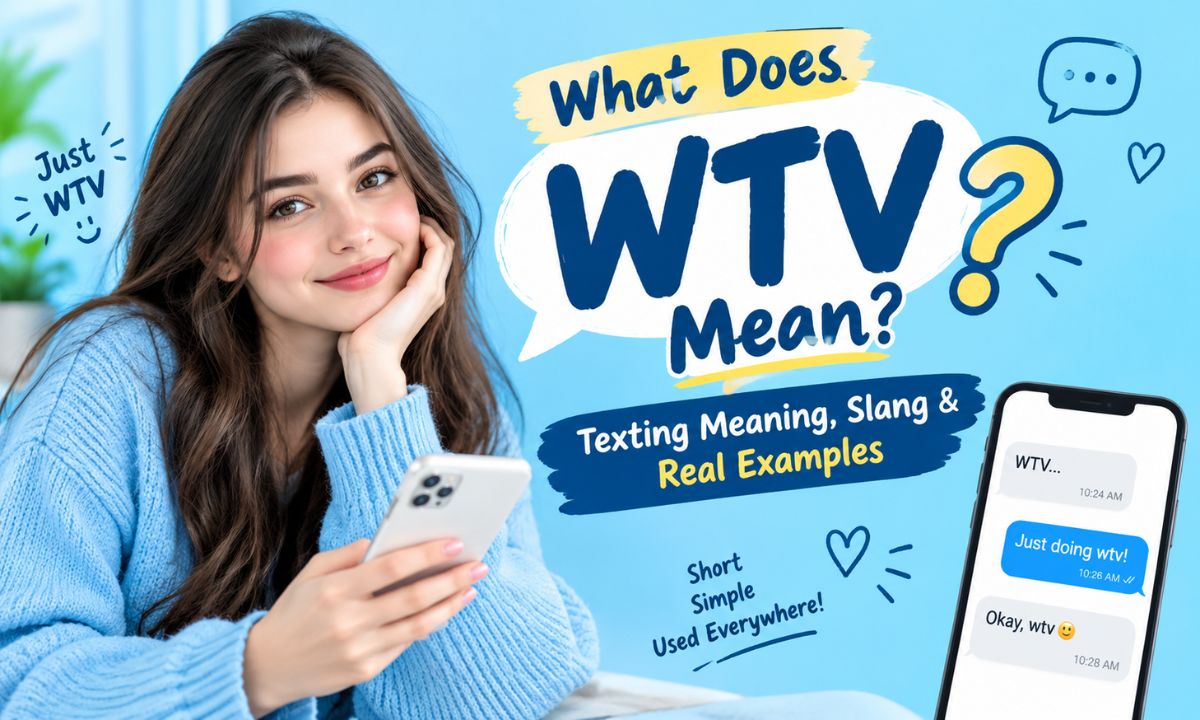

If you’ve been scrolling through texts, group chats, or comments and stumbled across “WTV,” you’re probably wondering what it means and why people keep using it instead of just typing the full word. The short answer: WTV is an internet shorthand, and it’s everywhere in casual digital conversation today.
Younger texters in particular use WTV constantly, often without even thinking about it, because typing three letters is simply faster than typing eight. Over time, this kind of shorthand has become a normal part of how people communicate online, showing up in texts, comments, captions, and even some workplace chat apps among close coworkers.
This guide breaks down exactly what WTV means, how its tone shifts depending on context, where you’ll see it most (TikTok, Snapchat, group chats), real conversation examples, and how to reply when someone sends it your way. By the end, you’ll be able to read WTV the way a native texter does, picking up on the small signals that change its meaning from message to message.
What Does WTV Mean?
WTV is a texting abbreviation for “whatever.” It’s a vowel dropped shorthand the kind of compression texters use to save time and keystrokes, similar to how “b4” stands for “before” or “gr8” stands for “great.”
This style of abbreviation has been around since the earliest days of SMS, when character limits and slow keypads pushed people to shorten everything they could. WTV survived and thrived because “whatever” is such a commonly used word in everyday speech, making it a natural candidate for compression.
At its core, WTV expresses one of these ideas:
- A lack of strong preference (“I’m fine with anything”)
- Indifference toward an outcome
- Mild dismissal or annoyance
- Casual agreement without much enthusiasm
The tricky part is that “whatever” itself is a flexible word in spoken English, and WTV inherits that same flexibility. It can sound chill and easygoing in one message, and cold or irritated in the next. That’s exactly why this guide spends so much time on context; the letters alone rarely tell the whole story.
WTV Slang Meaning in Text
In texting slang, WTV almost always maps back to “whatever.” Unlike acronyms with multiple unrelated meanings (think “IG” for Instagram or “I guess”), WTV rarely strays far from its core definition. What changes is the emotional weight behind it.
This makes WTV a bit easier to decode than some other slang terms, since you don’t have to guess between several unrelated meanings. Instead, your job is simply to figure out how much feeling is packed behind those three letters.
Here’s a quick breakdown of how WTV typically functions in a sentence:
| Usage Type | Example | Meaning |
| Standalone reply | “Wtv” | Simple agreement or indifference |
| With punctuation | “Wtv.” | Slightly clipped, can feel cold |
| With emoji | “Wtv 😂” | Playful, lighthearted dismissal |
| With extra letters | “Wtvvv” | Exaggerated, often sarcastic or teasing |
| In a sentence | “I’ll do wtv you want” | Literal use of “whatever” as a word |
Because texting strips away tone of voice and facial expression, small details like punctuation, capitalization, and emojis end up carrying a lot of the emotional signal. A period at the end of “wtv.” can make it feel final or curt, while a string of extra letters or a laughing emoji tends to soften it into something more playful.
Why Punctuation Matters So Much
A single period can completely change how a word feels in text. “Wtv” without any punctuation often reads as neutral or breezy, while “Wtv.” can feel abrupt, almost like a door closing on the conversation.
This is one of the quirks of digital communication: punctuation that used to be purely grammatical now carries emotional weight. Texters have learned to read periods, capital letters, and repeated letters as tone markers, even though that was never their original purpose.
Also Read This Meaning POS Meaning in Text
How Context Changes the Meaning of WTV
The same three letters can land completely differently depending on who’s sending them, when, and why. Here are the four most common tones WTV carries.
1. Casual Acceptance
Someone asks a low-stakes question, and WTV simply means “I don’t mind either way.”
“Pizza or tacos tonight?” “Wtv, both sound good.”
This version of WTV is friendly and relaxed. It’s the texting equivalent of a shrug paired with a smile, signaling genuine flexibility rather than any kind of frustration.
2. Indifference
WTV can signal genuine neutrality not caring about the outcome, but not upset either.
“Should we go at 6 or 7?” “Wtv works for me.”
Here, the sender truly has no preference. This is common in scheduling conversations, where the details simply don’t matter enough to weigh in strongly.
3. Dismissiveness
When someone doesn’t want to engage further, WTV shuts the conversation down.
“Can we talk about this later?” “Wtv, do what you want.”
This version carries a noticeably colder edge. It often signals that the sender has checked out of the conversation, whether out of frustration, exhaustion, or simple disinterest in continuing.
4. Mild Annoyance
After an argument or an unwanted answer, WTV often carries frustration or resignation.
“I’m not coming anymore.” “Wtv then.”
This is usually the tensest version of WTV, often appearing right after bad news or an unresolved disagreement. It signals that the sender is upset but may not want to escalate further by explaining why.
Understanding which of these four modes is in play usually comes down to what was said right before the WTV, and the relationship between the people texting. Close friends and siblings often read each other’s tone instantly, while newer acquaintances may need to ask for clarification.
WTV Meaning on TikTok, Snapchat, Instagram, and Chats
WTV shows up slightly differently depending on the platform.
Text Messages
In SMS and iMessage conversations, WTV is typically a quick reply to a question or decision, often used between friends, siblings, or partners in casual back and forth chats. Because texting often happens between people who already know each other well, the tone of WTV is usually easier to interpret correctly.
TikTok and Instagram
On TikTok and Instagram, WTV frequently appears in comments and captions to express a laid-back, unbothered attitude often paired with humor or irony rather than genuine indifference. Creators sometimes use it self-deprecatingly, poking fun at their own lack of effort or planning.
Snapchat
On Snapchat, WTV tends to appear in quick-fire chat replies, often in response to plans, memes, or casual banter, since Snapchat conversations lean fast and informal. The platform’s emphasis on quick, disappearing messages makes short slang like WTV a natural fit.
Group Chats and Online Communities
In group chats, WTV is often used to close out a back-and-forth without dragging it on, especially when a decision (like where to meet or what to order) doesn’t really matter to the sender. It’s a practical shortcut that keeps group conversations moving instead of stalling on minor details.
Real Conversation Examples
Seeing WTV in action makes the tone differences much easier to spot.
Example 1: Friends
A: “Movie night, your pick, comedy or horror?”
B: “Wtv, I’m down for either lol”
Here, WTV is friendly and low-stakes genuine flexibility. The added “lol” makes the tone unmistakably relaxed.
Example 2: Argument
A: “I said I was sorry, what more do you want?”
B: “Wtv.”
In this case, WTV reads as cold, closed-off, and possibly still upset. The blunt period at the end reinforces that impression.
Example 3: Group Chat
A: “Should we do 7pm or 8pm for dinner?”
B: “Wtv time works, just lmk”
This is a practical, no drama use just going along with the group’s decision. It shows how WTV can function as a helpful, cooperative response rather than a dismissive one.
Is WTV Rude?
WTV can come across as rude, but it isn’t inherently disrespectful. It depends heavily on context, tone, and timing.
- It’s usually not rude when responding to low-stakes questions like food or scheduling choices.
- It can feel rude when used mid-argument, after someone shares something important, or when it shuts down a conversation someone wanted to continue.
If you’re unsure how your WTV will land, adding a follow-up word or emoji softens it considerably. A simple addition like “wtv lol, either works” reads very differently from a bare “wtv” sent without any context.
Is WTV Flirty?

WTV isn’t typically flirty on its own, but it can take on a playful, teasing tone depending on the conversation. Paired with emojis, exaggerated spelling (“wtvvvv”), or a joking follow-up, it can read as lighthearted banter rather than genuine indifference. Without that context, though, it usually reads as neutral or dismissive rather than flirty.
In flirty exchanges, WTV often shows up as a playful tease, almost like saying “yeah, sure, whatever you say” with a wink. The surrounding words and emojis do most of the work in signaling that lighter tone.
How to Reply to WTV
How you respond depends on whether the WTV feels friendly or frosty.
Friendly Replies
- “Haha okay, I’ll decide then”
- “Cool, going with option B”
- “Bet, I got us”
Funny Replies
- “Wow, so committed 😂”
- “Love the enthusiasm”
- “Wtv yourself”
When WTV Sounds Dismissive
If it feels like it’s shutting you out, it’s usually better to address it directly rather than mirror the tone:
- “You okay? You seem kind of over this conversation”
- “Let me know if something’s bothering you”
Responding with genuine curiosity, rather than matching a cold tone with another cold reply, often helps de-escalate tension and keeps the conversation from spiraling further.
When to Use WTV
WTV works well in low-pressure, casual situations, including:
- Choosing between minor options (food, movies, timing)
- Chatting with close friends who understand your tone
- Keeping a lighthearted conversation moving
- Signaling genuine flexibility
When to Avoid WTV
There are moments where WTV can backfire or send the wrong signal:
- During serious or emotional conversations
- In professional or formal messages
- When someone is asking for your genuine input
- Right after an apology or a vulnerable moment
Using WTV in these situations risks making the other person feel unheard, even if that wasn’t your intention. In moments that call for care, a full sentence usually communicates respect far more clearly than a clipped abbreviation.
Common Mistakes About WTV

A few misunderstandings pop up often around this slang term:
- Assuming it always means indifference, context can flip it into annoyance or dismissal.
- Using it in serious conversations can unintentionally minimize someone’s feelings.
- Reading too much into it from strangers sometimes it’s just genuine ease, not an attitude.
- Confusing it with other acronyms WTV isn’t the same as WTF, though the two are sometimes combined informally (like “WTVTF”) for emphasis.
Avoiding these mistakes mostly comes down to slowing down and reading the full conversation, rather than reacting to the three letters in isolation.
Similar Slang Terms
WTV belongs to a broader family of shorthand indifference and casual texting terms:
| Term | Meaning |
| IDC | I don’t care |
| IDK | I don’t know |
| NVM | Never mind |
| K | Okay (often clipped/cold) |
| Meh | Expresses lack of enthusiasm |
| Sksksk | Overwhelmed reaction (different tone use) |
These terms often appear alongside WTV in casual conversations and carry similarly flexible emotional undertones. Learning to read one of them makes it easier to read the others, since they all rely on the same mix of context, punctuation, and relationship history.
WTV Meaning: Quick Recap
WTV stands for “whatever” and is one of the most common shorthand terms in modern texting. Its meaning shifts based on tone, punctuation, emojis, and the conversation leading up to it ranging from relaxed agreement to blunt dismissiveness. Reading the context around WTV, rather than the letters alone, is the real key to understanding what someone means when they send it.
Conclusion
WTV is a small acronym that carries a lot of nuance. At its core, it simply means “whatever,” but how it lands friendly, neutral, annoyed, or dismissive depends entirely on the context, punctuation, emojis, and relationship between the people texting.
Once you learn to read those small cues, WTV becomes easy to interpret and just as easy to use naturally in your own conversations, whether you’re texting a friend, replying on Snapchat, or keeping a group chat moving.
Like most modern slang, WTV rewards a little attention to detail. Pay attention to what came before it, how it’s punctuated, and who sent it, and you’ll rarely be confused about what someone actually means.

Hi, I’m Munaza, the creator of RTMeaning.com. I’m passionate about explaining internet slang, abbreviations, texting terms, and modern language in a simple and easy-to-understand way. Through this website, I help readers discover the meanings behind trending words, social media expressions, and online communication. My goal is to make learning new terms quick, clear, and enjoyable for everyone.