
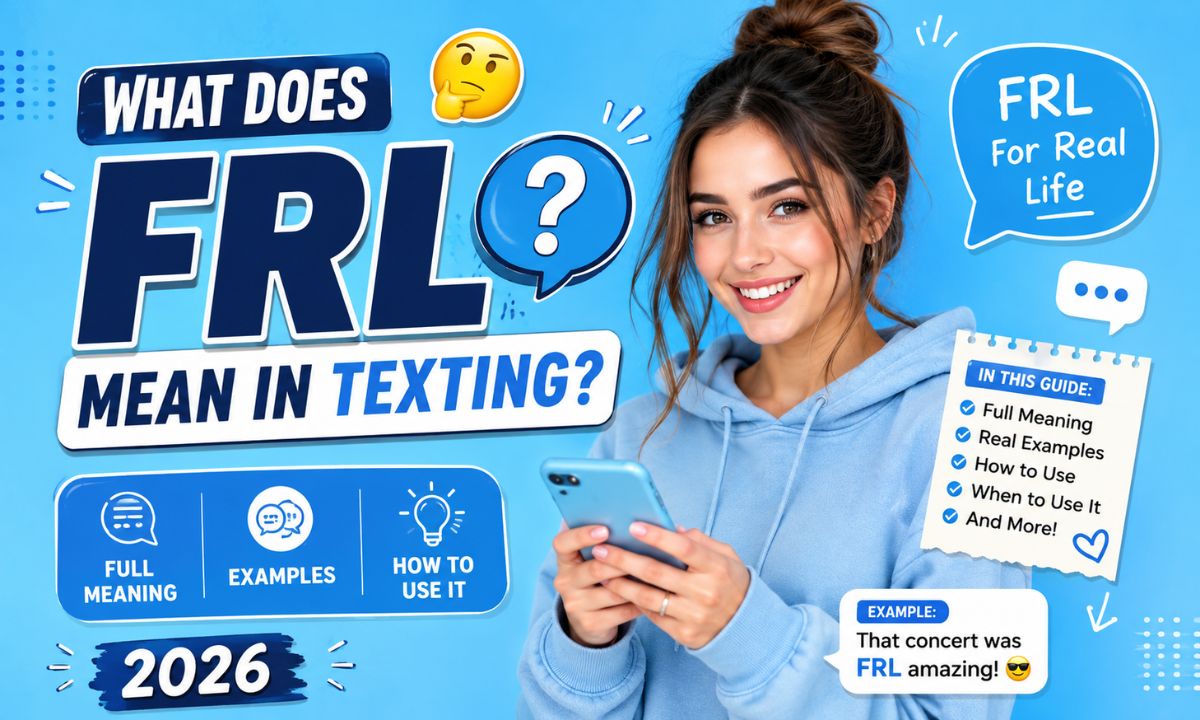

If you’ve been scrolling through Snapchat, Instagram, or a group chat and spotted “FRL” and had no clue what it meant, you’re definitely not the only one. This little three letter combo shows up everywhere in modern texting, and it can leave older users, or anyone new to internet slang, totally confused.
Slang moves fast. New abbreviations pop up every few months, and older ones fade out just as quickly. FRL happens to be one of those terms that has stuck around, mostly because it fills a very specific gap in casual conversation. It lets people add weight to what they’re saying without typing out a full sentence.
The good news is that FRL is one of the easier slang terms to understand once you know the context. In this guide, you’ll learn exactly what FRL means, where people use it, how to use it naturally, and which similar slang words you should know in 2026.
By the end, you should be able to spot FRL in any conversation and know instantly what the sender is trying to communicate, whether it’s excitement, disbelief, or simple agreement.
🧠 What Does FRL Mean in Text?
FRL is short for “For Real.” It’s used to emphasize that someone is being honest, serious, or genuinely means what they just said. Some people also stretch it to “For Real Life,” but the core meaning stays the same. It’s a way of stressing sincerity in casual conversation.
Think of FRL as a verbal nudge. When someone types it after a statement, they’re basically saying, “I’m not exaggerating, I actually mean this.” It works almost like an underline or an exclamation point, except it carries its own little identity as a piece of slang.
You’ll usually see FRL used in one of two ways.
As a statement, it confirms you’re telling the truth.
For example: “That was the best burger I’ve ever had, frl.”
As a question, it asks if someone is being serious.
For example: “You got the job? FRL?”
Because it’s an initialism, meaning it’s pronounced letter by letter as “F-R-L,” it works a lot like other texting shorthand such as LOL or BRB. The main difference is that FRL isn’t describing an action or an emotion. Instead, it’s built entirely around expressing sincerity.
In short, FRL equals For Real, which equals “I genuinely mean this” or “Are you serious?”
This dual function is part of why FRL has become so popular. It’s flexible enough to fit into almost any casual exchange, whether you’re confirming something or reacting with disbelief.
📱 Where Is FRL Commonly Used?
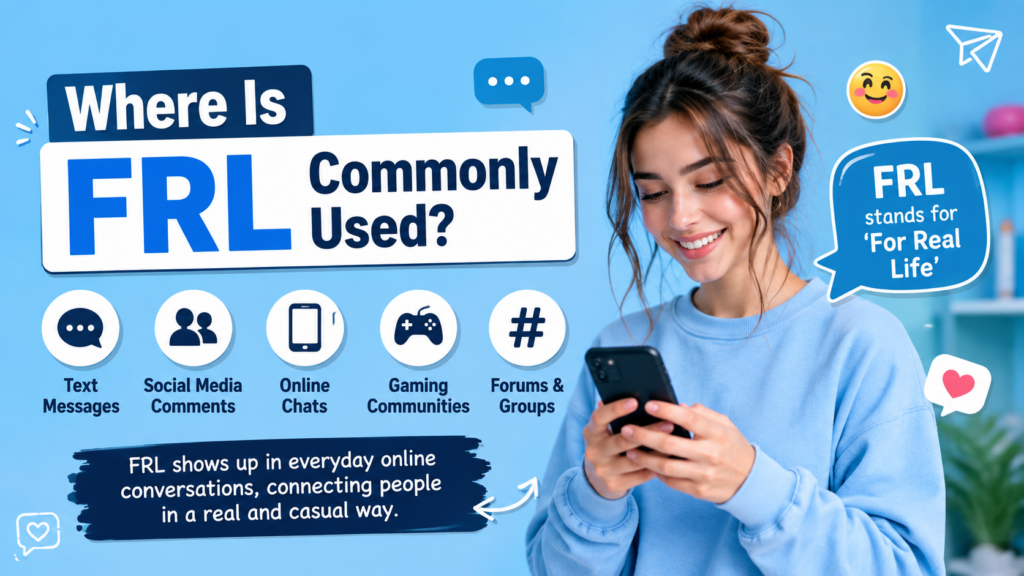
FRL pops up across nearly every major messaging and social platform, though the tone can shift slightly depending on where it’s used.
Different apps tend to shape how a piece of slang gets used. A term that feels natural in a Snapchat caption might read a little differently in a WhatsApp group chat. FRL adapts well across these different environments, which is one reason it has spread so widely.
| Platform | Common Use of FRL |
| Snapchat | Often used to ask for a photo update or check-in, sometimes shorthand for “for real look” |
| Used in comments or DMs to react to a post or ask for more detail | |
| Used casually between friends and family to confirm sincerity | |
| TikTok | Common in comment sections to react to surprising or funny content |
| Text Messages/SMS | Used in everyday chats to emphasize honesty or agreement |
No matter the platform, FRL almost always stays in the casual, informal lane. It’s built for quick, friendly exchanges, not for professional or formal communication.
It’s also worth noting that FRL rarely appears alone in more image-heavy platforms like Snapchat. It often gets paired with a photo, a reaction emoji, or a quick voice note, which adds extra context to whatever point the sender is making.
💬 Examples of FRL in Conversation
Seeing FRL used in real conversations makes it much easier to understand. Here are a few natural examples.
Friend A: “This show is actually so good.”
Friend B: “frl, I binged the whole season in one night.”
Friend A: “I just got accepted into my dream school!”
Friend B: “FRL?? That’s amazing, congrats!”
Friend A: “I’m never eating pizza again.”
Friend B: “frl or are you just saying that after tonight 😂”
In each case, FRL either backs up a statement with sincerity or reacts to something surprising by questioning if it’s true. The tone stays light, casual, and expressive, often paired with emojis to add extra emotion.
Here’s one more example that shows how FRL can shift the mood of an entire message.
Friend A: “I think I bombed that interview.”
Friend B: “Nah frl, you’re overthinking it. You did great.”
Notice how FRL here isn’t just decoration. It’s doing real work, reassuring the other person that the statement is genuine and not just empty encouragement. That’s the core function of the word across almost every context it appears in.
🕓 When to Use and When Not to Use FRL
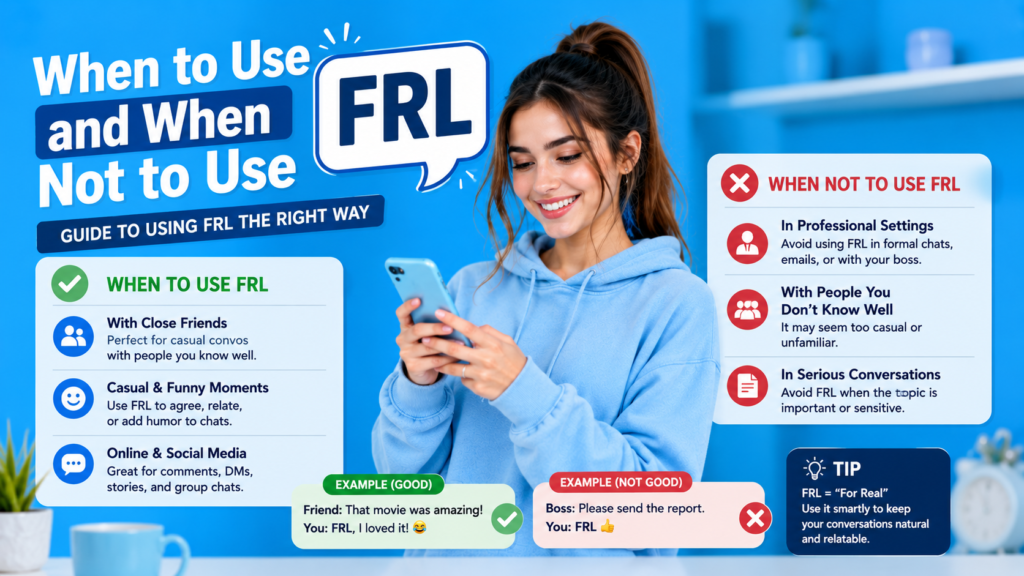
Like most slang, FRL fits perfectly in some situations and completely misses the mark in others. Here’s a quick breakdown.
✅ When to Use FRL
Use FRL when texting friends or family in casual conversation. It fits naturally into these low stakes, relaxed exchanges.
It also works well when reacting to surprising, exciting, or unbelievable news, since it signals genuine emotional investment in what the other person just shared.
Commenting on social media posts is another common spot for FRL, especially under posts that are funny, dramatic, or emotionally charged.
FRL is also useful for agreeing strongly with someone’s opinion, especially when a simple “yes” or “agreed” feels too flat.
Finally, it adds emotional emphasis to a message in a way that feels natural rather than forced.
❌ When Not to Use FRL
Avoid FRL in professional emails or workplace messages. It reads as too casual and can come across as unprofessional.
It also has no place in academic writing or formal documents, where clarity and precision matter more than tone.
Be cautious using FRL in conversations with people who may not understand internet slang, such as older relatives or new coworkers, since it can create confusion instead of connection.
Customer service or business communication is another setting where FRL should be avoided entirely.
Generally, any situation where clarity and professionalism matter more than personality is not the right place for FRL.
Comparison Table
| Situation | Use FRL? | Why |
| Texting your best friend | ✅ Yes | Casual tone fits naturally |
| Instagram comment | ✅ Yes | Common and widely understood |
| Email to your boss | ❌ No | Too informal for professional settings |
| Group chat with peers | ✅ Yes | Adds emphasis and personality |
| Formal school assignment | ❌ No | Slang isn’t appropriate in academic writing |
A simple rule of thumb: if you wouldn’t use a casual tone with someone in person, don’t use FRL with them in text either.
Also Read This Meaning HBU Mean in Text
🔄 Similar Slang Words or Alternatives
FRL isn’t the only abbreviation people use to express sincerity. A few close alternatives include the following.
FR (For Real): is the shorter, more commonly used version of FRL. Many people actually prefer FR simply because it takes less time to type.
FRFR (For Real, For Real): is an intensified version for extra emphasis, often used when someone wants to make absolutely sure their sincerity comes across.
NGL (Not Gonna Lie): introduces an honest opinion or confession, usually right before revealing something slightly unexpected or vulnerable.
TBH (To Be Honest): is similar to NGL but slightly softer, often used to soften an opinion rather than confess something surprising.
ONG (On God): is a stronger, oath-like way of confirming truthfulness, often used when someone wants to emphasize that they are absolutely serious.
FRL sits comfortably in the middle of this group. It’s more emphatic than a simple “yes,” but not as intense as FRFR or ONG, making it a versatile go-to for everyday texting. Knowing these related terms also helps you understand the broader vocabulary of sincerity-based slang, since they often appear together in the same conversations.
Frl Mean in Texting From a Girl
When a girl uses FRL in texting, it typically carries the same core meaning. She’s emphasizing honesty or reacting genuinely to something.
It can also add a warmer, more expressive tone, especially when paired with emojis, showing enthusiasm, agreement, or surprise in a friendly or flirty context.
In many cases, the surrounding emojis or punctuation say just as much as the word itself. A simple “frl” feels calm and confirming, while “FRL?!” with extra punctuation signals excitement or shock.
Frl Meaning From a Guy
When a guy sends FRL, it usually functions the same way, confirming sincerity or reacting to unexpected news.
The tone tends to be a bit more straightforward, often used to back up a statement or express genuine agreement without much extra emotional flair.
That said, context always matters more than gender. The same word can carry very different energy depending on who’s saying it, what platform it’s on, and what the conversation is about.
Final Thoughts
Slang like this evolves so quickly that it’s worth checking in on new terms every so often, especially if you’re active on platforms like TikTok or Snapchat. What feels new today might already be considered old news in a few months, replaced by some fresh variation or a completely different phrase. Staying a little curious about these shifts keeps your texting style feeling current and natural.
At the same time, there’s no pressure to use every piece of slang you come across. The goal isn’t to sound trendy for the sake of it, but to communicate clearly and comfortably with the people you’re talking to. If FRL fits your natural texting voice, use it. If it doesn’t, that’s completely fine too.
Ultimately, understanding terms like FRL is less about memorizing definitions and more about reading the room. Once you get comfortable recognizing tone, context, and platform, slang like this becomes second nature. You’ll be able to use it when it helps, skip it when it doesn’t, and always come across as genuine either way.

Hi, I’m Munaza, the creator of RTMeaning.com. I’m passionate about explaining internet slang, abbreviations, texting terms, and modern language in a simple and easy-to-understand way. Through this website, I help readers discover the meanings behind trending words, social media expressions, and online communication. My goal is to make learning new terms quick, clear, and enjoyable for everyone.