

Ever been texting someone and suddenly they reply with just “HBU?” and you had to stop and think for a second? You’re definitely not alone. Chat slang moves fast, and even people who text all day still run into abbreviations that make them pause.
Abbreviations like this one exist because typing speed matters in casual conversation. Nobody wants to type out a full sentence when three letters do the same job. That’s exactly why HBU has become such a permanent fixture in everyday texting culture.
This guide breaks down exactly what HBU means, where it comes from, how to use it correctly, and when you should probably avoid it altogether. By the end, you’ll never have to secondguess this abbreviation again.
Texting slang has evolved rapidly over the past decade, and abbreviations like HBU are a big part of that shift. As conversations moved from phone calls to instant messaging, people naturally started shortening common phrases to save time and keep the rhythm of a chat moving smoothly.
🧠 What Does HBU Mean in Conversation?
HBU stands for “How About You?” It’s a short, casual way of turning a question back on the person you’re talking to, usually right after you’ve answered something about yourself.
Instead of typing out the full sentence, people just tack on “HBU” at the end of a message. It’s quick, low effort, and fits perfectly into the fast pace of modern texting.
It works as a conversational bridge. Rather than letting a chat end after you share an update, HBU keeps the exchange going by inviting the other person to respond with something about their own life.
For example:
“I’m doing pretty good today. HBU?”
“Just finished dinner. HBU?”
It’s the digital equivalent of nodding and asking, “and you?” It shows interest without requiring extra effort, which is exactly why it has become so widely used across nearly every messaging platform.
Tone Check: What Does HBU Mean?
HBU is generally neutral and friendly, but its tone can shift a little depending on context.
| Context | Tone |
| Texting a close friend | Casual, warm |
| Talking to a crush or dating chat | Can feel flirty |
| Messaging a coworker | Slightly too casual |
| Formal email | Inappropriate |
The abbreviation itself doesn’t carry any hidden emotion; it’s the surrounding message, emojis, and punctuation that shape how it lands.
A single question mark after HBU usually reads as neutral curiosity. Add an emoji, a compliment, or a longer follow up message, and the same three letters can suddenly feel warmer or more personal. Context always does the heavy lifting.
This is why paying attention to the whole conversation matters more than focusing on the abbreviation alone. The same word can shift meaning entirely depending on who’s texting and what mood the chat is already in.
📱 Where Is HBU Commonly Used?

HBU shows up almost everywhere people chat casually. You’ll spot it most often in:
- Text messages (SMS) between friends and family
- Instagram DMs and story replies
- Snapchat chats
- WhatsApp group and one on one conversations
- TikTok and Twitter/X comments
- Gaming chats like Discord
It’s especially common on platforms where replies are short and quick, since typing “How about you?” every time feels unnecessarily long for a casual back and forth.
Younger users in particular rely on HBU heavily because so much of their daily communication happens through short bursts of text rather than long paragraphs. It fits naturally into that rhythm.
Even on platforms built around images and video, like Instagram Stories or Snapchat, HBU still pops up in caption replies and comment threads. Wherever conversation is quick and informal, this abbreviation tends to follow.
Group chats are another place where HBU thrives. When several people are replying at once, short abbreviations help keep the pace of the conversation quick without anyone feeling like they have to write a full paragraph just to stay involved.
💬 Examples of HBU Meaning in Conversation
Seeing HBU in real chat examples makes it much easier to understand how naturally it fits into everyday texting.
- “Had a long day at work. HBU?”
- “I’m bingewatching a new show tonight 📺. HBU?”
- “Just adopted a puppy 🐶! HBU?”
- “Feeling kind of tired today. HBU?”
- “Going out for pizza later. HBU?”
Notice how HBU almost always comes at the end of a message after the person has already shared something, not before. This ordering matters because it keeps the conversation flowing naturally, almost like a verbal handoff.
A typical short exchange looks like this:
Person A: Hey, how’s it going?
Person B: Pretty good, just relaxing. HBU?
Person A: Same here, taking it easy today.
This back and forth pattern is exactly why HBU has stuck around for so long. It’s efficient, it’s polite in its own casual way, and it signals that the conversation is a two way street rather than a one sided update.
🕓 When to Use and When Not to Use HBU
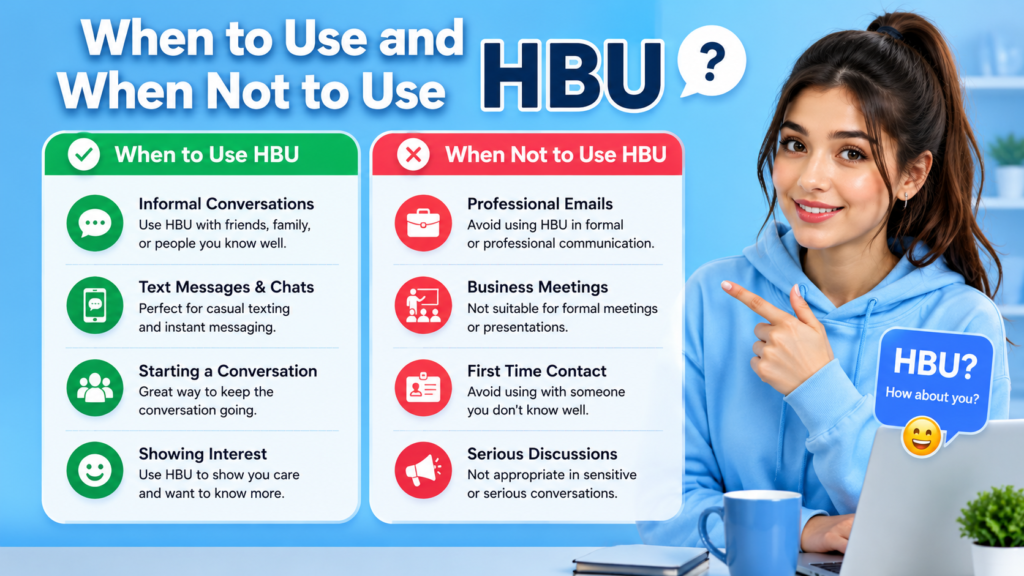
HBU is great in casual settings, but it doesn’t belong everywhere. Here’s a simple breakdown.
✅ When to Use HBU
- Texting friends or family
- Chatting on social media apps
- Casual group chats
- Gaming or online community chats
- Light, quick checkins with someone you know well
❌ When Not to Use HBU
- Professional emails or work reports
- Messaging someone new in a formal context
- Job interviews or business communication
- Academic writing or formal essays
- When the conversation is already serious or emotional in tone
In workplace chats like Slack or Teams, HBU can sometimes slide in among colleagues who already text casually, but full phrases are still safer for first impressions.
If you’re unsure whether an abbreviation fits a conversation, a good rule of thumb is to picture how it would read out loud. If “How about you?” would sound natural in that setting, then HBU is probably fine too. If it would sound out of place, it’s better to spell it out.
Also Read This Meaning WYT Mean in Text
Other Meanings of HBU
While “How About You?” is by far the most common meaning, HBU can occasionally stand for something else depending on the setting.
| Context | Meaning |
| Texting & chat (99% of cases) | How About You? |
| Gaming/online slang | Hit Back Up (reconnect later) |
| Education | Houston Baptist University |
| Business/finance | Highest and Best Use (a property valuation term) |
| Healthcare (rare, institution specific) | Varies by organization |
Unless you’re in a very specific context like real estate or academics, HBU almost always just means “How About You?” The surrounding conversation usually makes the intended meaning obvious right away, so confusion is rare in practice.
🔄 Similar Slang Words or Alternatives
HBU isn’t the only abbreviation people use to bounce a question back. Here’s how it compares to similar terms.
| Term | Full Meaning | Difference from HBU |
| WBU | What About You? | Same purpose, used after “what” questions |
| HBY | How About You | Slight variation, less common |
| UR | You Are | Different meaning entirely |
| HMU | Hit Me Up | An invitation to talk, not a question |
| WYD | What Are You Doing? | Asks about current activity, not opinion |
A quick rule of thumb: use HBU after a “how” question, and WBU after a “what” question though in casual texting, most people use them interchangeably anyway.
Knowing these related terms can also help you understand a conversation faster, especially in group chats where multiple abbreviations often appear together within just a few messages.
Some people even mix HBU and WBU within the same conversation without noticing much difference in meaning. As long as the context of the original question is clear, both abbreviations tend to be understood the same way by most texters.
HBU Meaning in Business

Outside of texting, HBU has a completely different meaning in real estate and property valuation: Highest and Best Use. This refers to the most profitable and legally permitted way a piece of land or property can be used. It’s a technical term used by appraisers and investors, and it has nothing to do with casual chat slang; context makes the difference obvious immediately.
Appraisers rely on this concept to determine a property’s true market value, comparing what the land currently offers against what it could realistically become under zoning laws and market demand. It’s a completely separate world from texting, but it happens to share the same four letters.
Anyone reading a real estate report or attending a finance class should keep this distinction in mind, since mixing up the two meanings could easily cause confusion in a professional setting.
HBU Meaning From a Girl
When a girl sends “HBU” in a text, it usually means exactly what it says she’s asking about you after sharing something about her own day. On its own, it’s neutral. But paired with emojis, compliments, or playful phrasing, it can carry a flirty undertone. The abbreviation itself isn’t romantic; the tone of the full conversation is what determines that.
HBU Mean in Text From a Guy
Similarly, when a guy uses HBU, it’s typically just a friendly way to keep the conversation balanced instead of talking only about himself. In dating conversations, it can signal genuine interest, especially if he’s actively following up on your answers rather than just asking and moving on.
HBU Mean in Text From a Boy
From a younger texter or a boy in a school age friend group, HBU is almost always casual and nonromantic. It’s simply part of everyday chat habits picked up from friends, group chats, and social media, a quick, low effort way to keep a conversation going without overthinking it.
HBU Mean in Text in Urdu
For Urduspeaking users, HBU translates roughly to “aap ka kya khayal hai?” or more simply “aap sunao?” a casual way of asking “and what about you?” after sharing your own update. It’s used the same way in Roman Urdu texting and mixed EnglishUrdu chats, especially among younger users on WhatsApp and Instagram.
Conclusion
HBU is one of those small abbreviations that makes a big difference in how natural your texting feels. At its core, it simply means “How About You?” a quick, friendly way to keep a conversation twosided instead of onesided.
It works great in casual chats with friends, family, and on social media, but it’s best avoided in formal emails or professional first impressions. Knowing where the line sits between casual and formal communication can save you from an awkward first impression.
Beyond texting, remember that HBU can also pop up in completely unrelated fields like real estate or education, so context always matters more than the letters themselves.
Once you understand the tone and context behind it, you’ll never have to pause and wonder what “HBU?” means again.

Hi, I’m Munaza, the creator of RTMeaning.com. I’m passionate about explaining internet slang, abbreviations, texting terms, and modern language in a simple and easy-to-understand way. Through this website, I help readers discover the meanings behind trending words, social media expressions, and online communication. My goal is to make learning new terms quick, clear, and enjoyable for everyone.