

If you have ever been texting someone and got a reply like “just chilling, wbu?” you are not alone in wondering what that last part means. Slang like this pops up everywhere, in DMs, group chats, and even dating apps. For anyone new to texting culture, it can feel like a secret code.
The good news is that WBU is one of the easiest pieces of chat slang to learn. This guide walks through what it means, where people use it, when it fits and when it does not, and a few similar terms you might come across too.
What Does WBU Stand For?
WBU stands for “What About You?” It is a short and casual way to turn a question back around on someone after you have already answered it yourself.
Here is the basic pattern. Someone asks you something. You answer. Then, instead of typing out the full question again, you just add “wbu” at the end.
For example:
Friend: How was your weekend? You: Pretty chill, just stayed home. Wbu?
In that exchange, wbu simply means “what was your weekend like for you?” It is a shortcut, not some separate idea. People use it to keep a conversation moving without retyping the same words over and over.
One small detail worth mentioning: in real texting, people almost always write it in lowercase, “wbu,” rather than the capitalized “WBU.” The capital version is mostly used when explaining what the letters stand for, like in this article.
Where Do People Use WBU?
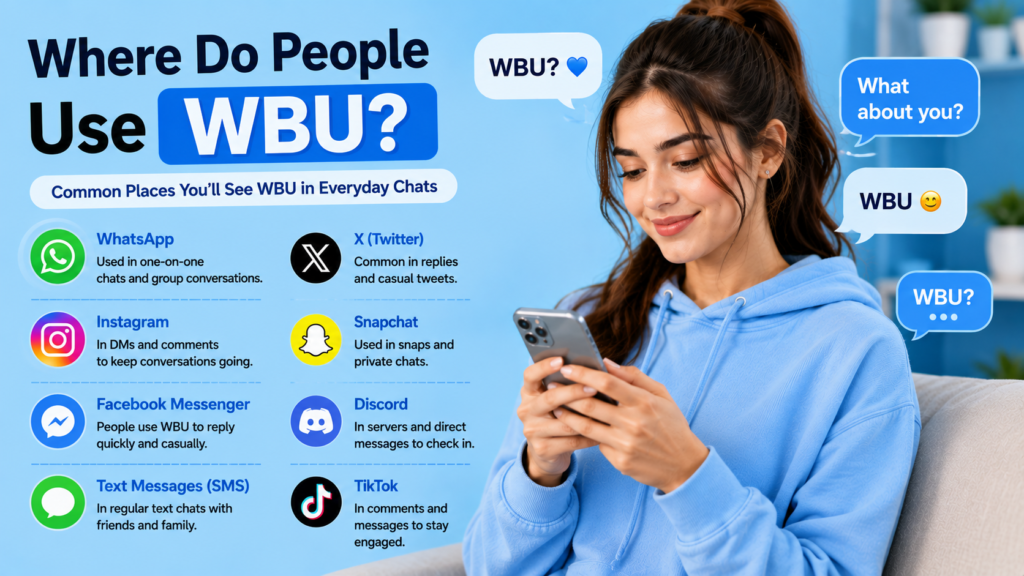
WBU shows up mostly in quick, informal, text-based chats. It was built for fast back-and-forth conversation, not for anything formal.
Some of the most common places you will see it include:
- Texting through SMS or iMessage
- Direct messages on Instagram, Snapchat, TikTok, or Twitter/X
- Messaging apps like WhatsApp, Telegram, or Discord
- Dating apps such as Tinder, Bumble, or Hinge, where it helps keep a light and easy exchange going
- Online gaming chats, especially between matches
- Comment sections when replying to someone’s post
The tone of WBU is relaxed and friendly by default, but the real vibe always depends on who is saying it and the context around it. A short “wbu?” between close friends feels warm and casual. That same word dropped into a stiff, one-word reply can come across as distant or a little low effort.
Examples of WBU in Real Conversations
Seeing WBU used in context makes it much easier to understand than a plain definition ever could. Here are a few realistic examples of how it shows up.
Friend 1: I’m starving, thinking about ordering pizza. Friend 2: Same honestly. Wbu, what are you craving?
Friend 1: Just got home from work, exhausted. Friend 2: Ugh, mood. Wbu, long day?
Friend 1: I’m watching a new show tonight, kind of excited. Friend 2: Nice! Wbu, planning anything else this weekend?
Friend 1: I’m doing okay, just busy with school. Friend 2: Same here. Wbu, how’s your week going?
Notice the pattern. WBU almost always comes right after someone shares something about themselves. It is a natural, easy way of saying “your turn” without sounding blunt or demanding.
When Should You Use WBU (and When Should You Not)?
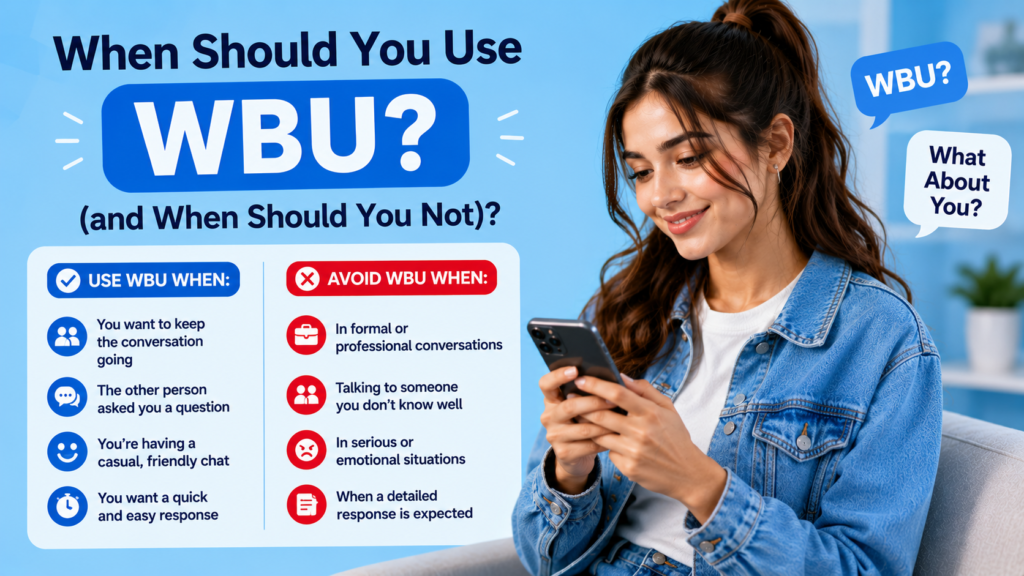
Like most internet slang, WBU fits perfectly in some situations and feels completely out of place in others. A simple rule of thumb: if the conversation is casual, WBU works well. If it is formal or professional, skip it entirely.
Situations where WBU makes sense:
- Texting close friends or family members
- Chatting casually on social media or dating apps
- Keeping a light conversation going without repeating yourself
- Talking with people your own age in an informal setting
- Group chats or gaming chats
Situations where you should avoid it:
- Emails to a boss, teacher, or client
- School essays or any formal writing assignment
- Job applications or professional messaging platforms like LinkedIn
- First conversations with someone in a professional context
- Any situation where clarity and formality matter more than speed
Texting a close friend is a clear yes. A casual Instagram DM with an acquaintance is a yes too. A work email to your manager, though, is a firm no, and so is a school assignment. A dating app conversation usually works, as long as you read the tone of the chat.
Other Meanings of WBU
While “What About You?” is by far the most common meaning of WBU, the letters can technically stand for a few other things in different contexts. These other meanings are far less common in everyday texting, but they do exist.
- World Boxing Union, a sanctioning organization connected to professional boxing
- World Blind Union, an international organization that represents blind and partially sighted people
- Wayland Baptist University, a school abbreviation used outside of chat contexts
In practice, though, almost every time you see WBU in a text message or on social media, it means “What About You?” The other meanings only really come up outside of casual chat, so context usually makes it obvious which one is meant.
Similar Slang Words You Might See
WBU is not the only shorthand people use to bounce a question back to someone. A few close alternatives show up regularly.
HBU stands for “How About You?” and is used almost identically to WBU. WBY stands for “What ‘Bout You?”, a slightly more relaxed, phonetic spin that carries the same meaning. AY or AU is less common, but some use it as shorthand for “and you?” U? is an even shorter, more direct way of tossing a question back, often used when the conversation is moving quickly.
These terms are mostly interchangeable. Choosing one over another usually comes down to personal habit rather than any real difference in meaning.
Why Do People Use WBU Instead of a Full Sentence?
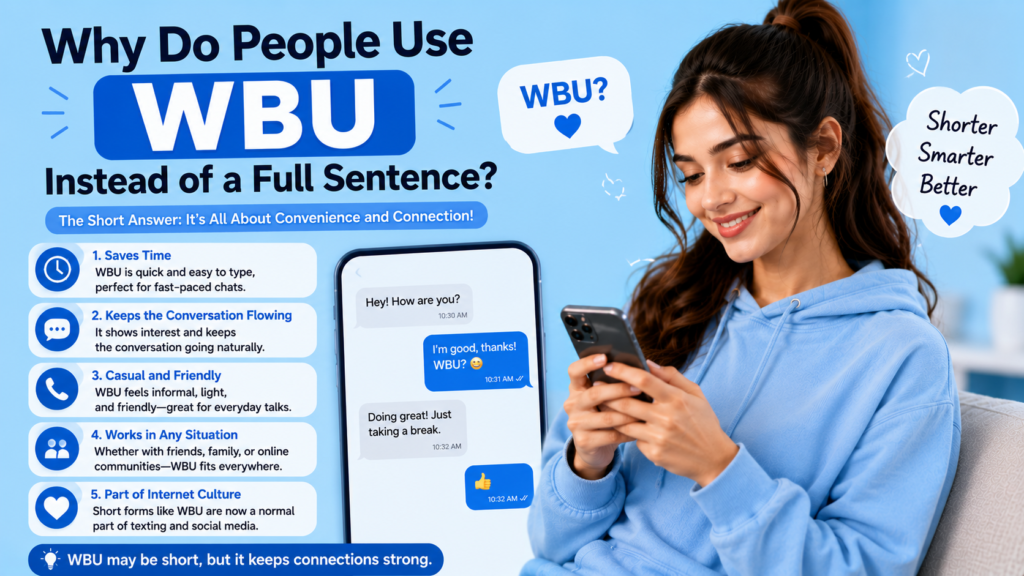
It might seem like a tiny thing, but there are real reasons this three letter abbreviation has become so popular in digital conversations.
It saves time. Typing “wbu” takes a fraction of the time it takes to type out “what about you?” Every saved keystroke adds up in a fast group chat.
It keeps conversations moving. Fast-paced chats rely on quick replies to stay alive. WBU keeps that rhythm going without slowing things down.
It feels natural. For people who grew up texting, slang like WBU feels like a normal part of conversation rather than something forced.
It is easy to understand. Unlike some slang that needs extra explanation, WBU is short and simple, and context almost always makes its meaning obvious.
Also Read This Meaning LYT Mean in Texting
Is WBU Friendly or Formal?
WBU is strictly informal. It was built for casual conversation, so it really does not belong in formal writing or professional messages of any kind. That said, how “friendly” it feels can shift quite a bit depending on how it is used.
When paired with warmth or emojis, WBU feels welcoming and genuinely interested. Something like “I’m doing great, just relaxing today! Wbu?” reads as warm and engaged.
On its own, though, a bare “wbu?” can come across as neutral, or even a little flat, since tone is already hard to read through text. It is not rude, but it can feel low effort if that is the entire reply.
What Does WBU Mean From a Girl?
When a girl uses WBU in a conversation, it means exactly the same thing it means for anyone else: “What About You?” There is no hidden or gender-specific meaning behind the word itself.
That said, context and tone often shape how a message gets read. In a friendly, everyday chat, WBU is simply a way of keeping the conversation going. In a flirty or dating-app setting, a quick “wbu” followed by a smiling emoji can come across as more of an invitation to keep talking rather than just a plain question.
As always, the surrounding conversation is the real clue to someone’s tone, not the abbreviation on its own.
WBU or WBY: What Is the Difference?
WBU and WBY mean the same thing and are used in basically the same way. The only real difference between them is spelling style.
WBU stands for “What About You?” while WBY stands for “What ‘Bout You?”, which is a more relaxed and phonetic version of the same phrase. Neither one is more correct than the other. It really just comes down to personal texting habits. Some people even switch between both in the same conversation without giving it a second thought.
Common Mistakes People Make With WBU
Even though WBU is simple, a few small habits can make it land the wrong way.
Using it without sharing anything first. WBU works best as a follow-up to something you already said. Sending “wbu” out of nowhere can leave the other person unsure what you are even asking about.
Relying on it too much. If every message ends with “wbu,” a conversation can start to feel repetitive or robotic.
Using it in the wrong setting. Sending “wbu” in a professional email can come across as careless, even if that was not the intention.
Sounding cold by accident. A bare “wbu” with no punctuation or emoji can feel flat, since tone is already hard to read in text. A little warmth usually fixes this.
How to Reply When Someone Sends You WBU
If someone sends you “wbu,” it is your turn to share something. You do not need a long answer, just a short, honest one works fine.
For example, if a friend asks “I’m doing okay, just tired. Wbu?” you might reply “Same here, work has been busy.” This keeps the exchange balanced and shows you are actually engaged, not just replying out of habit.
Final Thoughts
WBU is one of the simplest pieces of texting slang out there to learn, and once you understand it, you will start noticing it everywhere: in DMs, group chats, dating apps, and casual conversations of every kind. At its core, it just means “What About You?” and it is used to politely bounce a question back to whoever you are chatting with.
The one thing worth remembering is context. WBU works great in casual, friendly conversations, but it does not belong in emails, schoolwork, or professional messages. Once you get comfortable spotting it in the wild, using it naturally in your own conversations will come pretty easily too.

Hi, I’m Munaza, the creator of RTMeaning.com. I’m passionate about explaining internet slang, abbreviations, texting terms, and modern language in a simple and easy-to-understand way. Through this website, I help readers discover the meanings behind trending words, social media expressions, and online communication. My goal is to make learning new terms quick, clear, and enjoyable for everyone.