

If you have ever opened a message that simply said “wut,” you have probably paused for a second. Is your friend confused? Shocked? Joking around? This tiny word carries a surprising amount of emotional weight, and it shows up constantly across texts, comments, and group chats.
This guide walks through everything “wut” means, where it comes from, how people actually use it, and when you should reach for it (or avoid it) in your own conversations.
The Basic Meaning of “WUT”
At its core, “wut” is nothing more than a playful, informal spelling of the word “what.” It is not an abbreviation. It does not stand for a hidden phrase. It is simply a stylistic twist on a common word that internet culture adopted and ran with.
People type “wut” when they want to react to something. Maybe they are confused. Maybe they are shocked. Maybe they think what they just read is funny or unbelievable. The exact emotion behind the word depends heavily on the situation surrounding it.
A lone “wut?” sent after unexpected news feels very different from a cheerful “wut 😂” sent after a joke. The spelling stays the same, but the feeling behind it shifts completely based on context, punctuation, and tone.
A Quick Breakdown of Related Terms
| Term | Meaning | Typical Tone |
| What | The standard English word | Neutral |
| Wut | A casual spelling of “what” | Playful, expressive |
| Wat | A memestyle variant | Sarcastic, exaggerated |
| Wut? | A quick request for clarification | Confused |
| Wut?! | A stronger reaction | Surprised or alarmed |
Each version leans on the same root word but signals a slightly different emotional register. Native texters instinctively pick between them without even thinking about it.
Where You’ll See “WUT” Most Often

“Wut” belongs almost entirely to informal, digital spaces. You will not find it in a business email or a formal report, but it is everywhere in casual online conversation.
Common places you’ll spot it:
- Text messages between close friends
- Instagram and Snapchat direct messages
- TikTok and Twitter/X comment sections
- Gaming chats on Discord, Twitch, or in game messaging
- Group chats reacting to shared news
Each of these spaces shares one thing in common: low stakes and high informality. Nobody is grading grammar in a Discord server, so slang like “wut” fits right in.
Why the Setting Matters
The platform itself often shapes how “wut” reads. In a gaming chat, it might pop up after a surprising kill or an unfair loss. In a group chat, it might follow someone dropping unexpected personal news. On social media, it often reacts to a wild video or an unbelievable headline.
Understanding the setting helps you read the emotional tone correctly, since the word itself gives very few clues on its own.
Examples of “WUT” in Real Conversations
Seeing the word in action makes its flexibility much clearer. Below are a few everyday exchanges that show how “wut” bends to fit different emotional situations.
Example 1 Friend: “I accidentally deleted my whole essay.” You: “Wut?! No way.”
Example 2 Friend: “I just adopted three cats.” You: “Wut 😂 how did that happen?”
Example 3 Teammate: “We lost because I scored on our own goal.” You: “Wut bro?”
Example 4 Friend: “I got promoted!” You: “Wut! Congrats!!”
Example 5 Random text: “The meeting got moved to 6am.” You: “Wut… why so early”
Notice something important here. The core meaning barely shifts between these examples. What changes is the emotional charge, and that charge comes almost entirely from punctuation, emojis, and the surrounding conversation.
Also Read This Meaning HY Mean in a Text
When You Should Use “WUT”
Slang like this thrives in the right setting and falls flat in the wrong one. Knowing the difference keeps your messages sounding natural instead of awkward.
Good moments to use “wut”:
- Texting close friends or family casually
- Reacting to memes or funny posts
- Chatting inside gaming communities
- Commenting on lighthearted social media content
- Expressing playful shock or disbelief
In these situations, “wut” adds personality. It signals that you are relaxed, engaged, and speaking the same casual language as the person you are talking to.
When You Should Avoid “WUT”
On the flip side, there are plenty of situations where this word simply does not belong. Using it in the wrong context can come across as unprofessional or even careless.
Situations to steer clear of:
- Professional emails or workplace messaging
- Formal writing, essays, resumes, or reports
- Conversations with people you don’t know well
- Customer service or business communication
- Any setting where clarity and professionalism matter
If you are unsure whether a conversation counts as “formal,” it is usually safer to type out “what” in full. A little extra clarity rarely hurts, especially with someone you are meeting for the first time or communicating with professionally.
Why Do People Type “WUT” Instead of “WHAT”?
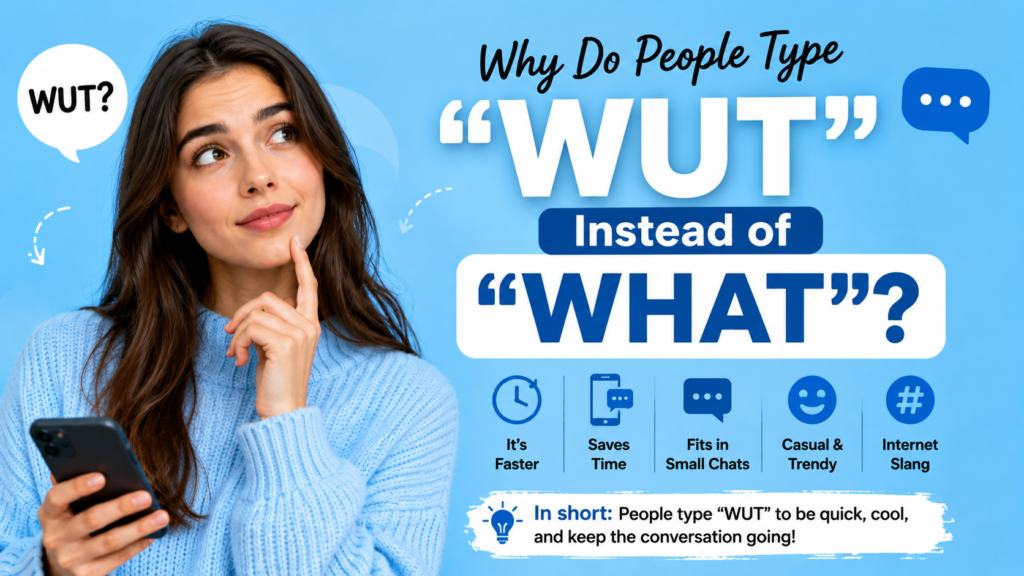
There is more behind this small spelling change than pure laziness. A handful of real reasons explain why “wut” caught on and stuck around.
1. It Carries More Emotional Punch
The unusual spelling gives the word a visual jolt that the standard “what” simply does not have. Seeing “wut” instead of “what” tells the reader instantly that this is not a neutral question. It signals heightened emotion before they even process the rest of the message.
2. It Mimics a Verbal Reaction
Say “wut” out loud. It sounds almost exactly like a quick, surprised grunt, similar to “huh?” That phonetic quality makes it feel more like a spoken reaction than a typed question, which is part of why it reads as so casual and immediate.
3. Gaming and Meme Culture Popularized It
Online gaming communities and meme culture played a huge role in spreading “wut” (along with its close cousin “wat”). It became a goto reaction word, often paired with exaggerated images, reaction GIFs, or over the top captions poking fun at something absurd.
4. It’s Faster to Type
Dropping the “ha” from “what” saves a keystroke, which fits neatly into the quick, abbreviated rhythm of texting and chat apps. Speed matters in fast moving conversations, and slang words that shave off letters tend to spread quickly.
5. It Signals a Relaxed Tone
Typing “wut” instead of “what” instantly tells the other person that the conversation is casual, not serious or businesslike. It works almost like a tone indicator, letting your friend know exactly how to read the rest of your message.
Other Popular Variations of “WUT”
Slang words rarely stay static. Over time, “wut” has picked up a handful of close relatives, each with a slightly different flavor.
| Variation | Typical Use |
| Wat | Memestyle reaction, often paired with images |
| Wut? | A quick request for clarification |
| Wut?! | A stronger expression of surprise |
| Lol wut | Confusion mixed with humor |
| Wut lol | A casual, amused reaction |
These variations let people finetune exactly how much shock, humor, or confusion they want to convey, all while staying within the same basic word family.
Similar Slang Words You Might Mix In
If “wut” feels a little repetitive after a while, plenty of other casual expressions serve a similar purpose. Mixing these into your texting vocabulary keeps conversations feeling fresh.
- Huh? classic confusion, a bit less playful than “wut”
- Bruh: general disbelief or exasperation
- Sus: something that feels suspicious or questionable
- Fr? short for “for real?”, checking if something is true
- No cap? another way of asking whether someone is being honest
Each of these words carries its own subtle flavor, but they all live in the same casual, reaction based corner of texting slang that “wut” occupies.
Is “WUT” Rude or Friendly?
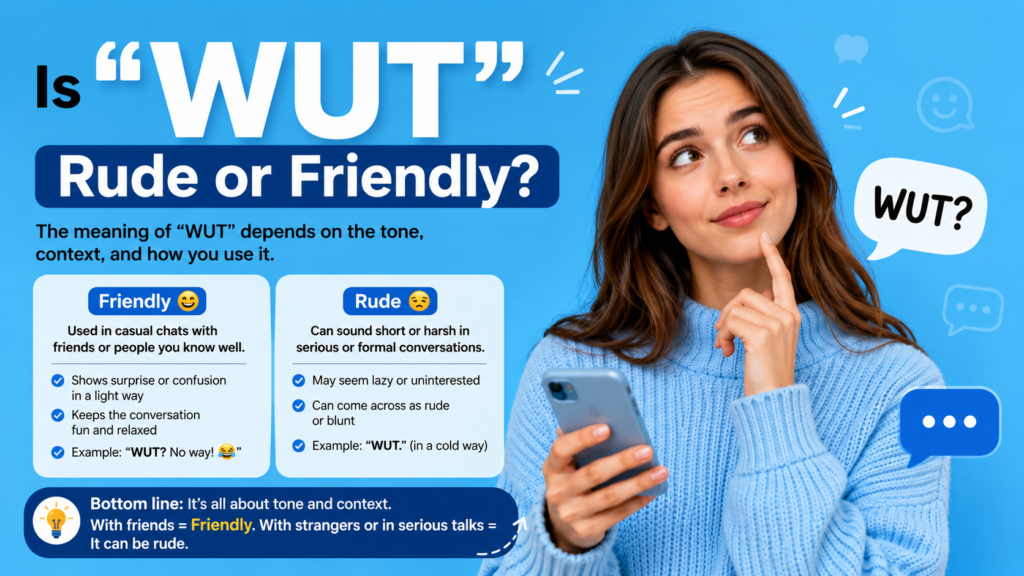
This is probably the most common question people have, and the honest answer is: it depends entirely on tone and relationship, not the word itself.
Friendly Use
When paired with emojis or exclamation points, “wut” almost always reads as playful and warm. It becomes a lighthearted way to react to something surprising, funny, or unexpected, and most readers will pick up on that energy immediately.
Neutral Use
On its own, without any extra context, “wut” simply functions as a quick, informal way to ask for clarification. Think of it as a casual standing for “what did you mean?” or “can you explain that?”
Potentially Negative Use
A blunt, oneword “wut” with no punctuation, emoji, or followup can sometimes come across as dismissive. This is especially true if it is replying to something the other person put real thought or effort into, like a long explanation or an emotional message.
If you want to avoid sounding cold, adding a little extra context or a followup question usually helps soften the message and clarify your intent.
WUT Urban Dictionary
In Urban Dictionary, “WUT” is commonly defined as a casual or humorous spelling of “what.” People use it in text messages, memes, online gaming, and social media to express surprise, confusion, disbelief, or to ask someone to repeat what they said. The spelling gives the word a more playful and informal tone.
Unlike the standard word “what,” WUT is almost always used in casual conversations and internet culture. It isn’t appropriate for formal writing, school assignments, or professional emails. Instead, it’s best used when chatting with friends or reacting to something unexpected online.
WUT meaning in chat from a girl
It usually stands for “What?” It is an informal and playful spelling that girls often use in text messages, Snapchat, WhatsApp, Instagram, and other social media chats. Depending on the situation, it can express surprise, confusion, disbelief, or curiosity.
For example, if a girl replies with “WUT?” After reading your message, she is usually asking you to explain what you mean or reacting with surprise. The tone depends on the conversation, so it can sound funny, shocked, or simply curious rather than rude. Reading the surrounding messages will help you understand the intended meaning.
Quick Tips for Using “WUT” Naturally
- Match the punctuation to your actual emotion (a question mark for confusion, an exclamation point for shock).
- Add an emoji when you want to make sure your tone reads as friendly.
- Avoid using it as a standalone reply to something serious or heartfelt.
- Save it for people you already text casually, not new contacts or coworkers.
- Switch to “what” the moment the conversation shifts into anything formal.
Final Thoughts
“Wut” is really just a fun, informal spelling of “what” that has become a permanent fixture of texting and online culture. It is not offensive, it does not hide any secret meaning, and its literal definition barely strays from the original word.
What actually changes is the energy behind it. Whether you are reacting to shocking news, a funny story, or an unexpected twist in a game, “wut” gives you a quick, expressive way to add personality to your response without typing out a full sentence.
The one rule worth remembering: keep “wut” for casual, low stakes conversations, and switch back to the full word “what” the moment things turn formal or professional.

Hi, I’m Munaza, the creator of RTMeaning.com. I’m passionate about explaining internet slang, abbreviations, texting terms, and modern language in a simple and easy-to-understand way. Through this website, I help readers discover the meanings behind trending words, social media expressions, and online communication. My goal is to make learning new terms quick, clear, and enjoyable for everyone.